

What is a gold IRA, in one line, is a United States retirement account that holds physical precious metal instead of paper assets. That line is accurate and it hides the interesting part, which is that the tax code does not permit this in general. It forbids it, then carves out a narrow exception, and almost everything that matters about these accounts lives inside the wording of the exception rather than in the sales material.
What is a gold IRA, and why the tax code starts by forbidding it
The governing text is 26 U.S.C. 408(m), and you can read it on govinfo.gov. Subsection (m) is headed "Investment in collectibles treated as distributions", and paragraph (1) sets the default:
The acquisition by an individual retirement account of any collectible shall be treated as a distribution from such account in an amount equal to the cost to such account of such collectible.
That is a severe rule. It does not say the purchase is void or that a penalty applies to the dealer. It says the account is treated as having paid the money out to you, with whatever tax consequences a distribution carries in your circumstances.
Then paragraph (2) defines the term, and the list is wider than most people expect. A collectible means any work of art, any rug or antique, any metal or gem, any stamp or coin, any alcoholic beverage, or any other tangible personal property the Secretary specifies.
Read "any metal or gem" and "any stamp or coin" together and the position is clear. Gold, in an ordinary reading of the statute, is exactly the thing an IRA is told not to buy. So the entire gold IRA industry rests on a single paragraph of exceptions, and the sensible question is not whether these accounts are legitimate, which they can be, but whether the specific metal you are being sold falls inside the exception or outside it.
The exception, read closely
Paragraph (3) is headed "Exception for certain coins and bullion" and it has two limbs that work differently.
The first limb, (3)(A), lists coins by cross-reference rather than by description. The term collectible does not include a gold coin described in paragraph (7), (8), (9) or (10) of section 5112(a) of title 31, a silver coin described in section 5112(e), a platinum coin described in section 5112(k), or any coin issued under the laws of any State.
Notice that this is a closed list pointing at another statute. If a coin is not one of those, it does not qualify under this limb, however pure it is and however reputable the mint. The paragraphs cited are the United States bullion coin specifications, the same ones behind the weight arithmetic in buying gold coins vs gold bars, where a one ounce coin turns out to weigh 33.931 grams because 2.83 of those grams are alloy rather than gold.
The second limb, (3)(B), covers bullion, and it is written as a standard rather than a list:
any gold, silver, platinum, or palladium bullion of a fineness equal to or exceeding the minimum fineness that a contract market requires for metals which may be delivered in satisfaction of a regulated futures contract
This is the sentence worth slowing down on, and the next section is about what it does not say.
The number the statute refuses to name
You will see "99.5 per cent" quoted everywhere as the purity a gold IRA requires. Go looking for that figure in the tax code and you will not find it. The statute names no number at all. It delegates, and it delegates to a moving target: whatever minimum fineness a contract market currently requires for metal deliverable against a regulated futures contract.
That is a meaningfully different kind of rule. A number written into law changes only when the law changes. A number defined by reference to an exchange's delivery specification changes when the exchange changes its rulebook, without anybody amending the tax code.
For context on where the familiar figure comes from, the London wholesale standard sits in the same place. The LBMA Good Delivery specification, published on lbma.org.uk, sets a minimum acceptable fineness of 995.0 parts per thousand fine gold, which is 99.5 per cent, on bars of 350 to 430 fine troy ounces. That is the wholesale market's floor, and the commonly quoted retirement account figure matches it.
What I would not do is treat 99.5 per cent as a fact about the tax code, because it is not one. The authoritative number for any particular product is the delivery specification in force for the relevant regulated contract at the time, and that is a thing to check rather than assume. The standard behind the bar itself is covered in what LBMA gold is.
The condition most summaries leave out
The bullion limb does not end at fineness. The paragraph closes with a condition that applies to the metal:
if such bullion is in the physical possession of a trustee described under subsection (a) of this section
Physical possession, by the trustee. Not by you, and not by an entity you control. Subsection (a) is the part of the statute that defines who may act as an IRA trustee, which is a bank or a person demonstrating to the satisfaction of the Secretary that they will administer the trust consistently with the requirements.
This is the whole answer to the question of whether you can keep the metal at home. The exception that makes bullion permissible is conditional on the trustee holding it. Arrangements that promise you a safe in your own house, sometimes through a company you own, are arranging around that condition rather than satisfying it. I am not able to tell you how any particular structure would be treated, and anybody who tells you confidently in a sales call is telling you something they are not in a position to guarantee. What I can tell you is which words in the statute the promise is in tension with, and that is the sentence above.
There is a structural point here that generalises beyond tax. Ownership of metal is layered: who has title, who has possession, and who bears the loss if the holder fails are three separate questions. That is the same distinction set out in allocated vs unallocated gold, and it is worth carrying into any arrangement where somebody else holds metal on your behalf.
What the structure costs, measured in ounces
A gold IRA has more cost layers than a brokerage account, because somebody has to be the trustee, somebody has to vault the metal, and somebody has to sell it to you in the first place. Each layer is defensible. Together they are worth measuring.
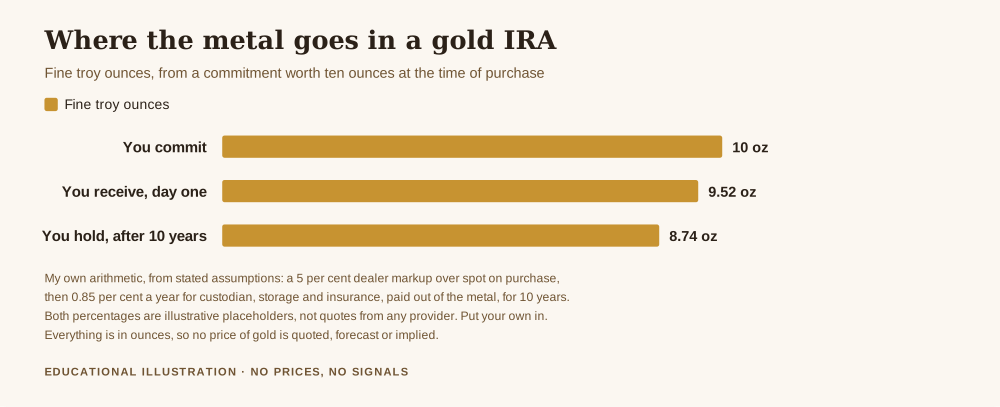
Here is the arithmetic, in ounces rather than currency, so that no price of gold is quoted or implied and the result does not depend on what the market does next. The percentages are illustrative placeholders. Substitute the real quotes you are given and the method is unchanged.
Assumptions. You commit an amount equal to the price of ten fine troy ounces. The dealer charges a 5 per cent markup over spot on the purchase. Annual custodian, storage and insurance fees come to 0.85 per cent of the metal's value each year, paid by selling metal. The horizon is ten years.
- On day one you do not receive ten ounces. You receive 9.5238 ounces, because the markup is paid out of the same commitment. The premium is 0.4762 of an ounce.
- After ten years of annual fees, 8.7446 ounces remain.
- Metal that was never yours or is no longer yours: 1.2554 ounces, which is 12.55 per cent of the original commitment. Of that, 0.4762 is the purchase premium and 0.7793 is the decade of fees.
- Expressed as a single flat rate, the whole structure drags 1.333 per cent a year over the decade.
Note what this calculation does and does not claim. It does not say a gold IRA is expensive or cheap, because that depends on what you are comparing it with and on quotes I do not have. It says that a 5 per cent markup and a 0.85 per cent annual fee compound into something larger than either number looks on its own, and that the honest unit for watching it is ounces, not percentages. The same logic applied to storage alone is in how much it costs to store gold.
The sensitivity is worth a sentence. The purchase premium is paid once and the fee is paid every year, so over a long horizon the annual line dominates. In the run above, the decade of fees costs more metal than the markup did, and it overtakes the markup in the sixth year.
What this article is not telling you
Three limits, stated plainly, because this is retirement money.
This is a description of a structure, not a recommendation. Nothing here says you should or should not hold metal in a retirement account. That depends on your tax position, your horizon and your other holdings, none of which I know.
It is United States specific. 26 U.S.C. 408 governs individual retirement accounts under US law. If you are elsewhere, the vehicle, the tax treatment and the custody rules are different, and the word "IRA" in an advertisement aimed at you may not mean this statute at all.
I am not able to give tax advice and would not try. The point of reading the statute here is to show you which questions to put to someone qualified, in their own words: does this metal fall inside 408(m)(3), who will have physical possession of it, and what is the total of the fee layers expressed in metal rather than in percentages.
Get the free Black Gold Market blueprint, the capital protection material in one place, for anyone who would rather check a number than take it on trust. One email, no spam, unsubscribe anytime.
Get the free blueprint →Frequently asked questions
What is a gold IRA, in plain terms?
A United States individual retirement account that holds physical precious metal. It is possible only because 26 U.S.C. 408(m)(3) carves specific coins and bullion out of the collectibles rule in 408(m)(1), which otherwise treats an IRA's purchase of metal as a distribution equal to its cost. The exception is narrow and conditional, which is why the detail matters more here than the headline.
Does the tax code really require 99.5 per cent purity?
Not in those words. The statute requires a fineness equal to or exceeding the minimum that a contract market requires for metal deliverable against a regulated futures contract, and it names no figure. The familiar 99.5 per cent matches the London wholesale floor, where the LBMA Good Delivery minimum is 995.0 parts per thousand, but the binding reference is the exchange delivery specification in force, which can change without the tax code changing.
Can I store the metal at home?
The bullion exception applies if the bullion is in the physical possession of a trustee described in 408(a). Possession by the account holder is not what that sentence describes. Structures marketed as home storage are working around that condition rather than meeting it, and the treatment of any specific arrangement is a question for a qualified tax professional rather than for a dealer or for me.
Which coins actually qualify?
The statute does not describe them, it cross-references them: gold coins under paragraphs (7) to (10) of 31 U.S.C. 5112(a), silver under 5112(e), platinum under 5112(k), and any coin issued under the laws of any State. A coin outside that list does not qualify under the coin limb regardless of its purity or its mint, though a bullion product might separately qualify under the fineness limb.
How should I compare the fees?
Convert them into metal. A markup is paid once and an annual fee is paid every year, so they are not comparable as percentages. On the illustrative figures used above, a 5 per cent markup plus 0.85 per cent a year removes 12.55 per cent of the original commitment over ten years, and the annual line overtakes the one off markup in the sixth year. Ask for both numbers in writing and run them in ounces.
Where this leaves you
Black Gold Market is free to follow and stays free. The daily work on Telegram writes out the level, the context and the risk, so you can judge the reasoning rather than copy a number, and there is a free blueprint for anyone who wants the capital protection material in one place. There is an optional kit for people who want the longer version. Nothing here promises a return, because a return is not something anybody can promise you, and nothing here is a recommendation to open any account or buy any product.
The foundation under this piece is how to protect your capital when gold gets volatile. Beside it, the title and possession distinction is in allocated vs unallocated gold, the coin specifications behind the qualifying list are in buying gold coins vs gold bars, the fineness standard is in what LBMA gold is, the storage question is in the best place to store gold, and the paper alternative is in whether there is an ETF that tracks gold. For a different corner of metal and tax, there is the tax basis for inherited gold coins.
Outside sources used here: the collectibles rule, the definition, the coin and bullion exceptions and the trustee possession condition are quoted from 26 U.S.C. 408(m), paragraphs (1) to (3), as published on govinfo.gov, and the minimum fineness of 995.0 parts per thousand and the 350 to 430 fine ounce bar range are from the LBMA Good Delivery specification. Every ounce figure is computed from the stated assumptions, so you can reproduce it.
About the author. Raphael writes Black Gold Market. He came to gold through the macro side rather than the chart side, and his standing complaint is that most commentary states a conclusion without ever showing where the number came from. He would rather hand you a smaller claim you can check yourself than a large one you have to trust. Figures here are quoted from the statutes and specifications linked above or computed from assumptions stated in the text, fee percentages are illustrative placeholders rather than quotes from any provider, nothing in this article forecasts the price of gold or recommends any account, product, dealer, custodian or mint, it is not investment, legal or tax advice, and no entry, stop or target discussed should be treated as a signal.