

The usual advice on buying gold coins vs gold bars is that bars are cheaper per ounce and coins are easier to sell, which is true and almost useless, because it does not tell you how much cheaper or how much easier. Both quantities can be worked out. One of them is written into law and the other you can compute in a minute. What follows is the arithmetic, and a result that surprised me: the bar's cost advantage can be wiped out entirely by a single forced sale.
Buying gold coins vs gold bars, starting with what a coin contains
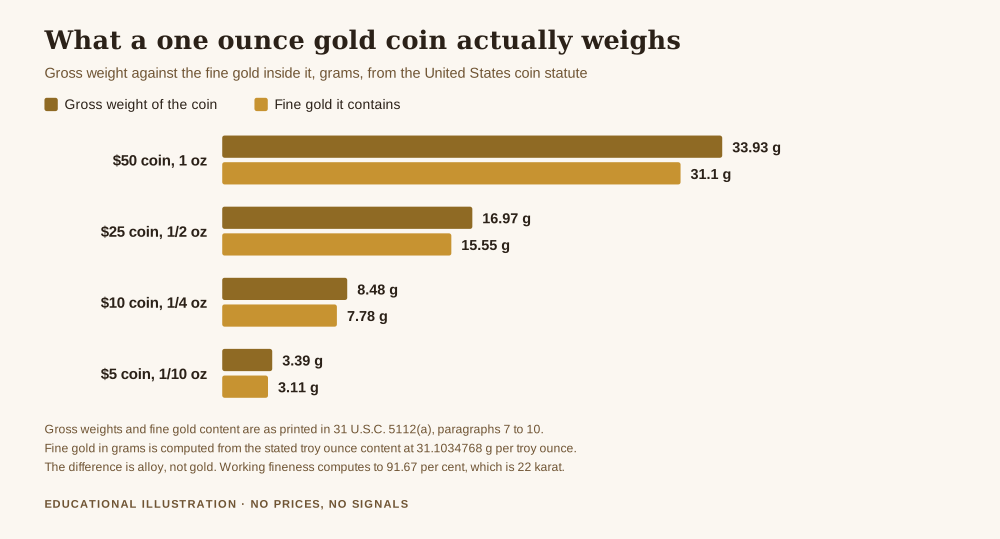
A bullion coin's specification is not a marketing claim. For the United States gold coins it is set in statute, at 31 U.S.C. 5112(a), and you can read the section on govinfo.gov. Four gold denominations are defined, and each entry gives a diameter, a weight, and a gold content as separate quantities:
- A fifty dollar coin, 32.7 millimetres, weighs 33.931 grams, and contains one troy ounce of fine gold
- A twenty-five dollar coin, 27.0 millimetres, weighs 16.966 grams, contains one-half troy ounce of fine gold
- A ten dollar coin, 22.0 millimetres, weighs 8.483 grams, contains one-fourth troy ounce of fine gold
- A five dollar coin, 16.5 millimetres, weighs 3.393 grams, contains one-tenth troy ounce of fine gold
Read the first line again. The coin everybody calls a one ounce gold coin weighs 33.931 grams, and a troy ounce is 31.1034768 grams. The coin is heavier than the gold in it by 2.8275 grams, which is 8.33 per cent of what you are holding. That extra mass is alloy, copper and silver, and it is not gold.
Divide the gold by the gross and you get the fineness the statute never states: 31.1034768 divided by 33.931 is 0.9167. That is 91.67 per cent, and 22 divided by 24 is 91.667 per cent, so the coin is 22 karat. The law specifies the outcome and leaves you to derive the purity, which is a good habit to have anyway.
The important part for a buyer is the direction of the guarantee. You are promised the fine content, one troy ounce, and the gross weight is whatever the alloy makes it. Nobody is short-changing you. But if you weigh the coin on a scale and see 33.9 grams, you have not found 33.9 grams of gold, and if you ever sell by weight to someone quoting a price per gram of pure metal, that distinction is the whole transaction.
Not every coin works this way. The same statute, at paragraph (11), defines a different fifty dollar coin that "weighs 1 ounce, and contains 99.99 percent pure gold". There the gross and the fine are effectively the same number. Two coins, same face value, same issuer, entirely different physical object. Check which one you are buying.
The bar at the other end of the market
Wholesale bars are specified differently, and the contrast explains why retail bars are sold the way they are. The London Bullion Market Association's Good Delivery specification sets a minimum of 350 fine troy ounces and a maximum of 430, which the guide glosses as approximately 10.9 to 13.4 kilograms, with a minimum fineness of 995.0 parts per thousand.
Check their approximation against the constant: 350 multiplied by 31.1034768 grams is 10.8862 kilograms, and 430 gives 13.3745. Their rounded figures land where the arithmetic says they should, which is the cheapest possible confirmation that you are reading the right table.
Notice what the range implies. A Good Delivery bar has no nominal weight at all. It is cast, then weighed, and its actual fine content is recorded against its serial number. The guide even specifies that gross weight is reported in increments of 0.025 troy ounces and rounded down, never to nearest, so a little real metal always sits below the reported figure and is simply not counted. At 0.7776 grams per increment that is small, and it is systematic, and it is written down rather than argued about case by case.
A retail bar borrows that logic at a size you can carry. It is sold as a stated weight of fine gold, usually at a high fineness, in tamper-evident packaging with an assay card. What you are buying is a larger, simpler unit with less fabrication per ounce. That is where the lower premium comes from, and it is a real advantage, not a trick.
What the premium actually buys, measured in gold
Premiums are normally quoted as a percentage over spot, which makes them feel like a rounding error. Converting them into metal makes the decision legible. Here I have deliberately expressed everything in ounces of gold rather than in currency, so no price of gold is quoted or implied, and the arithmetic stays true whatever the market is doing.
Assume you are buying ten troy ounces of fine gold, and call the price of one ounce P. The premium figures below are illustrative placeholders, because retail premiums move with product, dealer and demand. Put your own quotes in, the method does not change.
- Ten one ounce coins at a 5 per cent premium: you pay 10.50 P for ten ounces of gold. The premium is half an ounce of gold.
- One ten ounce bar at 2.5 per cent: you pay 10.25 P. The premium is a quarter of an ounce.
- A hundred tenth ounce coins at 9 per cent: you pay 10.90 P. The premium is nine tenths of an ounce.
So on a ten ounce purchase, the bar saves you 0.25 of an ounce of gold against one ounce coins, and 0.65 of an ounce against fractional coins. Stated as "two and a half per cent" that sounds like noise. Stated as a quarter of an ounce of metal you did not get, it sounds like what it is.
The fractional line deserves its own note. Small coins carry the highest premium per ounce because the fabrication cost is per coin, not per ounce, and a tenth ounce coin costs nearly as much to strike as a one ounce coin. You are paying for divisibility up front. Whether that is worth nine tenths of an ounce depends entirely on the next section.
Divisibility is the thing the premium is paying for
This is the part most comparisons skip, and it is the part that can reverse the answer.
Suppose you hold ten ounces and need to raise one ounce of value.
Holding ten one ounce coins, you sell one. You have liquidated 10 per cent of the position and the other nine ounces are undisturbed.
Holding one ten ounce bar, there is no way to sell a tenth of it. You sell the bar. You have liquidated 100 per cent of the position to raise 10 per cent of its value, and now you are holding nine ounces of cash that you presumably want back in metal. Buying those nine ounces again as coins at a 5 per cent premium costs 0.45 of an ounce of gold in fresh premium.
Set that against what the bar saved you. The bar's advantage on the original purchase was 0.25 of an ounce. One forced partial sale costs 0.45. The cheaper product has become the more expensive one, and nothing went wrong in the market to cause it.
That is the actual trade. The coin premium is an insurance payment against needing to sell part of a holding, and like any insurance it is wasted if the event never happens. If you are certain the metal will sit untouched for a decade, the bar is straightforwardly cheaper and you should buy the bar. If there is any realistic chance of a partial sale, the coin premium buys something real, and the break-even is nearer than the percentage figures suggest.
The things that are not arithmetic
Three considerations resist calculation and still matter.
Recognition. A widely minted sovereign coin is identified by its own design, weight and dimensions, all of which are published in law. A bar is identified by its refiner, serial number and assay card, which means the packaging is part of the product. Breaking a bar out of sealed packaging to inspect it can cost you money when you sell. Coins have no equivalent problem.
Durability. The 22 karat alloy in the coins above is harder than pure gold, which is soft enough to mark with a fingernail. A 999.9 fine bar wants to stay in its sleeve. If an object is going to be handled, alloy is a feature rather than a dilution.
Legal status and tax. A bullion coin carries a face value and is legal tender in its country of issue, which in some jurisdictions changes how it is treated for tax or for import. A bar does not. This varies enough by country that a general article cannot tell you the answer, and it is worth asking before you buy rather than after. I am not able to give you tax advice and would not try.
None of these decides the question on its own. Together with the premium arithmetic they usually do.
Get the free Black Gold Market blueprint, the capital protection material in one place, for anyone who would rather check a number than take it on trust. One email, no spam, unsubscribe anytime.
Get the free blueprint →Frequently asked questions
Buying gold coins vs gold bars, which is actually cheaper?
Bars, per ounce, on the purchase. On a ten ounce purchase at the illustrative premiums used above, the bar costs a quarter of an ounce of gold less than one ounce coins and sixty five hundredths of an ounce less than fractional coins. That advantage holds only if you never need to sell part of the holding, because one forced partial sale of a ten ounce bar costs about 0.45 of an ounce in fresh premium to re-establish the remainder.
Does a one ounce gold coin weigh one ounce?
Not necessarily, and the distinction matters. Under 31 U.S.C. 5112(a)(7) the fifty dollar coin weighs 33.931 grams and contains one troy ounce of fine gold, which is 31.1034768 grams. The other 2.8275 grams is alloy. A different coin defined at paragraph (11) weighs one ounce and is 99.99 per cent pure, so the answer depends on which coin you are holding.
Why are small coins so expensive per ounce?
Because fabrication cost attaches to the coin rather than to the metal. Striking a tenth ounce coin costs nearly what striking a one ounce coin costs, so the same minting expense is spread over a tenth of the gold. You are buying divisibility in advance, which is worth having if you expect to sell in pieces and is wasted if you do not.
Is a bigger bar always better value?
Per ounce on the purchase, generally yes, and the Good Delivery bar at 350 to 430 fine ounces is the extreme case. But a bar that size is a wholesale instrument with its own storage and verification requirements, and it cannot be divided at all. Value per ounce and usefulness move in opposite directions as size increases, which is the whole tension in this question.
What should I check before buying either one?
For a coin, the published specification: diameter, gross weight and stated fine content, all of which are a matter of public record for sovereign issues. For a bar, the refiner, the serial number, the stated fineness and intact packaging with the assay card. In both cases, confirm whether the quoted premium is over spot and what the dealer's buy-back spread is, because the cost of getting out is part of the cost of getting in.
Where this leaves you
Black Gold Market is free to follow and stays free. The daily work on Telegram writes out the level, the context and the risk, so you can judge the reasoning rather than copy a number, and there is a free blueprint for anyone who wants the capital protection material in one place. There is an optional kit for people who want the longer version. Nothing here promises a return, because a return is not something anybody can promise you, and nothing here is a recommendation to buy metal, a product or a dealer.
The foundation under this piece is how to protect your capital when gold gets volatile. The unit arithmetic used throughout is set out in how many grams equal a troy ounce of gold, the standard behind the wholesale bar is covered in what LBMA gold is, the question of where the metal then sits is handled in the best place to store gold, verification is covered in the difference between real and fake gold, and the exit side, which this article argues is part of the buying decision, is in how much it costs to sell gold.
Outside sources used here: the coin diameters, gross weights and fine gold contents are quoted from 31 U.S.C. 5112(a), paragraphs 7 to 11, as published on govinfo.gov, and the wholesale bar range, minimum fineness and weight reporting rule are from the LBMA guide, both the London Good Delivery section and the conversion table. Fineness, alloy mass and every premium figure are computed from those published values and the stated assumptions, so you can reproduce them.
About the author. Raphael writes Black Gold Market. He came to gold through the macro side rather than the chart side, and his standing complaint is that most commentary states a conclusion without ever showing where the number came from. He would rather hand you a smaller claim you can check yourself than a large one you have to trust. Figures here are from the published sources linked above, the calculations state their assumptions so you can repeat them, premium percentages are illustrative placeholders rather than quotes from any dealer, nothing in this article forecasts the price of gold or recommends any product, metal, dealer or mint, it is not investment or tax advice, and no entry, stop or target discussed should be treated as a signal.