

How much does it cost to store gold is one of those questions that sounds like it has a single number for an answer, and does not. The honest answer is that it depends entirely on which of three arrangements you are actually in, and that the published rates range from roughly a tenth of a per cent a year to something more than thirty times that. Worse, the headline rate is frequently not the rate you pay. This article works through the real figures, all of them taken from published tariffs and fund documents, and then does the arithmetic that the tariffs never show you.
No gold price appears anywhere below. You do not need one. Every charge discussed here is levied as a percentage of what you hold, which means the whole question can be answered in percentages and in the fraction of your metal that quietly disappears over time.
Three ways to hold gold, three completely different bills
The first arrangement is allocated custody, where specific metal is held in a vault in your name and you pay a custody charge for the privilege. As a concrete published example, BullionVault's tariff lists gold custody at 0.12 per cent a year with a minimum of 4 US dollars a month, and its heading for those charges states that insurance is included. Silver on the same tariff is 0.48 per cent with an 8 US dollar minimum, which is a useful reminder that storage cost scales with bulk rather than value.
The second is holding a fund that owns the metal for you. Here the charge is embedded rather than invoiced, and it goes by different names. The iShares Gold Trust publishes a sponsor fee of 0.25 per cent. SPDR Gold Shares publishes an expense ratio of 0.40 per cent. You never receive a bill for either. The fee is taken from the fund's metal, so the amount of gold behind each share declines slowly and permanently, which is also the mechanism behind tracking error.
The third is not storage at all, though people file it in the same mental drawer. A leveraged position in gold stores nothing, because no metal exists anywhere in the arrangement. What it costs you is financing, charged nightly, and that is an entirely different order of magnitude. Using the federal funds effective rate of 3.88 per cent from the Federal Reserve's H.15 release of 15 October 2026 as a reference point, the annual carry on a leveraged position is somewhere around ten to thirty times the custody rates above. If you have been treating a rolling long position as a way to hold gold cheaply, that comparison is the entire argument.
How much does it cost to store gold over a decade, not a year
A fee of 0.12 per cent a year sounds like nothing, and for one year it very nearly is. The reason to care is that storage charges are not paid once. They are levied every year against whatever is left, which makes them compound downward. The arithmetic is simply one minus the fee, raised to the number of years.
At 0.12 per cent, ten years costs you 1.19 per cent of the holding, twenty years costs 2.37 per cent, and thirty years costs 3.54 per cent. At 0.25 per cent those figures become 2.47, 4.88 and 7.23 per cent. At 0.40 per cent they become 3.93, 7.70 and 11.33 per cent. Sit with that last one for a moment. A third of a century in the most widely held gold fund in the world costs you better than a ninth of your metal, and at no point does anybody send you an invoice for it.
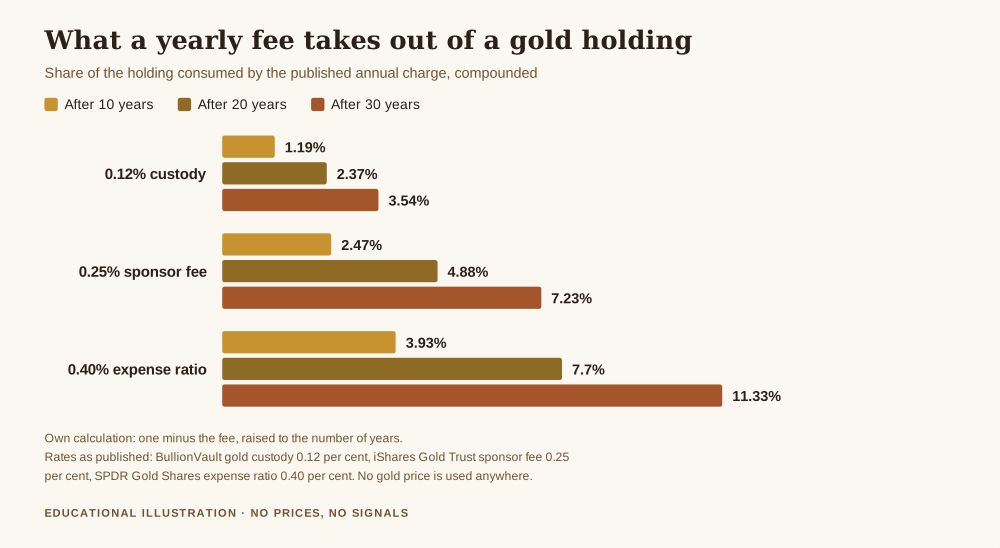
The gap between the cheapest and dearest of these is not dramatic in any single year. It is 0.28 percentage points. Over thirty years it is 7.79 per cent of everything you hold, which is the difference between the fee being a rounding error and the fee being a position of its own. The relevant question is therefore never what a custodian charges this year. It is what that charge removes across the period you actually intend to hold, which for most people buying gold is measured in decades rather than quarters.
The minimum charge is the part that catches small holdings
Here is the detail that the headline rate hides, and it is the single most useful thing in this article for anyone starting small. That 0.12 per cent custody rate carries a minimum of 4 US dollars a month, which is 48 US dollars a year. A minimum is a floor, and a floor only matters when you are below it.
Work out where it stops binding. Forty eight dollars divided by 0.0012 is 40,000 US dollars. Above that holding you pay the headline rate and the minimum is irrelevant. Below it you pay the minimum, and the rate you are genuinely being charged climbs sharply as your holding shrinks. On 20,000 US dollars of gold you pay 0.24 per cent. On 10,000 you pay 0.48 per cent. On 5,000 you pay 0.96 per cent, which is eight times the advertised figure and roughly two and a half times the most expensive fund mentioned above.
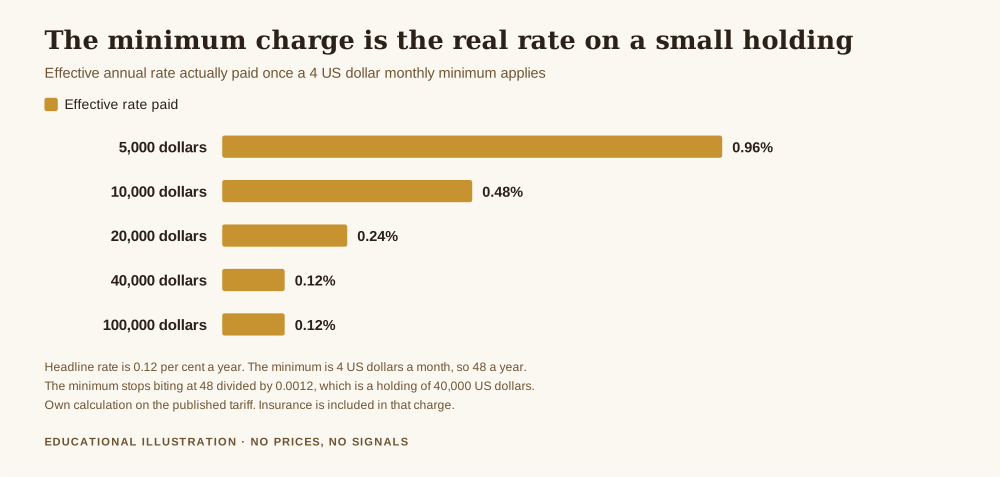
None of that makes the tariff unfair. Vaulting, insuring and auditing a holding has a fixed cost that does not fall to zero just because your holding is small, and a minimum is an honest way to charge it. It does mean that the standard advice to compare headline percentages is wrong for small holdings, and that the cheapest looking option on a comparison table can easily be the most expensive one for you. Work out the figure you will actually pay, in money, and divide it by what you hold. That number is the only one that matters.
What the London vault numbers say about scale
It is worth stepping back from your own holding to see the machinery you are buying into. The London Bullion Market Association publishes monthly vault holdings, and at the end of September 2026 the London vaults held 9,821 tonnes of gold, a 1.96 per cent increase on the previous month, across approximately 785,690 bars. Those two published numbers let you run a check that costs nothing and tells you something real.
Divide the tonnage by the bar count. The average bar works out at 12.50 kilograms, which is 401.9 troy ounces. A London Good Delivery bar is specified to contain between 350 and 430 troy ounces, so the figure lands almost exactly in the middle of the permitted range. Two independently reported statistics agreeing to that degree is a small piece of evidence that the reporting is sound, and running that sort of check is a habit worth keeping for every number you are handed.
The scale also explains the pricing. Storage at the wholesale end is a high volume, heavily standardised business, which is why institutional custody is quoted in basis points rather than percentages. Retail custody costs more per ounce because your holding is small, not because somebody is overcharging you. The same logic runs through the cost of selling gold and, at the other end of the chain, mining it in the first place.
What this actually changes
Three things follow from the numbers above, and none of them is a recommendation about whether to own gold.
The first is that the storage decision is really a holding period decision. Across one year the difference between the options is immaterial. Across thirty it is nearly eight per cent of your metal. Decide how long you intend to hold before you decide where, because the second question cannot be answered without the first.
The second is that below roughly 40,000 US dollars a minimum charge is likely to dominate your bill, and you should check whether a fund structure with no minimum is cheaper for you. That is an arithmetic question with a definite answer, and it takes about two minutes once you have both tariffs in front of you.
The third is that if you hold gold through a leveraged position, none of this applies to you, because you are paying financing rather than storage and the two are not comparable. Whether that is the right arrangement is a separate conversation, and the distinction between owning metal and owning exposure is covered in our piece on allocated and unallocated gold.
Get the free Black Gold Market blueprint, a short document on protecting capital and on checking a claim against the source before you trade on it. One email, no spam, unsubscribe anytime.
Get the free blueprint →Frequently asked questions
How much does it cost to store gold in a vault each year?
Published retail custody rates sit around 0.12 per cent a year for gold, with insurance included and a minimum charge of about 4 US dollars a month on the tariff cited here. The minimum means holdings under 40,000 US dollars pay an effective rate above the headline figure.
Is a gold fund cheaper than vault storage?
It depends on size rather than on principle. The funds cited here charge 0.25 and 0.40 per cent a year with no minimum, so on a small holding they can be cheaper than a 0.12 per cent tariff with a 48 dollar annual floor, and on a large holding they are clearly dearer. Work it out in money rather than in percentages.
Does the storage fee come out of my gold or my cash?
With a custodian you are normally billed and can pay in cash, so the metal stays intact. With a fund the fee is taken from the fund's metal, so the gold behind each share declines over time. The second arrangement is quieter, which is exactly why it is worth knowing about.
Is insurance included in storage costs?
On the tariff cited here it is, since the charge is headed as custody including insurance. Do not assume this is universal. It is a specific question to ask of any custodian, along with what the insurance actually covers.
Why is silver so much more expensive to store than gold?
Because storage is priced by bulk. The same tariff charges 0.48 per cent for silver against 0.12 for gold, which reflects the vastly greater volume needed to hold the same value in silver.
How much gold is held in London vaults?
9,821 tonnes at the end of September 2026, across roughly 785,690 bars, which works out at an average of 401.9 troy ounces per bar and sits neatly inside the 350 to 430 ounce Good Delivery specification.
Where Black Gold Market fits
Black Gold Market is a free journal about reading gold and protecting capital, written for people who would rather check a primary source than be told what to think. Nothing here is sold on a promise of returns, and there is no signal service. The free blueprint is a short document on protecting capital and on the unglamorous checks that decide whether a claim holds up. The piece underneath all of it is how to protect your capital when gold gets volatile.
About the author. Raphael writes Black Gold Market. He once compared two storage providers on their headline rates, picked the cheaper one, and only worked out a year later that the minimum charge had made it the more expensive of the two for a holding his size. What matters to him is the level, the context, and the risk, in that order.
Sources and method. Custody rates, the monthly minimum and the inclusion of insurance are from the BullionVault tariff page. The 0.25 per cent sponsor fee is published by the iShares Gold Trust and the 0.40 per cent expense ratio by SPDR Gold Shares, both on their own product pages. London vault tonnage, the monthly change and the bar count are from the LBMA London vault holdings data for end September 2026. The 3.88 per cent reference rate is the federal funds effective rate from Federal Reserve release H.15 dated 15 October 2026. All five sources are linked above. The compounding figures, the effective rates by holding size, the 40,000 US dollar break even and the average bar weight are my own arithmetic on those published figures, shown in the text so you can repeat it.
Disclaimer. This article is educational content about published storage charges and the arithmetic of fees. It is not investment advice, not a recommendation of any provider, product or fund, and not a forecast. The providers named are cited because they publish their charges openly, which makes the arithmetic checkable, and naming them is not an endorsement. Nothing here is personal advice, and no entry, stop or target discussed should be treated as a signal. No absolute gold price appears anywhere in this article. Rates and tariffs change, so verify them at the source before acting. Decide your own risk, and never trade money you cannot afford to lose.