

A box of coins arrives with an estate, and the question that follows is almost never the one people ask first. They ask what the coins are worth. The question that decides how much of that value they keep is what is the tax basis for inherited gold coins, because basis is the number subtracted from the sale price before any tax is calculated, and in the United States inherited property is handled very differently from property you bought yourself.
This belongs under Protect. Nothing below tells you whether to sell. It is the measurable part, with the rules named and the arithmetic done, because this is one of the few places in a gold holding where a single piece of paper obtained in the right month is worth more than any view on the market. I am not an accountant and this is not tax advice. Take it as a map of where the money moves, then take the map to a professional.
What is the tax basis for inherited gold coins, in one paragraph
Basis is your investment in a property for tax purposes. When you sell, the gain is the sale proceeds minus the adjusted basis, and the gain is what gets taxed. For property you buy, basis starts at cost. For property you inherit, it does not. The IRS sets this out in Publication 551, Basis of Assets, which states that generally the basis of property inherited from a decedent is the fair market value of the property at the date of the individual's death, or the fair market value on the alternate valuation date if the personal representative for the estate chooses to use alternate valuation.
That is the step-up. Whatever the person who died originally paid, and whenever they paid it, the clock is usually reset to the value on the day they died. For a holding of coins accumulated over decades, that single sentence is often worth more than every other tax consideration combined.
The rate is not the rate you think it is
Here is the part people get wrong in the other direction. Having reset the basis, they assume the gain above it is taxed like a share. It is not. The IRS Topic no. 409, Capital gains and losses lists the exceptions to the normal rates and says it directly: net capital gains from selling collectibles, such as coins or art, are taxed at a maximum 28 per cent rate.
Compare that with the ordinary long term rates in the same IRS topic, which for taxable years beginning in 2025 are 0 per cent, 15 per cent for most individuals, and 20 per cent above the stated thresholds. A gain that would face 15 per cent as a share can face 28 per cent as a coin. On a gain of 36,000, which is one of the worked cases below, that is 10,080 instead of 5,400, so 4,680 more, which is 86.7 per cent more tax on the same gain.
Two rules, then, pulling in opposite directions. The inheritance rule is generous. The collectibles rule is not. Which one dominates depends entirely on whether the basis is documented, and that is a question about paperwork rather than about gold.
Four ways the same sale can be taxed
Let me put numbers on it. These are worked assumptions, not quotations of any price: a coin holding with a documented purchase cost of 18,000 US dollars, a date of death appraisal of 54,000 US dollars, and a sale at that appraised value shortly afterwards. The rate used throughout is the 28 per cent maximum on collectibles from Topic no. 409. All four figures are my own arithmetic on those assumptions.
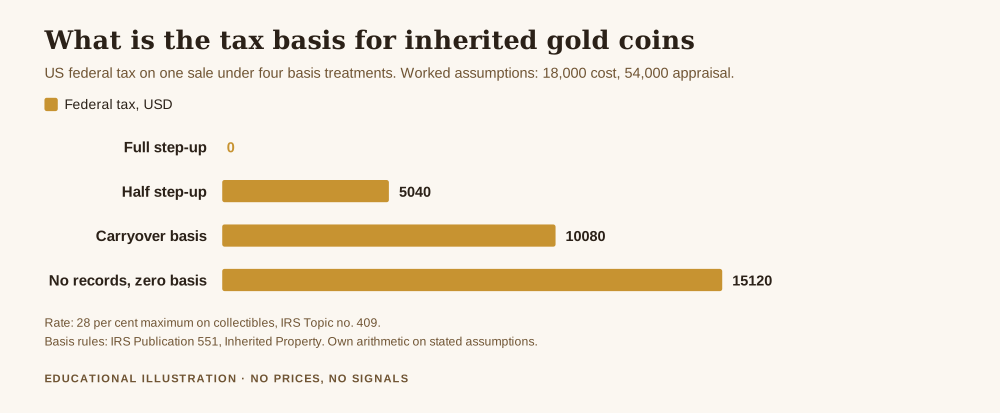
Full step-up to the date of death value. Basis 54,000, sale 54,000, gain zero, tax zero. This is the ordinary outcome when there is a proper valuation and the inheritance rule applies cleanly.
Half step-up. Property held jointly outside a community property state, where only the decedent's half is revalued. Basis becomes 9,000 plus 27,000, so 36,000. Gain 18,000, tax 5,040.
Carryover basis. The step-up does not apply and the decedent's own cost carries over. Basis 18,000, gain 36,000, tax 10,080. The most common route into this is described in the next section and it surprises people.
No records at all. Nobody obtained a date of death valuation and nobody can evidence what was paid. If basis cannot be substantiated, the exposure runs toward treating the whole proceeds as gain. Basis zero, gain 54,000, tax 15,120, which is 28 per cent of everything the coins sold for.
The spread between the best and worst outcome on an identical sale is 15,120. No market view produces that. One appraisal, obtained at the right time, does.
The one year rule that quietly removes the step-up
Publication 551 carries a trap that catches well meaning families. Under the heading of appreciated property it states that the step-up rule does not apply to appreciated property you receive from a decedent if you or your spouse originally gave the property to the decedent within one year before the decedent's death. In that case your basis is the same as the decedent's adjusted basis immediately before death, rather than fair market value. Appreciated property, in the IRS definition there, is any property whose fair market value on the day it was given to the decedent is more than its adjusted basis.
Read that against how families actually behave. A relative becomes unwell. Somebody moves the coins to them, for safekeeping, for simplicity, because it feels tidier to have everything in one estate. If that gift happens inside the final year and the coins have appreciated, the step-up is gone and the basis reverts. On the worked numbers above, that single act of tidying converts a zero tax outcome into 10,080.
I am not telling you what to do about that. I am telling you the date matters, and that nobody finds this out at the moment it would have been useful.
Community property changes the arithmetic, and it depends on the state
For married holders there is a second fork. Publication 551 explains that in community property states, specifically Arizona, California, Idaho, Louisiana, Nevada, New Mexico, Texas, Washington and Wisconsin, married individuals are each usually considered to own half the community property, and when either spouse dies the total value of the community property, even the part belonging to the surviving spouse, generally becomes the basis of the entire property, provided at least half the value of the community property interest is includible in the decedent's gross estate.
Outside those nine states, jointly held property typically gets the new basis only on the decedent's share. That is the half step-up case in the chart, and on the worked numbers it is the difference between 5,040 of tax and nothing. Same coins, same couple, same date, different state.
The paperwork that makes the number stick
A basis you believe in is not the same as a basis you can evidence, and the IRS has been tightening exactly this. Publication 551 notes that when an estate is required to file a federal estate tax return on Form 706, beneficiaries generally receive a Schedule A on Form 8971 from the executor reporting the estate tax value of the property distributed to them, and that certain beneficiaries are required to use that value as their initial basis. The publication points to section 1014(f), which requires the basis of certain inherited property to be consistent with the value as finally determined for estate tax purposes, and to the final regulations in T.D. 9991.
Where no Schedule A arrives, Publication 551 says basis can be determined using the appraised value at the date of death for state inheritance or transmission tax purposes. Which is the practical instruction hiding inside all of this: get a dated, independent valuation at the time, from somebody whose opinion an examiner would accept, and keep it where it will still be findable in ten years.
That is the same discipline this journal applies to everything else. The cost of a position is knowable in advance and is usually discovered afterwards. The same is true here, except the window for fixing it closes permanently a few months after the funeral.
What I would want written down before any sale
The date of death, and whether the estate elected alternate valuation, because that changes which day's value governs.
A dated appraisal of the coins themselves, itemised, from an independent appraiser, not a note of what somebody thought they were worth.
Whether a Schedule A on Form 8971 was issued, and if so, the value it reports, since that may be the figure you are required to use.
Whether anyone gifted these coins to the decedent in the final year, because that one fact can remove the step-up entirely.
Whether the holding was community property, and in which state, because that decides whether the step-up covers half or all of it.
Five lines on a single page. The chart above is what those five lines are worth.
What this article is not
It is not tax advice, and it is not a substitute for an accountant who can see your actual documents. The rules summarised here are the general ones in the publications linked above, they carry exceptions I have not covered, and they change.
It is not a view on whether to hold or sell inherited gold. The tax treatment of a sale is one input among several, and the worst reason to sell an asset is that you have just finished reading about how it is taxed.
It is United States federal tax only. State treatment differs, and if you are outside the United States none of this applies to you, though the underlying lesson, that the valuation date is the expensive part, usually travels.
Get the free Black Gold Market blueprint, a short document on protecting capital before you try to grow it, including the habit of pricing every cost attached to a holding before you commit rather than after. One email, no spam, unsubscribe anytime.
Get the free blueprint →Frequently asked questions
What is the tax basis for inherited gold coins, in one line?
Generally the fair market value of the coins at the date of the decedent's death, or the value on the alternate valuation date if the estate's personal representative elects it, as set out in IRS Publication 551.
Are inherited gold coins taxed at 28 per cent?
Gains on collectibles, which the IRS describes as including coins, face a maximum 28 per cent rate under Topic no. 409. That rate applies to the gain, not to the proceeds, so with a full step-up and a prompt sale the gain can be close to zero.
What happens if nobody had the coins valued?
You are left trying to evidence a basis after the fact. If it cannot be substantiated, the exposure runs toward treating the whole sale price as gain. On the worked example above that is 15,120 of tax instead of nothing, purely because of a missing document.
Does giving coins to an elderly relative help?
Publication 551 says the step-up does not apply to appreciated property you or your spouse gave the decedent within one year before death. The basis then carries over from the decedent instead of resetting. So the answer can be the opposite of what people expect.
Do I pay tax just for inheriting the coins?
This article is about basis and the capital gain on a later sale, which is a separate question from estate tax, which is assessed on the estate rather than on you. Those are different taxes with different rules, and an accountant should look at both.
Where did these numbers come from?
The step-up rule, the alternate valuation date, the one year rule on appreciated property, the nine community property states and the Form 8971 consistent basis requirement are from IRS Publication 551, revised December 2025. The 28 per cent maximum rate on collectibles and the 0, 15 and 20 per cent ordinary rates are from IRS Topic no. 409. Both links were read on 30 October 2026. The 18,000 cost and 54,000 appraisal are stated assumptions, not quotations of any price, and the resulting figures of zero, 5,040, 10,080, 15,120, 4,680 and 86.7 per cent are my own arithmetic on them.
Where Black Gold Market fits
Black Gold Market is free to follow. Daily XAU/USD analysis with the level, the context and the risk stated before the trade, losing days included, on Telegram. There is a free blueprint for anyone who wants the capital protection material in one place, and an optional Kit for people who want the full method. Nothing here promises a profit, and nothing here is a signal service. The groundwork this article rests on is in protecting your capital when gold gets volatile, the selling costs are in how much it costs to sell gold, and the coin specific fees are in what eBay charges to sell gold coins.
About the author. Raphael writes Black Gold Market. He works on the part of this business that happens before the entry, the level, the context, and the risk, and he has never once seen a market view worth as much as a dated appraisal obtained in the right month. Nothing in this article is a recommendation to trade or to buy any metal, it is not tax advice, and no entry, stop or target discussed should be treated as a signal.