

Allocated vs unallocated gold is the difference between owning a numbered bar and owning a promise, and almost everyone who trades gold holds the second one without having been told. It is not a scandal and it is not a trick. It is how the wholesale market was built, for reasons that make sense once you see the physical object at the centre of it. But it does change what you are exposed to, and that is worth understanding on a quiet afternoon rather than during a week when a counterparty is in the news.
I want to do this carefully, because the topic attracts a lot of noise. There are people who will tell you that unallocated gold is a fraud and that the vaults are empty. There are others who will tell you the distinction does not matter at all. Both are selling you something. The actual answer is duller and more useful: the two structures carry different risks, both are documented in public by the people who run the market, and you can read the rules yourself.
Every figure below is either quoted from a primary source or computed by me from assumptions I state as I go. Nothing here is a price and nothing here is a forecast.
What the London market is settling in the first place
Start with the thing being traded. The London Bullion Market Association, which sets the standards the wholesale market runs on, describes it plainly. In its own words, "the term Loco London simply refers to gold and silver bullion that is physically held in London vaults", and "counterparties and their clients from all over the world settle their transactions through the market, with the bullion settling physically across accounts held in London".
So there is real metal, in real vaults, in London. That part is not in dispute and the quantity is published. The LBMA states that "in excess of 8,000 tonnes of gold and 30,000 tonnes of silver are physically stored in the London vaults", held by six custodians, a list that includes three clearing banks, three security carriers, and the Bank of England, which offers a custodian service for gold only.
The question is not whether metal exists. The question is whose name is on which bar, and that is where the two account types diverge.
Allocated vs unallocated gold, the two account types side by side
The LBMA draws the line in two sentences. On unallocated accounts, it says that "most bullion trading and settlement in London uses unallocated accounts" and that with them, "customers do not own specific bars but have a general entitlement to an amount of metal". On the other side, "an allocated account is opened when the customer requires ownership of specific bars".
Read those again, because the whole article is in them. An allocated holding is a list of serial numbers. Particular bars, from particular refiners, with particular assays and weights, set aside in your name. An unallocated holding is a number on a statement, a general entitlement, backed by the balance sheet of whoever issued the statement.
That second structure means your position is a claim on a counterparty rather than a title to an object. The LBMA is explicit that in this market "all risks, including those of credit, exist only between the two counterparts". Credit risk is named, in the primary source, as one of the risks that sits between you and the other side. It is not hidden.
Allocated metal is not free of risk either, it is simply a different set. Specific bars still sit in someone's vault, so you carry storage, insurance and custody arrangements, and you usually pay for them. Unallocated metal typically carries no storage fee, which is one of the honest reasons it dominates. You are, in effect, being paid in convenience for accepting a credit exposure.
Why unallocated accounts exist at all
Here is the part that gets left out of the angry version of this story. The wholesale market could not function on allocated accounts alone, because of the physical specification of the bar itself.
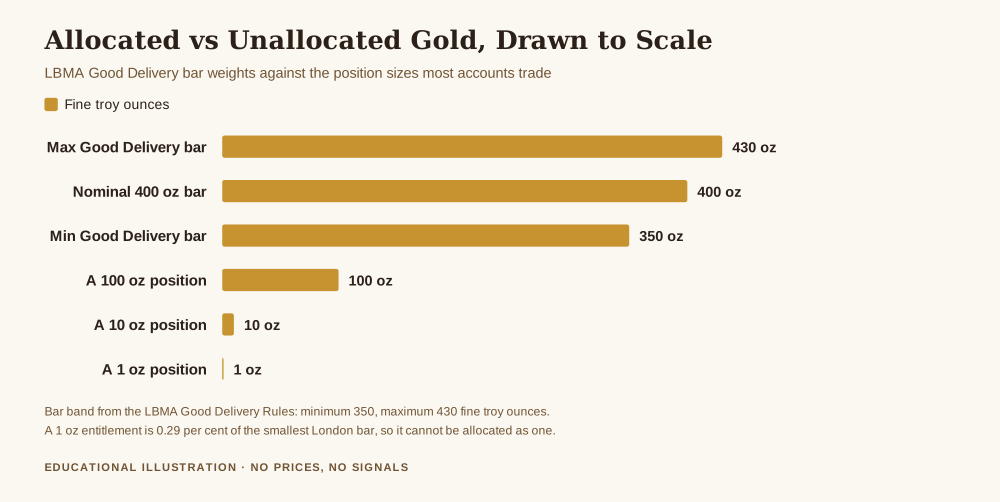
The LBMA Good Delivery Rules set out what qualifies for physical settlement of a loco London gold trade. On weight, the rules state a "minimum gold content: 350 fine troy ounces (approximately 10.9 kilograms)" and a "maximum gold content: 430 fine troy ounces (approximately 13.4 kilograms)". On purity, "the minimum acceptable fineness is 995.0 parts per thousand fine gold".
Two things follow immediately. First, a Good Delivery bar is large. Second, and this is the one people miss, there is no standard weight. The permitted band is 80 fine ounces wide. Taking the troy ounce as 31.1034768 grams, which is its international definition, I get 350 fine ounces at 10.886 kilograms and 430 fine ounces at 13.374 kilograms. Those reproduce the LBMA's own rounded figures of approximately 10.9 and approximately 13.4, which is a reassuring sign that we are reading the same specification. The heaviest permitted bar is 22.9 per cent heavier than the lightest.
So the "400 ounce bar" is a nickname, not a quantity. Every bar is its own number, and the rules reflect that: the gross weight "should be expressed in troy ounces, in multiples of 0.025, rounded down to the nearest 0.025 of a troy ounce". That step is 0.778 grams, and it always rounds down, never up.
Now put a normal trade next to that object. A one ounce entitlement is 0.29 per cent of the smallest Good Delivery bar. Ten ounces is 2.86 per cent. Even a hundred ounce position is 28.57 per cent of one bar, under a third of a single indivisible lump of metal. You cannot allocate a third of a bar to someone, so a market that settles in bars cannot also settle in the sizes most people trade. The pooled, unallocated account is the mechanism that bridges that gap, and the chart below is the whole argument in one picture.
Gross weight, fine weight, and the difference you pay for
There is a second distinction inside the bar, and it has a number attached that is easy to check. A bar has a gross weight, which is how much the lump weighs, and a fine weight, which is how much actual gold is in it. Minimum fineness is 995.0 parts per thousand, so up to five parts in a thousand can be something else.
The Good Delivery Rules include a worked example in a commercial weight list: a bar with a gross weight of 401.125 troy ounces and an assay of 995.8, giving a fine weight of 399.440 troy ounces. Multiplying 401.125 by 0.9958 gives 399.440, so the arithmetic is straightforward and it matches their printed figure exactly.
The gap is 1.685 troy ounces of non-gold in a bar that a careless description would call "a 400 ounce bar". Anyone paying for gross weight when they should be paying for fine weight would be paying 0.42 per cent too much. On one bar that is a rounding error to a bullion bank and a meaningful sum to a person. Fine weight is what is owned, and an allocated holding states it bar by bar.
This is also where the market's famously unglamorous rules start to look sensible. Bars must be stamped by pressure or dot matrix punching, and the rules say "laser engraving is not permitted under any circumstances". The fineness, date and serial number have to be at least 12 millimetres tall. These sound like bureaucracy until you remember that the entire allocated model depends on being able to identify one particular piece of metal, years later, in a vault, by eye.
What this means if you trade gold rather than store it
Most people reading this will never take delivery of anything. You trade XAU/USD, or a gold CFD, or a futures contract, and you close the position before it ever becomes a question about bars. So why does the distinction matter?
Because it tells you what kind of risk you are actually carrying, and it is not only price risk. When you hold a spot gold position with a broker, you do not own metal and you do not own an allocated claim on metal. You own a contract with that broker. Your exposure to the gold price is real, and so is your exposure to the institution on the other side of it. Those are two separate things that move for completely different reasons.
That is the practical reason the dull subjects matter more than the exciting ones. Whether your counterparty is regulated, what happens to client money if it fails, and whether you have protection against a negative balance are not administrative details. They are the terms of the claim that is your position. If you have never checked them, that is the gap worth closing this week, and what a regulated broker actually means is the place to start. The same instinct applies to the metal itself: the test for whether something is what it claims to be is documentary, which is the theme of the difference between real and fake gold.
The honest summary is that the unallocated structure is not a scam, it is a trade. You accept a credit exposure to a counterparty and you get liquidity, divisibility and no storage bill in return. For a market moving thousands of tonnes between institutions, that trade is obviously worth making. For an individual deciding how to hold long term savings, it may not be, and that is a decision about your own circumstances rather than something an article can settle for you.
The scale, so the numbers mean something
One last calculation, to put the vault figure in human terms. A tonne of gold is 32,150.7 troy ounces, taking the troy ounce at 31.1034768 grams. At a nominal 400 fine ounces per bar, that is 80.38 bars to the tonne. So the LBMA's "in excess of 8,000 tonnes" works out to roughly 643,000 individual bars sitting in London vaults.
Six hundred and forty three thousand distinct objects, each with its own serial number, its own refiner, its own assay and its own weight recorded down to a twenty five thousandth of an ounce. Allocation, at that scale, is a records problem as much as a metal problem. Which is a good note on which to remember that the market standard is an unallocated claim precisely because the alternative is this much paperwork, and that the paperwork is the only thing that makes "ownership of specific bars" mean anything at all.
None of this should change what you do tomorrow morning. It should change what you think you are holding, and that tends to change the questions you ask about who is holding it. Protecting capital starts earlier than most people assume, which is the argument running through how to protect your capital when gold gets volatile.
Get the free Black Gold Market blueprint, a short document on protecting capital and checking who is on the other side of your position. One email, no spam, unsubscribe anytime.
Get the free blueprint →Frequently asked questions
Is unallocated gold the same thing as paper gold?
Not quite, and the loose use of "paper gold" is what muddies this. An unallocated account is a general entitlement to metal held in the London system, which the LBMA describes as customers who "do not own specific bars but have a general entitlement to an amount of metal". There is metal behind the system, in excess of 8,000 tonnes of it by the LBMA's own figure. What you lack is title to particular bars, which means you hold a claim on a counterparty rather than an object. That is a credit exposure, not an absence of metal.
Can an unallocated holding be turned into allocated bars?
In the wholesale market, yes, that is a normal service, and the LBMA notes that an allocated account is opened "when the customer requires ownership of specific bars". The practical obstacle is size. The smallest Good Delivery bar is 350 fine ounces, so an entitlement smaller than that cannot be expressed as whole London bars, and allocation also brings storage and insurance arrangements you were not previously paying for.
Is a spot gold position allocated or unallocated gold?
Neither, strictly. A spot gold trading position with a broker is a contract with that broker. It is a step further removed than an unallocated bullion account, because your counterparty is the broker rather than a London clearing bank, and the bars are not part of the arrangement at all. This is why the regulatory status of your counterparty is a risk question and not a paperwork question.
Why does the market not simply standardise the bar weight?
Because refining to an exact weight is wasteful and unnecessary when the metal is priced by fine content. The rules accept any bar between 350 and 430 fine troy ounces, a band 80 ounces wide, and then require the weight to be recorded precisely, in multiples of 0.025 of a troy ounce, rounded down. Accuracy is placed in the record rather than in the casting, which is the cheaper way to get the same result.
Does the 995.0 minimum fineness mean I could be sold a bar that is 0.5 per cent base metal?
It means the bar can contain up to five parts per thousand of something other than gold, and that this is accounted for rather than ignored. The LBMA's own worked example lists a bar of 401.125 troy ounces gross at an assay of 995.8, giving 399.440 fine troy ounces. You would be buying 399.440 ounces of gold, not 401.125, and the 0.42 per cent difference is exactly why fine weight is the figure that appears on an allocated holding.
Where Black Gold Market fits
Black Gold Market is a free journal about reading gold and protecting capital, written for people who would rather check a primary source than be told what to think. Nothing here is sold on a promise of returns, and there is no signal service. The free blueprint is a short document on protecting capital and on the unglamorous checks that decide whether a position is as safe as it looks. The piece underneath all of it is how to protect your capital when gold gets volatile, and if you want the market plumbing next to this, read what the London gold fix is.
About the author. Raphael writes Black Gold Market. He spent an afternoon reading the Good Delivery Rules because he realised he had been saying "400 ounce bar" for years without knowing it was a nickname, and found the answer more interesting than the assumption. What matters to him is the level, the context, and the risk, in that order.
This article is educational and is not financial advice. Trading gold and other leveraged products carries a high risk of losing money rapidly, and no entry, stop or target discussed should be treated as a signal. The bar specifications, fineness, weight list example and vault figures above are quoted from the London Bullion Market Association's published Good Delivery Rules and market standards pages, as linked. The kilogram conversions, percentages and bar counts are my own arithmetic from the stated troy ounce definition, and are illustrations rather than valuations. Decide your own risk, and never trade money you cannot afford to lose.