

Ask is there an etf that tracks gold and the honest answer is yes, several, and they do not all track it the same way. Some hold metal in a vault. Some hold futures contracts and roll them. A few hold neither and promise you a multiple of the daily move. All four are sold in the same aisle, with similar names, and the difference between them decides what you actually own. This article sets out what each shape does, what the tracking is measured against, and the one cost that is certain no matter which you choose.
The short answer, and the three shapes they come in
Yes. The question worth asking is not whether such a fund exists but which mechanism it uses, because that is what determines how closely it follows the metal.
Physically backed funds. The fund holds gold bars in a vault with a custodian, and each share represents a fraction of that pile. Tracking is close by construction, because the thing the fund owns is the thing you are trying to track. The holdings are published daily, usually down to the bar list, which means the claim is checkable rather than something you have to take on faith.
Futures based funds. The fund holds exchange traded futures contracts and rolls them forward as they expire. It gives you gold exposure without a vault, but the roll has a cost, and over long horizons that cost separates the fund from the metal. This is the shape most likely to disappoint somebody who bought it expecting to own gold.
Leveraged and inverse funds. These aim at a multiple of the daily move, not the move over your holding period. Compounded across many days, the result can drift a long way from a simple multiple of where gold went. They are instruments for a defined short horizon, and they are the most common source of the complaint that a fund did not do what it said.
There is also a fourth thing often shelved beside these, the gold miner fund, which holds mining company shares. It is not a gold tracker at all. It tracks the equity of businesses whose fortunes are correlated with gold but also with energy costs, labour, debt and the decisions of their own management.
Is there an ETF that tracks gold closely, and what does "tracks" mean here?
Tracking is measured against a benchmark, so the sentence "it tracks gold" is incomplete until you know which gold number it is being measured against. For most physically backed funds, that reference is the LBMA Gold Price.
This matters more than it sounds. There is no single worldwide gold price ticking in one place. There is a benchmark, set through an auction, and the fund values its holdings against it. According to the LBMA, that price is administered independently by ICE Benchmark Administration, runs on an electronic and auditable platform aligned with the IOSCO principles for financial benchmarks, and has fifteen direct participants on-boarded to contribute to it. Those participants are named publicly.
So when a fund says it tracks gold, the fuller statement is that it values a vaulted holding against an audited auction benchmark with fifteen named contributors. That is a far more specific claim than "it follows the gold price," and it is one you can verify at the source rather than accept from a fund's marketing page.
How big this corner of the market actually is
It is not a niche. In the World Gold Council's Gold Demand Trends research, US-listed gold ETF holdings reached a record 2,019 tonnes with US$280 billion of assets under management in full year 2025, after net inflows of 437 tonnes across that year.
Those three numbers are worth holding together. The 437 tonnes of inflow is a flow, what arrived during the year. The 2,019 tonnes is a stock, what was sitting there at the end. A flow roughly a fifth the size of the stock tells you this is a market where positioning can change quickly, which is the part that matters if you hold gold for other reasons, because that flow has to be absorbed by the same market that prices your position.
For scale against the whole market, the same research puts total gold demand including over-the-counter at 2,522 tonnes in the first half of 2026, a record US$380 billion by value. Fund holdings are a serious share of the picture, not a rounding error, and that is precisely why fund flows get reported as market news.
The fee is the one cost that is certain
Everything else about a gold position is uncertain. The fee is not. It is charged whether the price rises, falls or does nothing, and it is charged out of the metal itself, which is the part people miss. A physically backed fund typically pays its expenses by selling a sliver of the gold, so the quantity of metal behind each share slowly declines. Your share count stays the same. What each share represents does not.
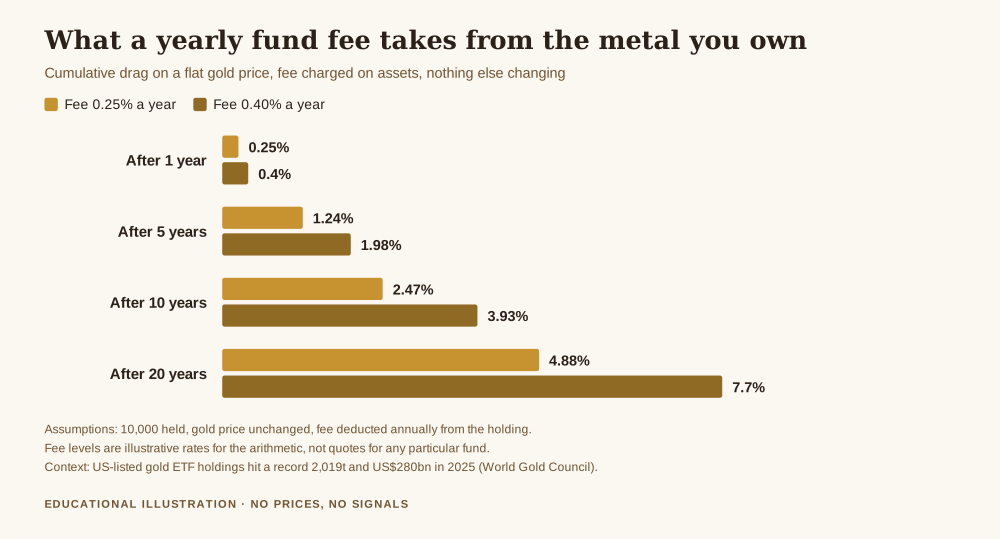
Here is the arithmetic, with the assumptions written out so you can redo it with your fund's actual number. Assume 10,000 held, the gold price completely flat, the fee charged annually on assets, and nothing else changing. At an annual fee of 0.25 per cent:
- After 1 year, 99.75 per cent of the metal is still yours, a drag of 25.
- After 5 years, 98.76 per cent, a drag of 124.
- After 10 years, 97.53 per cent, a drag of 247.
- After 20 years, 95.12 per cent, a drag of 488.
At 0.40 per cent a year, the same stake leaves you 92.30 per cent after twenty years, a drag of 770. The gap between those two fee levels is 15 basis points a year, which sounds like nothing and compounds to roughly 282 on this stake over two decades.
Two honest caveats. Fee levels differ between funds and change over time, so the 0.25 and 0.40 figures above are illustrative rates for the arithmetic and not quotes for any particular product. And a fee is not automatically bad: it buys vaulting, insurance, audit and the ability to sell your position in seconds, all of which cost real money to provide. The point is simply that it is certain, so it belongs in the decision before you buy rather than discovered later.
What a fund does not give you
A tracker is a claim on a pooled holding, not a bar with your name on it. For most people, most of the time, that distinction is academic. It stops being academic in exactly the circumstances people buy gold to protect against, which is why it is worth understanding before rather than during.
You are also holding a structure. There is a custodian, an administrator and a sponsor, each of which is an institution with its own obligations. The structures are long established and heavily audited, and the holdings are published. That is a reasonable basis for confidence. It is not the same thing as metal in your own possession, and anybody who tells you it is has skipped a step.
And a tracker does not solve timing. It makes gold exposure easy to buy, which is useful, and it makes gold exposure easy to buy at the wrong moment, which is the same feature pointed the other way. The flow numbers above are the aggregate record of people doing both.
Get the free Black Gold Market blueprint, the capital protection material in one place, for anyone who would rather understand the market they are trading than react to it. One email, no spam, unsubscribe anytime.
Get the free blueprint →Frequently asked questions
Is there an ETF that tracks gold one to one?
No fund matches the metal exactly, because the fee is deducted from the holding and there are small operational frictions. A physically backed fund valued against the LBMA benchmark gets closest, and the gap over a year is dominated by the fee. On the arithmetic above, 0.25 per cent a year compounds to a 4.88 per cent gap over twenty years on a flat price.
What is the difference between a physically backed and a futures based gold fund?
The physically backed fund owns bars in a vault and publishes the holdings. The futures based fund owns contracts and must roll them before expiry, which has a cost that recurs. Over weeks the two can look similar. Over years they can diverge noticeably, and the futures structure is the one that surprises people.
What price does a gold fund actually use?
Most physically backed funds value against the LBMA Gold Price, administered by ICE Benchmark Administration with fifteen direct participants contributing to the auction. That is the reference the tracking is measured against, and it is published rather than internal to the fund.
Does holding a gold fund mean I own gold?
You own a claim on a pooled holding of gold, which is not identical to owning an allocated bar. The holdings are audited and published daily, so the backing is verifiable. Whether the distinction matters to you depends entirely on why you hold gold in the first place.
Are leveraged gold funds a cheaper way to get exposure?
They are a different instrument, not a cheaper version of the same one. They target a multiple of the daily move, and compounding across many days can take the result away from a simple multiple of the period return. They are built for short, defined horizons, and holding one for months is the most common way people end up with a result they did not expect.
How to check any of this yourself in five minutes
This is the part I would rather you take away than any particular fund name, because fund names change and the method does not. Four checks, all of them free, all of them on documents the fund is obliged to publish.
Check the mechanism. Open the fund's own factsheet and find whether it holds metal, futures or shares in miners. If the document does not make that obvious in the first paragraph, that is itself a useful signal about how the product is being sold.
Check the benchmark. Find the sentence naming what the fund values against. For a physically backed gold fund you expect to see the LBMA Gold Price. Then go to the LBMA page linked above and confirm the administrator and the participant count for yourself rather than taking the factsheet's word for it.
Check the holdings. Physically backed funds publish holdings daily, often with a bar list. Look at it once. A claim you have verified once is held differently from a claim you have only ever read.
Check the fee, then compound it. Take the annual figure, put it through the arithmetic above for the number of years you actually intend to hold, and decide with that number in front of you. Most people compare fees as single year percentages, which makes a 15 basis point difference look trivial. Over twenty years on a flat price it is not trivial.
None of these four checks requires you to trust me, which is the point. The whole argument of this article is that gold funds are unusually checkable instruments, and that the people who end up unhappy with them are almost always the ones who never opened the document.
Where Black Gold Market fits
Black Gold Market is free to follow. Daily XAU/USD analysis with the level, the context and the risk stated before the trade, losing days included, on Telegram. There is a free blueprint for anyone who wants the capital protection material in one place, and an optional Kit for people who want the full method. Nothing here promises a profit, and nothing here is a signal service. The groundwork this article rests on is in protecting your capital when gold gets volatile, the ownership distinction is drawn properly in allocated versus unallocated gold, the measurement of how far a fund drifts is in what gold ETF tracking error is, the cost side is in what an expense ratio in ETFs means, and the benchmark itself is explained in what LBMA gold is.
About the author. Raphael writes Black Gold Market. He came to gold through the macro side rather than the chart side, and his standing complaint is that most commentary states a conclusion without ever showing where the number came from. He would rather hand you a smaller claim you can check yourself than a large one you have to trust. Figures here are from the published sources linked above, the calculations state their assumptions so you can repeat them, nothing in this article forecasts the price of gold or is a recommendation to trade or buy any metal or fund, it is not investment advice, and no entry, stop or target discussed should be treated as a signal.