

Search for the best place to store gold and you get a list of options ranked as though they were competing on the same axis. They are not. Home, a bank box and a professional vault each remove a different risk and each add a different one, and the only way to choose well is to know which risk you are actually trying to get rid of. This article sets out what each option does to three things: who physically holds the metal, who insures it, and how much it costs you per year to keep.
The question behind the question
Owning metal creates a problem that owning a fund does not. The metal is a physical object. It exists in one place at a time, somebody is standing closer to it than you are, and if it disappears, the loss is total and final rather than a line item you can dispute.
So the storage decision is really three decisions, and people usually make only the first one consciously.
Custody. Who physically has it. If it is not you, you hold a claim rather than a thing, and the quality of that claim depends entirely on the paperwork behind it.
Insurance. If it goes, who makes you whole. This is the one most people get badly wrong, and I will spend most of this article on it, because the common assumption is not merely slightly off, it is inverted.
Cost. What you pay every year to keep the arrangement. Unlike the price of gold, which nobody can forecast, this number is known in advance and compounds against you with complete reliability.
The best place to store gold depends on which risk you are removing
Take the three common options in turn, judged on those three axes rather than on how safe they feel.
At home. Custody is perfect. Nobody stands between you and the metal, there is no counterparty to fail, and no form to fill in to get it. Cost is close to zero, a safe being a one off purchase rather than an annual fee. The problem is insurance. Household policies generally cap the cover for valuables, often well below what a serious holding is worth, and the cap is usually specified per item as well as in total. A holding that exceeds the cap is uninsured above it, and the practical consequence is that the home option scales badly. It is strongest for small holdings and gets weaker with every bar you add.
A bank safe deposit box. This is the option that feels safest and is most widely misunderstood, so it gets its own section below.
A professional vault. Custody passes to somebody else, which is the cost, and in exchange you get purpose built security and, crucially, insurance written for the actual contents. The annual fee is real and compounds. The counterparty question becomes the live one, and the answer turns on a distinction this blog has covered before, namely allocated versus unallocated gold. Allocated means specific bars, identified by serial number, held as your property. Unallocated means you are a creditor of the institution. The second is cheaper and is not the same thing at all.
The bank box assumption that is simply false
Most people believe that metal in a bank safe deposit box is insured by the bank, or failing that, by whatever government scheme insures the bank. In the United States it is neither, and the regulator says so plainly.
The FDIC states that deposits are automatically insured to at least 250,000 dollars at each insured bank. It then lists what it does not insure, and that list contains mutual funds, annuities, life insurance policies, stocks and bonds, crypto assets, municipal securities, and safe deposit contents.
Run the arithmetic on that and it is stark. For metal in a box, the insured fraction is 0 per cent, and it stays 0 per cent whether the box holds one coin or five hundred. The 250,000 dollar figure is doing no work at all here, because it applies to deposits, and a box is not a deposit. The bank is renting you a lockable space inside a secure building. That is the whole product.
This does not make a bank box a bad choice. Its security is genuine and for many holdings it is entirely sensible. It makes it a choice you should pair with separate insurance arranged by you, and the number of people who have made that pairing is much smaller than the number who believe they are already covered.
What a professional vault market actually looks like
If you want a sense of the scale at which this is done properly, the LBMA publishes London vault holdings, and the figures are checkable rather than impressive sounding. As at end September 2026, London vaults held 9,821 tonnes of gold worth approximately 1.3 trillion dollars, equating to roughly 785,690 bars. Alongside it sat 28,985 tonnes of silver, about 966,175 bars.
Two things are worth pulling out of those numbers rather than just reading past them.
First, divide 9,821 tonnes by 785,690 bars and you get 12.500 kilograms per bar exactly, which is the standard bar weight the LBMA states it assumes for the calculation. The figure is internally consistent, and checking that took one division. I would rather you form the habit of that division than remember the tonnage.
Second, the bar in question is not a retail object. The LBMA Good Delivery standard covers bars of approximately 400 troy ounces for gold, with requirements for fine ounce weight, purity, and physical appearance including marking and surface quality. A 12.5 kilogram bar is 401.884 troy ounces, and 400 troy ounces is 12.441 kilograms. One such bar is the equivalent of 400 one ounce coins. The entire London holding comes to about 315.75 million troy ounces.
The practical takeaway is that the wholesale vault market is built around a unit most private holders will never own, which is part of why retail vault services exist as a separate layer with their own fee structures sitting on top.
The cost that is certain
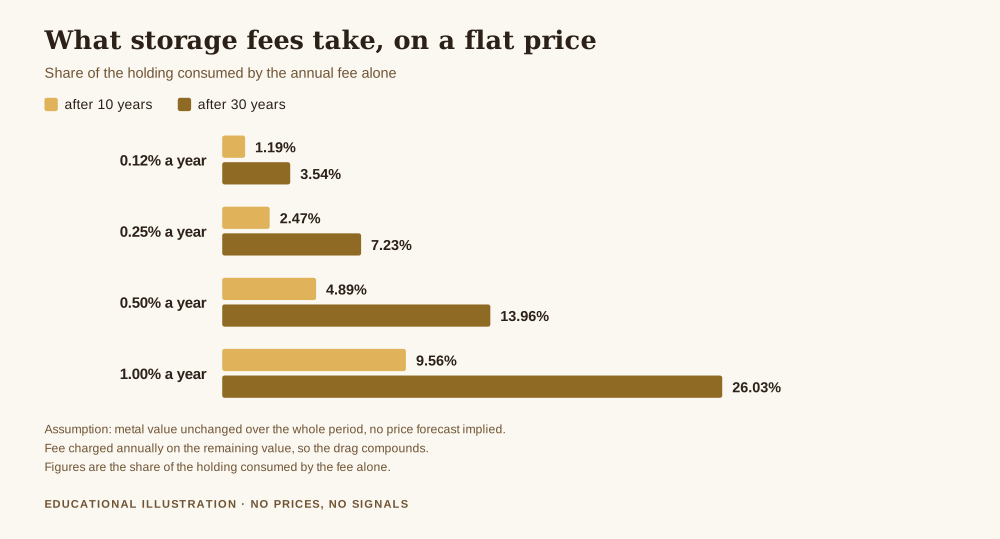
Here is where I would push back on the way storage is usually compared. People treat the annual fee as a small number and the gold price as the big one. The gold price is unknowable. The fee is not, and on a flat price it is the only thing happening to your holding.
Assume the metal value is unchanged over the whole period, which is not a forecast but a way of isolating the fee, and assume the fee is charged annually on the remaining value. The chart above shows what each fee level takes. At 0.12 per cent a year, 10 years costs 1.19 per cent of the holding and 30 years costs 3.54 per cent. At 0.25 per cent, those become 2.47 and 7.23 per cent. At 0.50 per cent, 4.89 and 13.96 per cent. At 1.00 per cent a year, 9.56 per cent over 10 years and 26.03 per cent over 30.
Another way to say the same thing: the number of years it takes for the fee alone to consume a tenth of the holding is 87.7 years at 0.12 per cent, 42.1 years at 0.25, 21.0 years at 0.50, and 10.5 years at 1.00 per cent. If you intend to hold metal across a generation, the difference between a 0.12 and a 1.00 per cent arrangement is not a rounding detail.
There is a second cost trap that catches small holders specifically, which is the flat minimum annual fee. Where a vault charges a minimum of 250 dollars a year, that minimum alone equals 0.5 per cent on a 50,000 dollar holding and 1.0 per cent on a 25,000 dollar one. At a 500 dollar minimum, the same thresholds move to 100,000 and 50,000 dollars. Below those sizes the headline percentage rate is irrelevant, because you are paying the minimum. This is the arithmetic that most often makes professional vaulting the wrong answer for a modest holding, and it has nothing to do with the vault being bad.
Get the free Black Gold Market blueprint, the capital protection material in one place, for anyone who would rather understand the market they are trading than react to it. One email, no spam, unsubscribe anytime.
Get the free blueprint →Frequently asked questions
What is the best place to store gold for a small holding?
For small holdings the arithmetic usually favours home storage with insurance checked, because a flat minimum vault fee of 250 dollars a year is already 1.0 per cent on a 25,000 dollar holding. The binding constraint is your household policy's cap on valuables, so read that cap before deciding, not after.
Is gold in a bank safe deposit box insured?
Not by the FDIC. It lists safe deposit contents among the things it does not insure, so the insured fraction of metal in a box is zero regardless of value. Some banks offer limited optional cover and some household policies extend to a box, but both are things you have to arrange and verify rather than assume.
Is allocated storage worth paying more for?
It depends on whether you are trying to remove counterparty risk or price exposure. Allocated storage means specific identified bars held as your property. Unallocated means you are an unsecured creditor. If the institution failing is a risk you are trying to remove, unallocated does not remove it at any price.
How much should storage cost?
Rather than quote a figure that will be out of date, do the comparison properly: take each quoted annual rate, check the flat minimum, work out which of the two you would actually pay at your holding size, then compound it over the years you intend to hold. The chart above does the compounding, and the minimum fee arithmetic above does the rest.
Does splitting storage across locations help?
It changes the shape of the risk rather than the amount. Splitting reduces the loss from any single failure and increases the number of arrangements you have to keep correct, including insurance on each. It is a reasonable answer for a holding large enough that a single total loss would be unrecoverable, and unnecessary complexity below that.
How to check any of this yourself in five minutes
Four checks, all free, all on documents somebody is obliged to publish or to give you.
Read your household policy's valuables cap. Find the total limit and the per item limit. Compare both against what you hold. This single step settles the home storage question for most people and it takes about two minutes.
Ask the bank, in writing, what the box is insured for. Expect the answer to be nothing, and treat the written confirmation as the thing that lets you arrange cover deliberately rather than discover the gap later.
Ask a vault whether the holding is allocated, and ask for the bar numbers. A provider who holds allocated metal can tell you which bars are yours. One who cannot is offering something different from what you thought you were buying, whatever the brochure says.
Compound the fee before you sign. Take the rate, check the minimum, pick the larger, and run it over your real holding period. Fees are compared as single year percentages almost universally, which is exactly why the 30 year column above surprises people.
None of these four requires you to trust me, which is the point. Storage is an unusually checkable decision, and the people who end up unhappy with it are nearly always the ones who assumed an answer instead of asking for one.
Where Black Gold Market fits
Black Gold Market is free to follow. Daily XAU/USD analysis with the level, the context and the risk stated before the trade, losing days included, on Telegram. There is a free blueprint for anyone who wants the capital protection material in one place, and an optional Kit for people who want the full method. Nothing here promises a profit, and nothing here is a signal service. The groundwork this article rests on is in protecting your capital when gold gets volatile, the ownership distinction that decides what a vault owes you is in allocated versus unallocated gold, the cost side in more detail is in how much it costs to store gold, and the benchmark behind the vault valuations is explained in what LBMA gold is.
About the author. Raphael writes Black Gold Market. He came to gold through the macro side rather than the chart side, and his standing complaint is that most commentary states a conclusion without ever showing where the number came from. He would rather hand you a smaller claim you can check yourself than a large one you have to trust. Figures here are from the published sources linked above, the calculations state their assumptions so you can repeat them, nothing in this article forecasts the price of gold or is a recommendation to trade or buy any metal, fund or storage provider, it is not investment advice, and no entry, stop or target discussed should be treated as a signal.