

Two metals, one question, and almost every answer you will read begins in the wrong place. People ask is it better to buy gold or silver expecting a verdict, and the honest reply is that the two are not competing versions of the same thing. They are bought by different people for different reasons, and once you can see who is bidding for each, most of the disagreement dissolves.
This belongs under Protect, because the part of this comparison that actually costs people money is not the choice of metal. It is the costs attached to the choice, which are knowable in advance and are usually discovered afterwards. Nothing below tells you which to own. It is the measurable differences, with the arithmetic done and the sources named.
Is it better to buy gold or silver, or is that the wrong question
A market price is just the place where buyers and sellers agree. So if you want to understand how two assets behave differently, start by asking who the buyers are. For these two metals the answer is not similar, and it is not close.
The Silver Institute reports that silver industrial demand reached 680.5 million ounces in 2024. Against total silver demand of 1.16 billion ounces for the same year, industry took 58.7 per cent of everything the silver market absorbed. More than half of all silver demand came from people who were not investing at all. They were building things.
Gold is the mirror image. The World Gold Council's full year 2025 demand figures put total gold demand at 5,002.3 tonnes, of which technology, the category covering electronics, other industrial uses and dentistry, accounted for 322.8 tonnes. That is 6.5 per cent. Jewellery took 1,638.0 tonnes, investment took 2,175.3 tonnes, and central banks and other institutions took 863.3 tonnes. Investment plus the official sector alone is 60.7 per cent of gold demand.
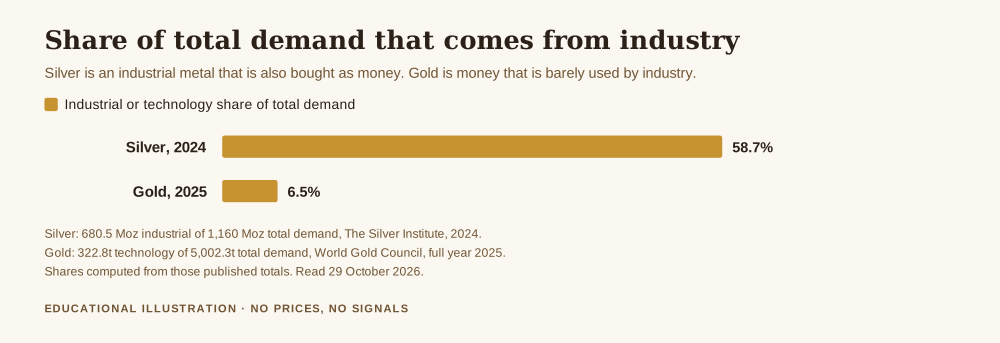
Put the two shares side by side and the industrial exposure differs by a factor of about nine. That single number explains more about how these two metals behave than any chart pattern I could show you.
What a factory bid does that an investor bid does not
When most of your demand comes from manufacturing, your price carries a piece of the industrial cycle inside it. Factories buy silver because they have orders to fill. When orders thin out, that part of the bid thins out with them, and it does so for reasons that have nothing to do with how worried anyone is about currencies or debt.
Gold does not have that passenger. With technology at 6.5 per cent of demand, almost nothing about gold's bid depends on industrial output. What it depends on instead is the investment and official sector demand that makes up 60.7 per cent of the total, which responds to a different set of worries entirely.
This is why the two metals can disagree with each other for long stretches, and why people find that disagreement so confusing. They are not failing to track each other. They were never answering the same question. We have written separately on how closely the two metals actually move together, and on the specific case of silver rising while gold falls.
There is a second consequence, and it matters more for capital protection than the first. A demand base that is half industrial is a demand base that can shrink for ordinary economic reasons. That tends to make the ride rougher. If you are the kind of person who sizes a position by what it would feel like at its worst rather than at its best, that roughness is not a footnote. It is the main event.
The cost nobody puts in the comparison
Here is where most gold against silver articles stop, and where the money actually is.
In the United Kingdom, HMRC's VAT Notice 701/21 states plainly that investment gold is exempt from VAT, subject to an option to tax. The notice defines investment gold as bars or wafers of a purity not less than 995 thousandths in a weight the bullion markets accept, or gold coins minted after 1800 of a purity not less than 900 thousandths that meet the pricing test, or coins on the specified list. Gold that falls outside that definition is, in the notice's own words, chargeable with VAT at the standard rate.
Read the notice carefully and you will see what it does not do: the relief is written for gold alone. There is no equivalent investment silver exemption inside it. So in that jurisdiction silver bullion is supplied at the standard rate, which gov.uk gives as 20 per cent.
Now do the arithmetic, because the size of this is not intuitive. Buy 100 units of metal at the standard rate and you hand over 120. The tax is 16.67 per cent of what left your account. When you sell as a private individual you receive roughly the metal's value, not the value plus the tax you paid. So the metal has to rise 20 per cent before you are back to level, and that is before a single penny of dealer spread.
Twenty per cent is not a fee. It is a head start you are giving away at the counter. And note what it is not: it is not a statement that silver is a worse asset. It is a statement that in one jurisdiction one metal is sold with a tax wrapper and the other is not. Tax treatment differs by country and changes over time, so check the rule where you actually live rather than the rule where the article was written. That sentence is the whole point of this section.
What the same money looks like when it arrives
There is one more difference that people discover only after the courier knocks, and it is pure physics.
The National Institute of Standards and Technology lists the density of gold as 19.32 grams per cubic centimetre and of silver as 10.50. Gold is roughly 1.84 times denser. But density is only half of it, because the other half is that an ounce of gold buys a great many ounces of silver.
Write the price ratio as R, meaning R ounces of silver per ounce of gold. For the same amount of money, the volume of silver you take delivery of is R multiplied by 1.84. I am going to use R equal to 80 purely as a worked assumption so you can see the shape of the answer, not as a quotation of any market: at that ratio, the same money in silver occupies about 147 times the volume it would in gold.
That is the difference between a drawer and a pallet. It changes what you can insure, what you can store at home, what a vault charges you, and what it costs to move. Our piece on what it costs to store gold covers the fee side of that; the volume multiple above is why the same fee schedule lands so differently on the two metals. Recalculate it at whatever ratio is actually in front of you, because the number moves when R moves.
What this comparison genuinely cannot tell you
Everything above is an observation about structure. None of it is a forecast, and I want to be exact about the boundary.
Demand composition tells you which pressures a metal is exposed to. It does not tell you which way the price goes next, and a metal with more industrial demand is not therefore cheaper or dearer than it should be. The tax wedge tells you what a purchase costs you at the counter in one jurisdiction. It does not tell you what the metal does afterwards. The volume multiple tells you what you will be storing. It says nothing about value.
So if you came here for a verdict, the structure of the question refuses to give one. What the figures do support is a narrower and more useful claim: the two metals have different buyers, different sensitivities, different tax treatment in at least one major jurisdiction, and dramatically different physical bulk per unit of value. Those are the things you can know before you commit. Which of them matters most depends on why you are buying, how long you intend to hold, and where you are standing when you do it.
The question worth asking instead
After enough years you notice that the people who do badly with either metal rarely did badly because they picked the wrong one. They did badly because they never priced the decision.
They did not know the exemption was written for one metal and not the other. They did not know that more than half of one metal's demand answers to factory orders. They did not multiply the price ratio by the density ratio before ordering something that turned out to need a shelf. Each of those is a five minute check, and each of them gets skipped because the exciting question, which metal wins, sits in front of the boring questions and hides them.
So replace the question. Instead of asking which is better, ask what each one costs you to own, what each one's price is actually responding to, and whether you can sit through the worse of the two rides without changing your mind at the worst possible moment. Those have answers. The original question does not.
Get the free Black Gold Market blueprint, a short document on protecting capital before you try to grow it, including the habit of pricing every cost of a position before you commit rather than after. One email, no spam, unsubscribe anytime.
Get the free blueprint →Frequently asked questions
Is it better to buy gold or silver, in one line?
There is no single answer, because the two metals have different buyers. Industry takes 58.7 per cent of silver demand and 6.5 per cent of gold demand, so silver carries industrial cycle exposure that gold largely does not, and the two also differ sharply in tax treatment and physical bulk per unit of value.
Why does silver move more roughly than gold?
A large share of silver's demand comes from manufacturers filling orders rather than investors holding a store of value. When industrial orders change, that part of the bid changes with them, for reasons unconnected to the monetary worries that move gold. More sources of demand pulling in different directions tends to mean a rougher ride.
Do I really pay VAT on silver and not on gold?
In the United Kingdom, HMRC VAT Notice 701/21 exempts investment gold meeting its purity and form tests, and that relief is written for gold alone. Silver bullion does not fall inside it, so it is supplied at the standard rate, currently 20 per cent. Rules differ by country and change, so check your own jurisdiction rather than assuming this applies to you.
How much more space does silver take up?
Gold is about 1.84 times denser than silver, by the NIST figures of 19.32 against 10.50 grams per cubic centimetre. Multiply that by the price ratio to get the volume multiple for the same money. At a ratio of 80, which I use only as a worked assumption, the same money in silver takes roughly 147 times the volume.
Does the higher industrial demand make silver a better buy?
No, and that inference is the trap. Demand composition describes what a price is exposed to, not whether it is too high or too low. Industrial demand can support a price and can also withdraw from it. It is a statement about sensitivity, not about direction.
Where did these numbers come from?
The 680.5 million ounces and 1.16 billion ounces are from The Silver Institute for 2024. The 5,002.3 tonnes, 322.8 tonnes, 1,638.0 tonnes, 2,175.3 tonnes and 863.3 tonnes are from the World Gold Council for full year 2025. The densities are from NIST and the VAT rate from gov.uk. All links were checked on 29 October 2026. The 58.7 per cent, 6.5 per cent, the factor of nine, the 20 per cent break even and the 147 times volume multiple are my own arithmetic on those published figures, with the price ratio of 80 stated as an assumption rather than a quotation.
Where Black Gold Market fits
Black Gold Market is free to follow. Daily XAU/USD analysis with the level, the context and the risk stated before the trade, losing days included, on Telegram. There is a free blueprint for anyone who wants the capital protection material in one place, and an optional Kit for people who want the full method. Nothing here promises a profit, and nothing here is a signal service. The groundwork this article rests on is in protecting your capital when gold gets volatile, and the official sector side of gold demand is in what gold reserves actually are.
About the author. Raphael writes Black Gold Market. He works on the part of this business that happens before the entry, the level, the context, and the risk, and he would rather spend an evening reading a tax notice than a decade paying for one he never opened. Nothing in this article is a recommendation to trade or to buy any metal, it is not tax advice, and no entry, stop or target discussed should be treated as a signal.