

A question came up in the group that sounded simple and turned out not to be. Someone had read a headline about central banks buying gold and wanted to know whether that meant the price had to go up. Before you can even attempt that question you have to answer a smaller one honestly, and most people skip it. So: what are gold reserves, who actually holds them, and how much of the world's gold are we talking about?
This is a Master article. It is about getting the units right and the quantities right, because a lot of confident commentary about gold falls apart the moment you check whether the speaker knows how much gold exists. I am going to use published figures and my own arithmetic, and I am going to name every source. No gold price appears anywhere in this piece. Reserves are measured in tonnes of metal, and the moment you switch to dollars you have stopped talking about reserves and started talking about valuation, which is a different subject with different rules.
What Are Gold Reserves in the Strict Sense
In the strict sense, gold reserves are the monetary gold held by a country's central bank or treasury as part of its official international reserves. That is a narrow definition and it excludes a great deal of gold that people casually call reserves.
It excludes the gold in your neighbour's wedding ring. It excludes the bars in a private vault in Singapore. It excludes the metal backing an exchange traded fund, even though that is real allocated gold sitting in a real vault, because an ETF's gold belongs to its shareholders and not to a state. It also excludes gold still in the ground, which is a resource, not a reserve, in the sense we are using here.
What it includes is metal held by an official institution, reported as part of that institution's reserve assets, and available to be used as a reserve asset. That last part is why the definition matters. A reserve is something a state can deploy in a crisis. That is the entire point of holding it.
How Much Gold There Is, and Where It Sits
Start with the total, because every share is meaningless without it.
According to the World Gold Council's above-ground stocks estimates, around 220,700 tonnes of gold has been mined throughout all of history, on end-2025 figures. Their split of where that metal now sits is as follows: jewellery accounts for 45 percent, about 99,700 tonnes; bars, coins and ETFs for 23 percent, about 51,000 tonnes; central banks for 17 percent, about 38,600 tonnes; and other uses plus over the counter holdings for 14 percent, about 31,400 tonnes. Those four figures add to exactly 220,700 tonnes, which is a small sign that the numbers are internally consistent rather than assembled from different vintages.
So the answer to the scale question is that official gold reserves worldwide are roughly 38,600 tonnes. My own arithmetic on their figures puts that at 17.49 percent of all the gold ever mined. The Council's own summary of the same point is that central banks hold "around a fifth" of it, which is the same statement rounded generously.
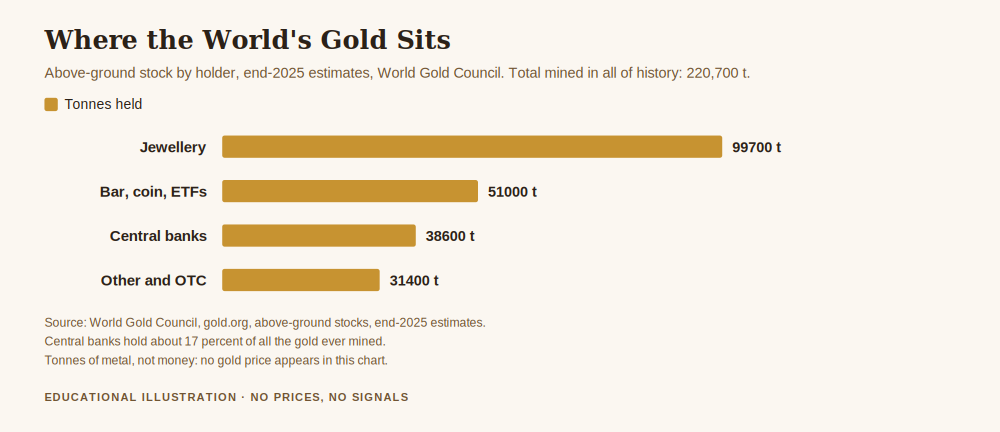
Notice what the chart says about the balance of power. Jewellery plus bars, coins and ETFs comes to 68.28 percent of the above-ground stock by my arithmetic. Private hands hold more than two thirds of the world's gold. Central banks are the single largest coordinated holder, and they are still a minority owner. That is worth remembering the next time someone tells you central banks control the gold market. They are the biggest single voice in the room. They are not the room.
How the Numbers Reach You, and Why They Are Always Late
Here is a detail that separates people who read the data from people who read headlines about the data.
The World Gold Council's gold reserves by country dashboard carries a note that most commentary ignores. At the time of writing it presents data as of 31 March 2026, and it states plainly that "IFS data are two months in arrears, so holdings are as of December 2025 for most countries."
Read that carefully. The dashboard is dated March. The underlying holdings are from December. The lag is structural, because the figures come through the IMF's International Financial Statistics, and countries report on their own schedule.
This matters for a practical reason. When a story tells you a central bank "just bought" a quantity of gold, the purchase it is describing may be several months old, and the market has had all that time to absorb it. Anyone trading a fresh reserves headline as new information is usually trading something the market read a quarter ago. Being early is a fantasy here. The data does not permit it.
One Country's Reserves, Counted Properly
Abstractions are easy to nod along to, so let me do one country in full, using the primary source rather than a secondary summary.
The United States Treasury publishes a Status Report of U.S. Government Gold Reserve every month, and it is machine readable. I pulled the statement dated 31 July 2026 and added up its eight component lines myself. The total is 261,498,926.241 fine troy ounces.
That is an unhelpful unit for comparison, so I converted it. At 31.1034768 grams to the troy ounce, which is the standard definition, 261,498,926.241 ounces is 8,133.53 tonnes. That conversion is my own, and the assumption is stated so you can redo it.
Now the comparisons become possible. On my arithmetic, the United States alone holds 21.07 percent of the world's 38,600 tonnes of official gold. It holds 3.69 percent of all the gold ever mined on this planet. One country, one twenty-seventh of the entire historical output of the species.
The statement also breaks holdings down by vault, and the concentration surprised me the first time I added it up. Fort Knox holds 147,341,858.382 ounces, which my arithmetic makes 56.35 percent of the entire national holding. Adding the other two deep storage sites, Denver and West Point, accounts for 93.79 percent. The rest sits with the Federal Reserve Banks, including a small display quantity.
The Number on the Books Is Not a Market Number
Now the part I find genuinely instructive, and the reason I wanted a primary source rather than a summary.
The same Treasury statement carries a book value for that gold: 11,041,059,957.90 dollars. Divide the book value by the ounces, as I did, and you get 42.2222 dollars per fine troy ounce.
That is not a market price and has not been one for a very long time. It is a statutory value fixed in law, and it has sat there while the actual metal went its own way for over half a century. The United States carries the largest official gold holding on earth on its books at a number that has no relationship to what the metal would fetch.
I am deliberately not telling you what gold trades at, and not computing the difference, because that is not the lesson. The lesson is about reading balance sheets. A reserve can be enormous in metal and trivial in stated value, at the same time, in the same document, and both figures are correct within their own accounting convention. If you cannot hold those two ideas at once, you will misread every official reserve figure you ever see.
This generalises well beyond gold, and it is the habit I most want to pass on. When a number surprises you, find out what convention produced it before you decide what it means. Most of the confident nonsense written about gold reserves comes from people who found a number, felt something about it, and never checked which question it was answering.
Get the free Black Gold Market blueprint, a short document on protecting capital before the trade rather than after it, including how to check a number's source before you let it change your mind. One email, no spam, unsubscribe anytime.
Get the free blueprint →Frequently Asked Questions
What are gold reserves, in one sentence?
The monetary gold held by a country's central bank or treasury as part of its official international reserves, measured in tonnes of metal, and reported through the IMF's statistics with a lag of roughly two months.
How much of the world's gold do central banks hold?
About 38,600 tonnes on end-2025 World Gold Council estimates, which my arithmetic makes 17.49 percent of the roughly 220,700 tonnes ever mined. Private hands hold more than two thirds.
Does an ETF's gold count as reserves?
No. The metal is real and allocated, but it belongs to the fund's shareholders rather than to a state, so it sits in the bar, coin and ETF category instead of the official sector.
Do central bank purchases automatically push the price up?
I am not going to hand you a causal rule, because the honest position is that reserves data reaches the public months late and the market has already traded on whatever it knew. Reserve flows are one input among many, and the timing of the reporting alone should make you cautious about treating a reserves headline as fresh information.
Why is US gold valued at 42.2222 dollars an ounce?
Because that is a statutory book value set in law, not a market quotation. It is the figure the Treasury is required to carry the metal at. It tells you nothing about what the gold is worth and it is not a signal about anything.
Where did every figure in this article come from?
The above-ground stock split and the 220,700 tonne total are the World Gold Council's end-2025 estimates. The reporting lag note is from their reserves by country dashboard. The ounces, the book value and the vault breakdown are from the Treasury statement dated 31 July 2026. The tonnage conversion, every percentage and the 42.2222 figure are my own arithmetic on those inputs, with the 31.1034768 grams per troy ounce assumption stated in the text.
Where Black Gold Market Fits
Black Gold Market is free to follow. Daily XAU/USD analysis with the level, the context and the risk stated before the trade, losing days included, plus an optional Kit for people who want the method written down in one place. There is no promise of profit here, because nobody can honestly make one.
Protect comes first. How to protect your capital when gold gets volatile is the pillar this article sits under, how central banks affect the price of gold takes the same institutions and asks what their buying actually does, and how the US dollar affects the price of gold covers the other half of any official reserves conversation. If you want the macro set in order, gold versus real yields is the one that ties them together.
About the author. Raphael writes Black Gold Market. He works on the part of this business that happens before the trade, the level, the context, and the risk, and on the conviction that a method you can follow through a quiet quarter is worth more than a better one you cannot.
Disclaimer: This article is general educational content about how official gold reserves are defined, measured and reported. It is not financial advice, not a recommendation to buy or sell gold or any other asset, and not a solicitation to trade. The above-ground stock figures and the reporting lag note are from the World Gold Council, and the United States holdings, book value and vault breakdown are from the US Treasury's monthly gold reserve statement dated 31 July 2026. Every tonnage conversion and every percentage is my own arithmetic on those published inputs, with assumptions stated in the text, and is not a measurement of any market or a description of anyone's results. No gold price level is quoted anywhere in this article, and the 42.2222 dollar figure is a statutory book value rather than a market price. Trading gold, CFDs and leveraged products carries a high risk of losing money rapidly, and no entry, stop or target discussed should be treated as a signal. Readers should consider their own circumstances and speak to a licensed professional in their jurisdiction.