
Macro fundamentals

You are looking at a clean setup. Price has pulled back to a level you like, your stop is a sensible distance away, and the chart says the trade is worth taking. Then you notice the clock icon on your calendar app has gone from twenty minutes to four. A high impact number is due, and you had not planned for it.
Or maybe you already have a trade open from an hour ago, sitting in a small profit. The countdown hits zero, a headline flashes past, and in the next ten seconds price moves further than it moved in the two hours before. Your stop was resting right there the whole time, and you do not yet know what it filled at.
The idea in plain words
An economic calendar is a public schedule of data releases and central bank decisions due at a known time, the same releases covered in Interest rates and expectations and Inflation, jobs and growth.
Read the time carefully. It is usually set in a fixed zone such as GMT, not automatically yours, so convert it before you plan anything. Next to the time sits an impact rating, low, medium or high, a measure of how many traders watch that release, not a guess about direction. A high rating means many people watch the same number at the same second, which is what makes a market move fast.
The last three figures matter as much as the time. Previous is the number from the last report, forecast is the median guess from economists ahead of the release, and actual is the number once it prints. Markets react to the gap between forecast and actual, because the forecast is already priced in. Watch for a fourth detail, a revision. Providers often quietly restate the previous figure at the same moment they publish the new one, so a headline beat can turn out ordinary once that previous number was revised up to meet it.
Now picture the market in the seconds around a high impact release. Quotes get pulled back just before the number prints, so the spread, the gap between the buy and sell price, can widen sharply. Depth, the stack of resting orders just above and below price, thins out at the same time, so a burst of orders can make price gap, jumping from one level to the next without trading in between. A stop order caught in that gap fills at the next price the broker can deal at, not at its trigger. Let the first sharp move settle, usually a few minutes, before trusting it, since the first tick is often the thinnest, most exaggerated print of the event and part of it tends to unwind once trading resumes.
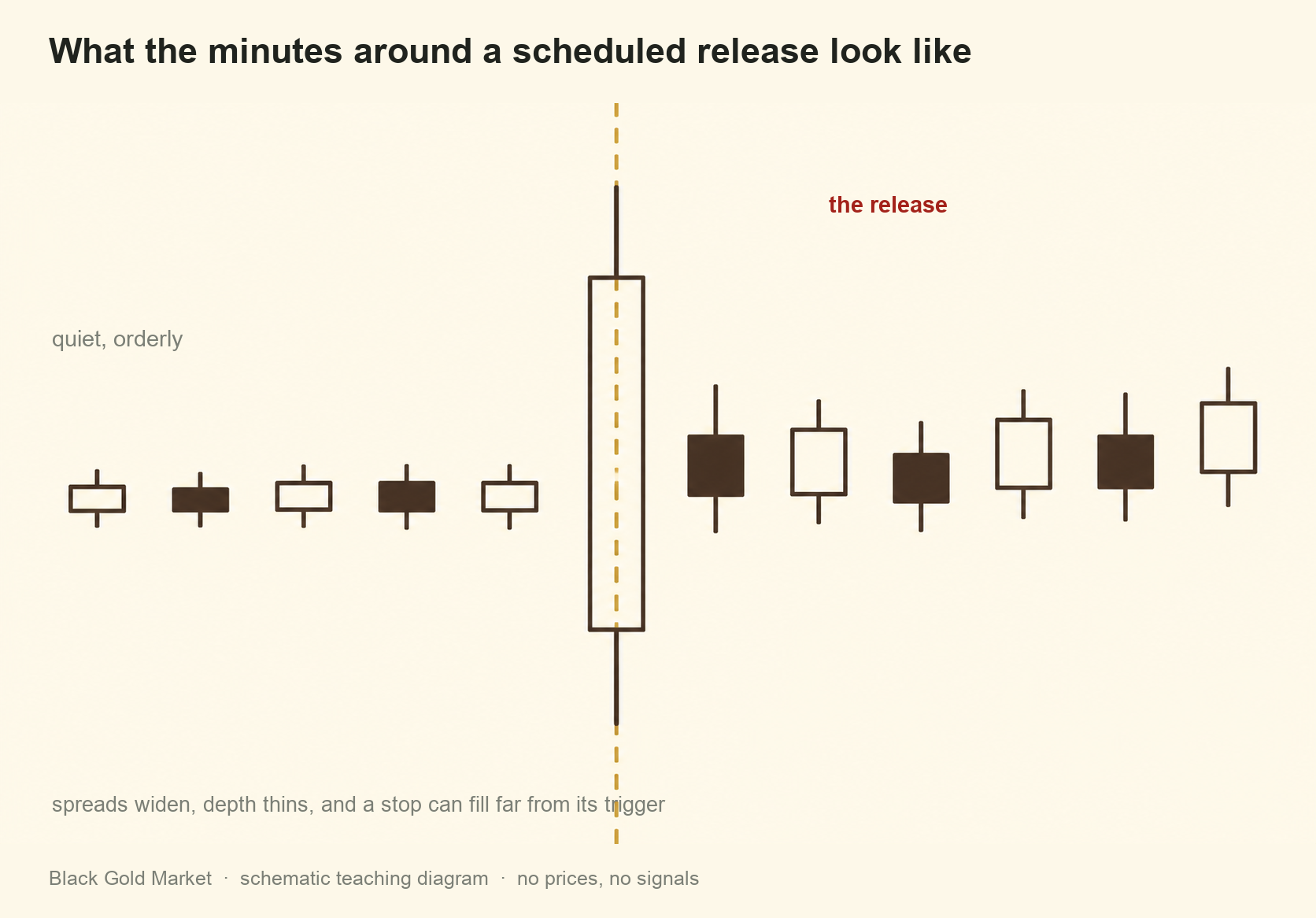
A worked example
Hypothetical numbers, no real price level, so you can redo the math with your own broker's figures.
One standard lot of gold equals 100 ounces, so a one dollar move changes its value by 100 dollars. This example uses 0.10 lot, one tenth of that, so a one dollar move is worth 10 dollars.
The plan is a stop 3.00 dollars away, for a planned risk of 3.00 times 10, or 30 dollars. The normal spread on gold might run 0.20 dollars, adding 0.20 times 10, or 2 dollars. Total planned cost, spread included, commission not, is 32 dollars.
Now say the spread widens to 3.00 dollars around the release, not unusual. A new entry then costs 3.00 times 10 in spread alone, 30 dollars, fifteen times the normal 2.
Worse, a stop order was already resting at the planned exit. Depth thins at the same moment, so the broker fills it at the next price available once trading resumes, not the level you set. If that gap costs 2.50 dollars worse than requested, the extra loss is 2.50 times 10, or 25 dollars.
Total loss, the planned 30 plus 25 of slippage, is 55 dollars, 23 more than planned, an increase of about 72 percent, from one event lasting under a minute.
The three honest choices
None of these predicts what the number will be. Each one only changes how much of your account is exposed to the seconds after it prints.
| Choice | What it protects | What it costs |
|---|---|---|
| Flatten before it | No exposure to the spike, no slippage on a closed position | May lock in a loss or give up a profit, plus a fresh spread to re-enter |
| Stand aside | Capital stays free for a calmer entry once the spread narrows | May miss the first leg if the release goes the way your idea expected |
| Size much smaller, stop much wider | Keeps you in the trade, stop unlikely to be caught by ordinary noise | Same dollar risk but a smaller position, so any gain is smaller too |
Where people go wrong
- Leaving a pending order sitting right at a level in front of a known release. It feels efficient, an automatic entry with no need to watch the screen. In practice the order sits where liquidity is about to vanish and often fills well past the price that made the trade look good.
- Treating the first minute after the print as the final answer. That spike is usually the thinnest, most exaggerated part of the move. Traders who jump in during that window often find the market partly reverses, leaving them against the calmer trend that follows.
- Reading a beat or a miss without checking the revision. A number can look like a clear beat while the previous figure was quietly revised up, erasing most of the surprise.
Your turn
- Find the next high impact release for a market you already watch. Write down its date and time, then convert that time to your own time zone.
- Thirty minutes before, write down the previous and forecast figures without looking ahead to the actual.
- Without opening a position, watch the spread through the release and note roughly how many times wider it got compared with a quiet moment.
- Fifteen minutes after the print, write down the actual figure, any revision, and one sentence on whether the first minute's reaction still held.
Check yourself
What is the difference between the forecast and the actual figure, and why does the previous figure sometimes change?
Forecast is the economists' median guess before the release, actual is the real figure once reported. The previous figure changes because providers often revise it at the same time, which can make a headline beat or miss look different.
Why can a stop loss fill at a worse price than the level it was set at during a high impact release?
Spreads widen and depth thins out, so price can gap between levels without trading in between. A stop does not fill at its trigger inside that gap, only at the next price the broker can deal at.
What are the three honest choices for handling a scheduled release, and what do they have in common?
Flatten before it, stand aside from new trades, or size much smaller with a wider stop. None predicts the number, each one only sets how much of the account is exposed to the print.
Reading a calendar and managing your exposure around it is only half of the macro picture. The next lesson looks at a slower, steadier force behind the price of gold, in Gold, the dollar and real yields.