
Intermarket context

You open the news and see the dollar just had its worst day in a month. Ten minutes later gold is green on every timeframe, and it feels like a cheat code. Sell the dollar, buy gold, done.
Then a week later the dollar drops again and gold barely moves, or it drops too. Nothing about your logic was wrong on Monday. What was missing is the rest of the story, because gold sits inside three separate relationships, and on any given day only one or two are doing the driving.
The idea in plain words
Start with the plumbing. Gold is quoted in US dollars almost everywhere you will trade it. Every gold price you see is really a ratio, ounces of gold against dollars, not a pure reading of what gold is worth. When the dollar weakens against other currencies, a dollar buys less of almost everything, gold included, so the dollar price of gold can rise even though nothing about gold changed. Part of every move on your screen is the dollar moving, not gold being revalued.
The second relationship is what gold competes against for your money. Gold pays no interest, no dividend, no coupon, so holding it costs you the return you gave up by not holding a government bond instead. Strip expected inflation out of a bond's yield and you get the real yield, roughly what an investor keeps after inflation. When real yields rise, gold gets relatively more expensive in forgone interest and demand tends to soften. When real yields fall, gold tends to look better by comparison. Nobody rings a bell when this shifts, it just leans the odds one way or the other.
The third relationship is sentiment, often called safe haven demand. When investors are frightened, by a banking scare, a war, or a currency losing credibility, some buy gold simply because it cannot default and does not depend on any government's promise. This runs on fear, not on the dollar or on yields.
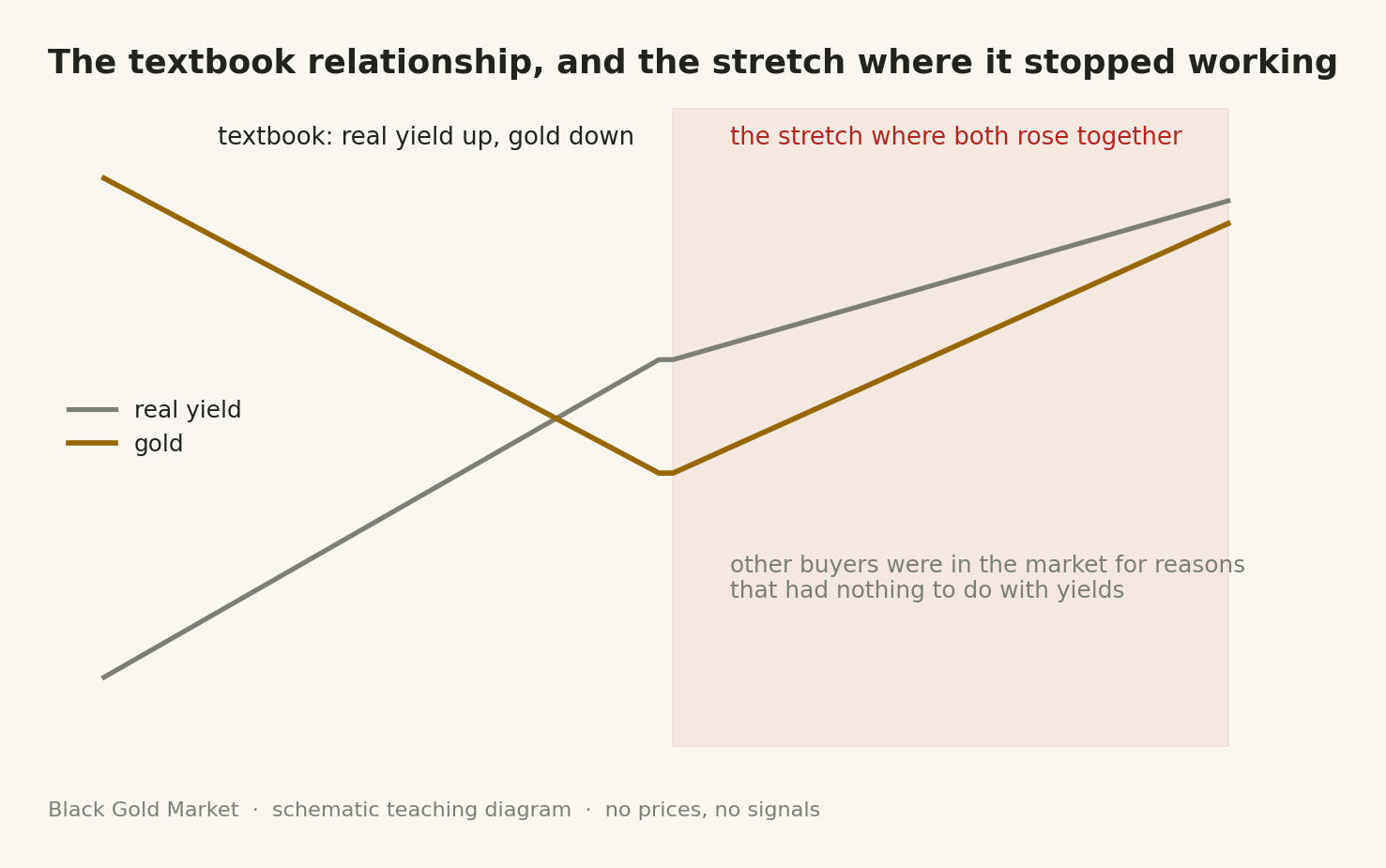
Central banks add a fourth wrinkle, buying steadily for years as reserve diversification, a decision made on a horizon of years, not this week's data. When that buying is heavy, gold can hold firm or climb even while the dollar strengthens and real yields rise, the opposite of the textbook relationship, for months at a time. That gap is exactly why a rule based trader treats this subject as context, something that tells you which side of the chart you would rather lean toward, never as a signal on its own.
A worked example
Step one, the dollar effect. Suppose gold is quoted in Europe at a hypothetical 1,850 euros an ounce, unmoved all session. The dollar then weakens, EURUSD moves from 1.0800 to 1.0908, about one percent. Multiply the unchanged euro price by the new rate, 1,850 times 1.0908 is about 2,018. If the dollar price of gold had opened at a hypothetical 2,000, it can drift up to roughly 2,018 from the conversion alone, with the euro price not moving a cent. That eighteen dollar move is the dollar showing up inside a number you were reading as a gold move.
Step two, the real yield effect. Take a hypothetical 10 year Treasury yield of 4.2 percent and inflation expectation of 2.4 percent. Subtract one from the other for a rough real yield of 1.8 percent. On a hypothetical 10,000 dollar gold position, that is close to what an investor gives up each year by holding gold instead of an inflation protected bond, about 180 dollars. Now suppose inflation expectations climb to 2.9 percent while the nominal yield stays put. Real yield falls to about 1.3 percent, so the forgone interest drops to roughly 130 dollars a year. Gold got no cheaper in absolute terms, but the bond alternative got less rewarding, and that 50 dollar swing is the real yield story in miniature. Both figures are illustrations, not a forecast or advice.
Three drivers, one price
| Driver | Textbook effect on gold | When it does not hold |
|---|---|---|
| The dollar | Dollar weakens, gold's dollar price tends to rise, and vice versa | A currency crisis can send the dollar and gold up together as investors flee everything except safe assets |
| Real yields | Real yields rise, forgone interest on gold rises, gold tends to soften, and vice versa | Heavy, sustained central bank buying can keep gold firm for months even as real yields climb |
| Risk sentiment | Fear rises, safe haven demand lifts gold regardless of the dollar or yields | A calm market with a soft dollar and low yields can still leave gold flat with no reason to seek a haven |
Where people go wrong
Trading the headline alone. A trader buys gold purely because the dollar index dropped, without checking whether real yields moved the other way for an unrelated reason. Result, entering on half of a three part relationship and getting surprised when the other two parts do the deciding.
Treating the relationship as fixed. A trader assumes gold must fall whenever real yields rise, gets stopped out repeatedly during a stretch of heavy central bank buying, and decides the framework is broken. Result, abandoning sound context instead of noticing which force was actually in charge that month.
Turning context into a signal on its own. A trader sizes a full position because "the dollar is weak, so gold has to go up," with no chart level, no invalidation point, and no plan for being wrong. Result, a guess dressed up as analysis, carrying real risk with none of the structure a rule based trader normally requires.
Your turn
- For ten trading days, note a dollar index level, a published 10 year real yield if you can find one, and gold's own percent change.
- Tag each day dollar led, yield led, or sentiment led, based on which of the three best explains that day's gold move.
- Count how many days all three matched the textbook direction. For each disagreement, write one sentence naming the force that overrode the other two.
Check yourself
If the dollar weakens one percent overnight and nothing else changes, what happens to gold's dollar price, and why
It tends to rise by roughly that amount, because gold's dollar price is partly a currency conversion, so a weaker dollar buys less of almost everything, gold included, even if gold's value in other currencies has not moved.
What does a rising real yield do to the appeal of holding gold, in plain terms
It raises the interest an investor gives up by holding gold instead of a safe bond, since that bond now pays more after inflation, so gold looks relatively less attractive by comparison.
Why can gold and the dollar sometimes rise together, breaking the textbook relationship
Strong, sustained demand from central bank buying or a flight to safety can push gold up regardless of the dollar or real yields, sometimes for months at a stretch.
One relationship rarely tells the whole story, which is why the next lesson lines several markets up side by side, so a single macro theme does not quietly double your risk. Continue to Correlation and combined exposure.