
Macro fundamentals

A trader circles a date on the calendar three weeks out, "rate decision" written next to it, and pictures gold tearing in one direction the second the number crosses the wire. The day arrives, the decision matches what everyone already guessed, and the five minute candle barely moves. They stare at the flat chart feeling cheated out of the fireworks they had braced for.
Months later the same trader watches a "boring" meeting, no change to the headline rate at all, spark the sharpest gold move of the month. Nothing changed on paper. One sentence in the press conference changed everything that mattered.
The idea in plain words
A policy rate is the short term interest rate a central bank sets for lending in its own currency. In the United States that is the Federal Reserve, through its rate setting group, the FOMC, meeting roughly eight times a year. Other currencies have their own central bank running the same kind of meeting on their own calendar. Banks price savings accounts, bonds and loans off that one rate, so a change at the top works through the whole system of what money earns for sitting still.
Here is the part that trips up almost every new trader. Markets do not wait for the announcement to react. Traders and analysts spend the weeks before a meeting building a consensus for where the rate is heading over the next several meetings, not just this one. By the time the decision is read out, most of that expected path already sits inside the price of gold, bonds and the dollar. What actually moves the market is the gap between what was expected and what is delivered, in the number or in the wording. A cut everyone saw coming can land as a non event. A hold, paired with a sentence that sounds more worried about inflation than expected, can move price further than the cut did.
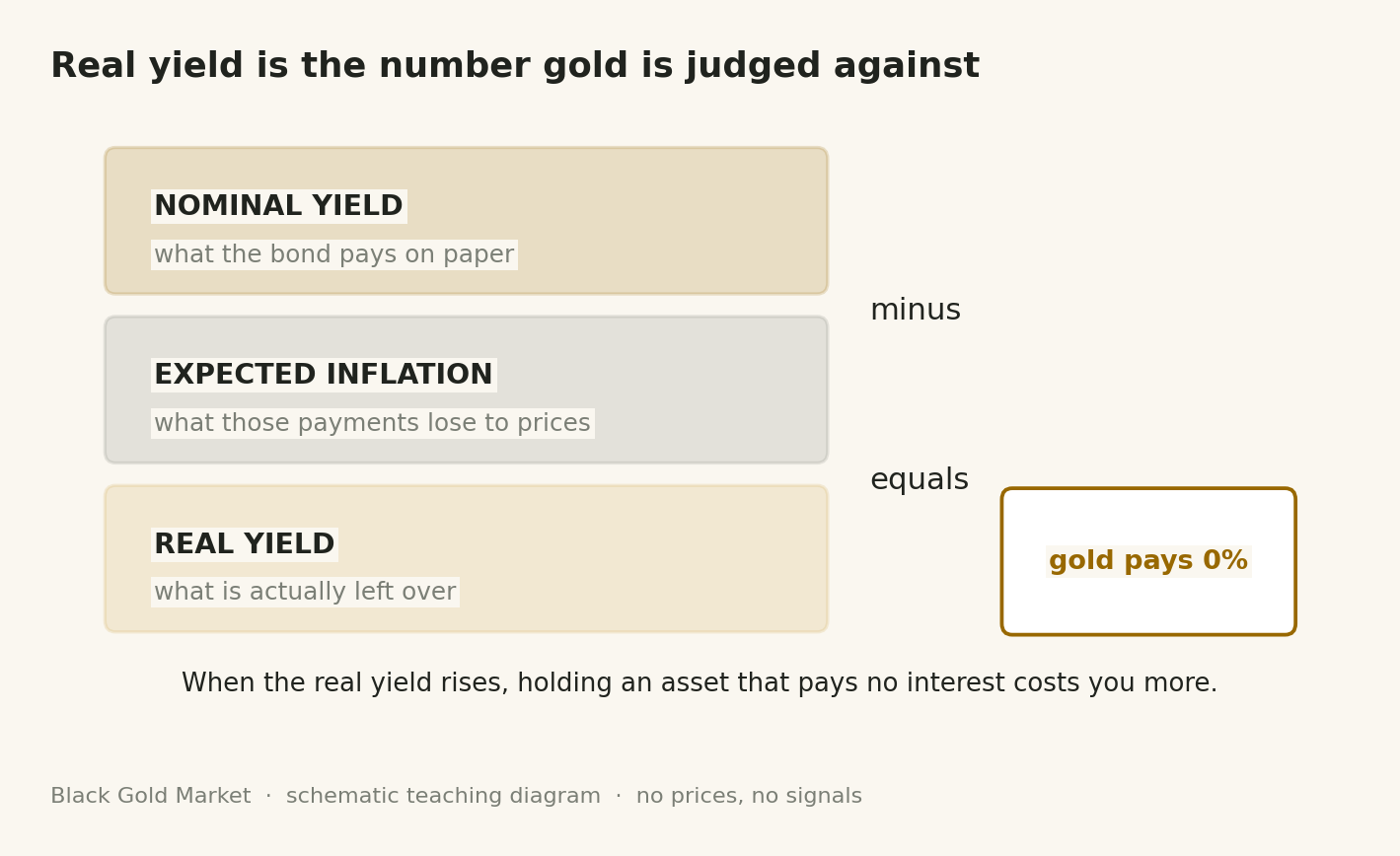
The number that connects all this to gold is the real yield. Take the nominal yield on a government bond, the number printed everywhere, and subtract the inflation investors expect over that bond's life. What is left is the real yield, the purchasing power a saver actually earns once rising prices are accounted for. Gold pays no interest at all, so it is judged against that real number, not the headline rate. When the real yield rises, holding zero yield gold instead of a bond costs more in forgone return, and gold tends to be pressured. When it falls, that gap narrows and gold's lack of yield stops feeling like much of a sacrifice.
A worked example
Every figure below is a hypothetical example built to show the arithmetic. It ignores spread, commission and financing entirely, since it is comparing yields, not a trading outcome.
Quarter one. A hypothetical government bond yields 4.6% and investors expect inflation of 2.9% over that period. Real yield is 4.6 minus 2.9, which equals 1.7%.
Quarter two. New data arrives suggesting inflation is cooling. The bond's nominal yield has not moved, it is still 4.6%, but expected inflation has dropped to 2.1%. Real yield is now 4.6 minus 2.1, which equals 2.5%.
The headline rate did not change at all between the two quarters. The real yield still rose by 0.8 percentage points, from 1.7% to 2.5%, purely because expected inflation fell. That is the move that matters to gold, and it is invisible if you only watch the printed rate.
Picture a hypothetical $10,000 parked in that bond for one year, ignoring taxes and trading costs. At 1.7% real yield it gains about $170 in real purchasing power. At 2.5% it gains about $250. That $80 gap is the extra reward now on offer for choosing the bond over a zero yield asset like gold, and it appeared without any change to the headline number.
A small table
| Scenario | What it means | Typical first reaction | Honest caveat |
|---|---|---|---|
| As expected | The decision and the tone match what was already priced in | Gold often barely moves in the first few minutes | A quiet number can still move once the press conference wording is fully digested |
| More hawkish than expected | The path implied is tighter than priced, fewer cuts, later cuts, or firmer inflation language | Gold typically drops as real yields jump on the surprise | The first drop sometimes fades or partly reverses once traders reread the full statement overnight |
| More dovish than expected | The path implied is looser than priced, more cuts, sooner cuts, or softer language | Gold typically jumps as real yields fall on the surprise | The pop can partly unwind if a later data release questions the dovish read |
Where people go wrong
Trading the printed number and ignoring the surprise. A trader sees "rate held" and assumes nothing happened, missing that the press conference language was read as more hawkish than expected, and gold sold off on that gap.
Confusing nominal and real. A trader watches the headline rate stay flat and expects gold to sit still, then gets caught off guard when shifting inflation expectations move the real yield, and gold, the other way.
Holding a directional bet through the decision. A trader enters a position hours before the statement, hoping to catch the move. Spreads widen sharply around the release and price can whipsaw both ways before settling, so a bet on the wrong side of that first spike can be stopped out just before price turns back the other way.
Your turn
- Find the date of the next scheduled rate decision for the currency behind an instrument you follow.
- Before the decision, write down what the market already expects, in one sentence.
- After the release, note whether the outcome was as expected, more hawkish, or more dovish, using the table above.
- Record the price move in the first fifteen minutes, then check the same instrument a day later and note whether that first reaction held or partly reversed.
Check yourself
Why can a widely expected rate cut move gold less than a rate hold that comes with surprising language?
Markets price the expected path in advance, so an outcome that matches expectations is already reflected in price. It is the gap between what was expected and what is delivered that tends to move gold.
What is the real yield and why does gold care about it more than the headline rate?
The real yield is the nominal yield minus expected inflation, the reward left once rising prices are accounted for. Gold pays no yield at all, so it is judged against that real number, which can move even when the headline rate does not.
Why might a beginner choose to stand aside around a scheduled rate decision rather than guess the direction?
Spreads widen and price can swing both ways around the release, and the first reaction sometimes reverses once the details are fully read. Guessing which way a surprise will land is a different skill from reading the mechanism after the fact.
Real yield is only half the macro picture. The next lesson looks at inflation, jobs and growth, the data releases that shape those expectations in the weeks between one rate decision and the next.