

You pick a level, you lodge the order, the platform writes Pending next to it, and then nothing happens for two days. So what does pending order mean in forex trading, in the only sense that matters when money is at stake? It means the broker is holding an instruction on your behalf. It does not mean the broker is holding a price for you.
That difference is small on a quiet Tuesday and expensive on the Monday after a long holiday. What a pending order buys you is the right to stop staring at the screen, which is genuinely worth having, as long as you know exactly what you have handed over and what you have not.
What Does Pending Order Mean in Forex Trading, Stated Plainly
A pending order is an instruction lodged with your broker to open a position if and when price reaches a level you name. Until that moment it is not a position. It has no profit and no loss, it costs no swap, and it uses no margin. It sits in a list, and it waits. There are four standard shapes, easier to remember as two questions: is your level above or below the current price, and do you want to buy the move into it or the move through it?
- Buy limit. Below the market. You want to buy cheaper than now, so you wait for price to come down to you.
- Sell limit. Above the market. You want to sell dearer than now, so you wait for price to come up to you.
- Buy stop. Above the market. You do not want to buy here, you want to buy only if the market proves something by trading higher first.
- Sell stop. Below the market. The mirror image, and also the shape your protective stop loss takes once you are in a trade.
The limits are patience orders. The stops are confirmation orders. Neither is better, and the choice between them is covered in market order vs limit order and in stop limit order explained, which deal with what each one charges you. What those two articles do not cover, and what this one is about, is the part that happens while the order is simply sitting there with your name on it.
Because a pending order lives in four states, not one. It is lodged, then triggered, then filled, and if none of that happens it dies. Every one of those transitions has a way of surprising people, and none of the surprises are rare.
The Lifespan Nobody Reads
Every pending order carries an expiry, and most people never look at it because the platform picks a default and the default is invisible. The usual choices are good till cancelled, good for today, or good until a date and time you set. Brokers differ on which one they pre-select, and some quietly clear the whole list at the end of the trading week. That produces two opposite accidents.
The first is the order you believed was alive and was not: you set a level on Thursday, the platform defaulted to good for today, the level printed on Friday morning, and nothing happened. You did not lose money on that trade. You simply never had it, and you spent the weekend believing you did.
The second is worse, because it is a live order rather than a dead one. You lodged something three weeks ago on a view you no longer hold, forgot it, and it fired into a market you have not looked at since. Now you are in a position you did not choose today, sized for an account balance you had last month.
The fix takes about ninety seconds. Open the pending list before you close the terminal on Friday and delete anything you would not place fresh right now. Not anything that looks wrong, anything you would not place fresh. Those are different tests, and only the second one is honest.
There is one more thing a pending order does not do, and it catches people at the worst possible moment. It reserves nothing. Margin is checked when the order triggers, not when it is placed, so a pending order that fires into an account already under pressure is not a fresh decision made in calm conditions, it is extra exposure arriving exactly when you have the least room for it. Under the European measures, retail accounts also sit under a margin close out rule on a per account basis at fifty per cent of required margin, which means the platform can begin closing positions for you while your pending order is still in the list, waiting to add more.
How Far Gold Actually Travels While Your Order Waits
The interesting question is not whether price can jump past your level. Everyone knows it can. The question is how often, and by how much, because that is the number you can size against.
Here is how this was measured. The London Bullion Market Association publishes the full history of its gold auction, a benchmark price set in a formal auction each working day, and it was downloaded and counted before this article was written. From 4 January 2000 to 17 September 2026 the record holds 6,697 auction days. Each pair of consecutive prints was compared, and the moves were split by what sat between them: a single weekday night, a normal weekend, or a longer closure such as a holiday. One caveat, stated plainly because the number is useless without it: the auction is a single print each day, not a tick feed, so these are benchmark to benchmark moves that understate how far price travelled in between and say nothing about what your broker was quoting at any particular second. What they are is a clean, public and auditable measure of how far this market can relocate while an instruction of yours sits unattended.
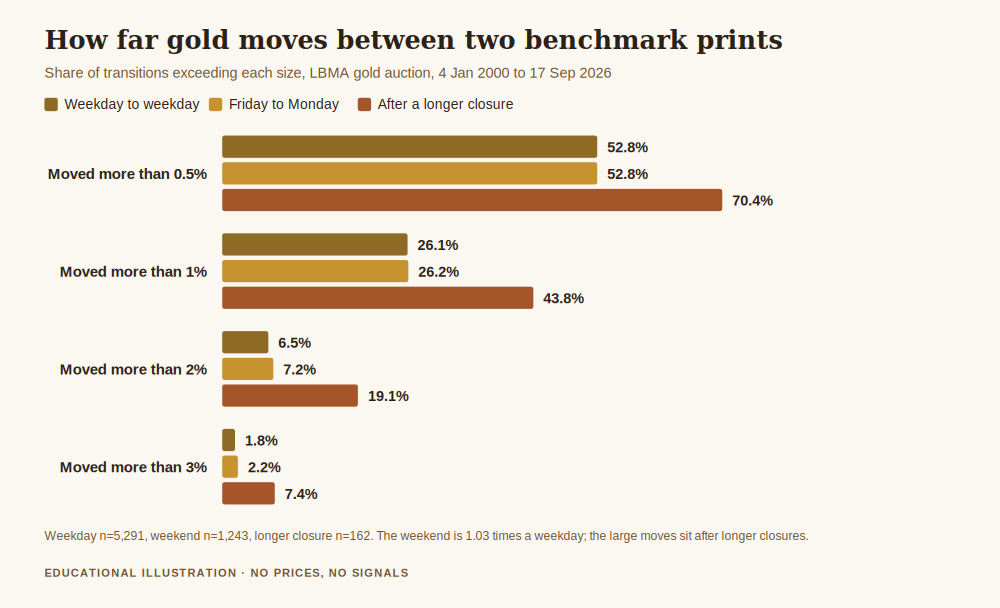
Between two ordinary weekday prints, the benchmark moved an average of 0.75 per cent. It moved more than one per cent on 26.06 per cent of those transitions, more than two per cent on 6.50 per cent, and more than three per cent on 1.80 per cent. The largest single weekday move in the sample was 7.83 per cent.
Now the weekend, which is the one everybody worries about. Friday afternoon to Monday afternoon, across 1,243 weekends, the average move was 0.78 per cent. More than one per cent on 26.15 per cent of weekends. More than two per cent on 7.16 per cent.
Read those two paragraphs again, because they say something most traders would bet against. The weekend gap is 1.03 times the size of an ordinary weekday move, and on the one per cent threshold the two are identical to two decimal places. The widely held belief that the weekend is where the danger concentrates is, on this evidence, misplaced.
It concentrates somewhere else. Across the 162 transitions that spanned a longer closure, a holiday running into a weekend or a stretch such as the Christmas week, the average move was 1.20 per cent, sixty per cent larger than an ordinary night. More than one per cent on 43.83 per cent of them, and more than two per cent on 19.14 per cent. One long closure in five reopened more than two per cent away.
And it is not only the closures. Within a single working day, comparing the morning auction with the afternoon auction on the same date, the benchmark moved an average of 0.44 per cent, more than half a per cent on 31.55 per cent of days and more than one per cent on 8.99 per cent of days. The largest same day move was 5.75 per cent. Roughly one working day in eleven moves more than a full per cent between breakfast and the middle of the afternoon, with the market fully open the whole time.
What a Jump Costs, Counted in Planned Risks
Percentages of price do not mean much on their own. Convert them into the only unit that matters, which is the size of the loss you agreed to take.
Assume a protective stop sitting one per cent of price away from your entry, and assume that stop defines exactly one unit of planned risk. If price reopens or jumps past the level rather than trading through it calmly, you are filled further out, and the arithmetic is simply how much further:
- Jumps 0.25 per cent past your level: you lose 1.25 times the risk you planned.
- Jumps 0.50 per cent past: 1.50 times.
- Jumps 1.00 per cent past: 2.00 times.
- Jumps 2.00 per cent past: 3.00 times.
- Jumps 3.00 per cent past: 4.00 times.
Now change one thing. Put the stop two per cent away instead of one, keep the same jumps, and the same overshoot buys much less damage: 1.12, 1.25, 1.50, 2.00 and 2.50 times planned risk. The wider stop absorbs the overshoot better in relative terms, because the overshoot is a smaller fraction of a bigger number.
That is a real effect and it is also a trap, because a wider stop with the same lot size is simply a bigger bet. The version that actually protects you is a wider stop with a smaller position, so the planned risk in money stays where you put it. Which lands, as these things always do, back at position sizing so one trade cannot hurt you. The order type does not protect you. The size does.
Get the free Black Gold Market blueprint, a short document on protecting capital before you try to grow it, including how to decide what size you are willing to leave waiting in an order you are not watching. One email, no spam, unsubscribe anytime.
Get the free blueprint →Four Ways a Pending Order Fails to Become the Trade You Planned
- Price traded through your level rather than at it. A limit order needs somebody on the other side at your price, and the numbers above are how often the market relocates too far for that.
- The margin was not there at the trigger. Nothing was reserved when you lodged it, so it can be rejected at the exact moment you would have called it a good entry.
- It expired. The quietest failure of the four, and the only one that leaves no trace in your account history.
- The broker rejected or requoted it, because in fast conditions the price you named was no longer available. See what is requote in forex and what is slippage in gold trading.
Three of the four have nothing to do with being right about direction. You can read the market correctly and still end up with no trade, a worse trade, or a trade you did not want any more.
What This Does Not Say
It does not say the London auction is your broker's price. The auction is one formal print per working day, your broker quotes continuously from its own liquidity providers, and the two will not match. The auction is used here because it is public and auditable, which makes it a fair yardstick for how far this market moves, not a claim about your platform.
It does not say pending orders are dangerous, and it does not predict anything. They are the opposite of dangerous when they replace a decision made in a hurry with one made in advance. Counting how a market behaved from 2000 to 2026 describes the past, so use these numbers as a floor for how much room to leave, never as a forecast of the next gap. And nothing here tells you where to put a level, which is yours and depends on a method this article is not about.
Frequently Asked Questions
What does pending order mean in forex trading, in one sentence?
It is an instruction lodged with your broker to open a position if price reaches a level you name, which is a promise to attempt the trade and not a promise to get you that price.
Does a pending order use my margin while it waits?
No. Margin is checked when the order triggers, which is precisely why a pending order can be rejected at the moment it fires if an open position has consumed your free margin in the meantime.
How long does a pending order stay active?
Whatever the expiry says, and the default is set by your broker rather than by you. Good till cancelled, good for today and good until a set date and time are the usual options. Check which one your platform picked, because it is rarely the one you assumed.
Should I leave pending orders over the weekend?
That is a size question, not an order question. On this data the weekend move is 1.03 times a normal weekday move, so a weekend is not the special hazard it is made out to be. The longer holiday closures are the ones that reopen far away, with 19.14 per cent of them moving more than two per cent.
Why did my pending order not fill even though price reached my level?
Price traded through rather than at your level, free margin was not available at the trigger, the order had already expired, or it was rejected or requoted in fast conditions.
Where did the numbers in this article come from?
All of them were calculated from the published LBMA gold auction history linked below, downloaded before publication. The method is to take every pair of consecutive auction dates from 2000 onward, measure the percentage change between them, and group the results by the length of the closure in between. The margin close out wording is quoted from the ESMA measures linked in the text. None of it is a price quote, a forecast or a performance claim.
Where Black Gold Market Fits
Black Gold Market is free to follow. Daily XAU/USD analysis with the level, the context and the risk stated before the trade, losing days included, on Telegram. There is a free blueprint for anyone who wants the capital protection material in one place, and an optional Kit for people who want the full method. Nothing here promises a profit, and nothing here is a signal service.
An order you are not watching is a Protect problem, which puts this article under how to protect your capital when gold gets volatile. Market order vs limit order covers what each order type charges you, why has gold stopped trading covers the closures that produce the largest jumps above, and what is a margin call covers an order firing into an account with no room. The price history comes from the London Bullion Market Association price record. More on the about page.
About the author. Raphael writes Black Gold Market. He works on the part of this business that happens before the entry, the level, the context, and the risk, and he has a standing habit of clearing the pending list on a Friday because he has been on the wrong end of an order he forgot he owned. Nothing in this article is a recommendation to trade, and no entry, stop or target discussed should be treated as a signal.
Disclaimer: This article is general educational content about order types, order handling and gap risk in retail trading. It is not financial advice, not investment advice and not a recommendation to buy, sell or use any product, venue or firm. Order handling rules, expiry defaults and execution arrangements vary between brokers and change over time, and current terms should be checked with your own broker and with the sources linked in the text. Trading leveraged products carries a substantial risk of loss and most retail accounts lose money. Figures are calculations from the stated public data, not predictions or performance claims.