

You open the terminal, the gold chart is a flat line, the spread looks wrong or the Sell button does nothing at all, and the question arrives in the same shape every time: why has gold stopped trading. It feels like a fault. Most of the time it is a calendar, and the calendar is public.
This belongs under Protect rather than under Master, because the expensive version of this question is never asked at the screen. It is asked with a position open, when you want out and the market will not take the order, and at that point you are not learning about market hours, you are paying for not having learned about them earlier.
Why Has Gold Stopped Trading: the Four Honest Answers
There are only four, and they are easy to tell apart once you know they exist.
One, the daily break. The round-the-clock gold market is not actually round the clock. It closes briefly each weekday for settlement and rollover, and during that window quotes stop updating and orders are refused.
Two, the weekend. The market closes on Friday evening and does not reopen until Sunday evening. Nothing you hold can be adjusted in between.
Three, a holiday. Ten weekdays in 2025 set no London benchmark price at all. Your broker may quote something thin during part of them, or nothing.
Four, it is not the market, it is you or your broker. The symbol is not in your watchlist, your account type does not carry that instrument, or the broker has suspended the symbol.
Three of those four are the calendar. Only the fourth is a problem, and it is the one people assume first.
The Calendar Nobody Puts in Front of You
The London Bullion Market Association runs the auction that sets the world benchmark price for gold, and it publishes the entire history of that auction for anybody to download. That record is a clean way to count the days the gold market genuinely had a price, because on a day with no auction there is simply no entry.
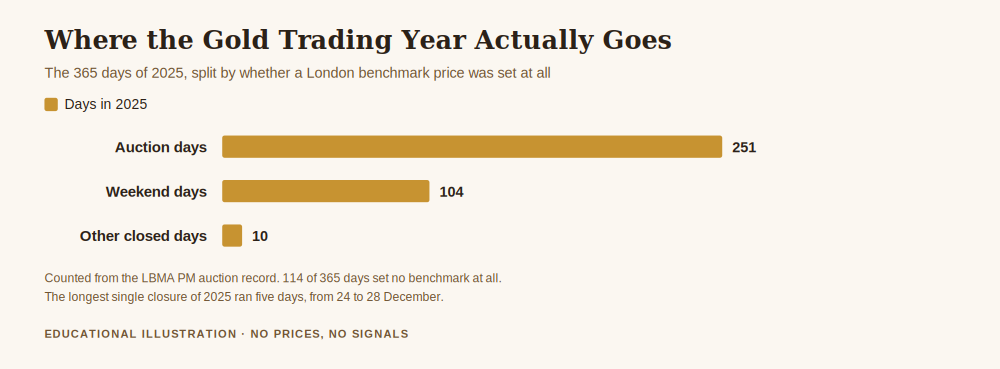
Take 2025 and count it out. The year had 251 auction days. It had 104 weekend days. And it had 10 further weekdays with no auction at all. Add them and you get 365 exactly, with nothing left over.
Which means that on 114 of the 365 days in 2025, or 31.2 per cent of the calendar, the gold market set no benchmark price whatsoever. Close to a third of the year. If you have ever felt that gold stops trading more often than a 24-hour market should, you were not imagining it.
The ten weekdays in 2025 with no auction were 1 January, 18 and 21 April, 5 and 26 May, 25 August, 24, 25 and 26 December, and 31 December. They are the London holiday calendar, because the benchmark is a London auction, which is a detail worth holding on to: gold's closed days follow London rather than your own country's holidays.
Across 2015 to 2025 the pattern is remarkably steady, averaging 250.6 auction days a year. This is not a market that varies much. It is a market with a fixed shape that almost nobody bothers to look at.
How Long the Closures Actually Run
The length matters more than the count, because the length is how long you are stuck with whatever you are holding.
Looking at the gaps between consecutive auctions through 2025: on 198 occasions the next auction was the very next day. On 47 occasions two days passed with no benchmark, which is an ordinary weekend. On three occasions it was three days, on one occasion four, and on one occasion five days closed in a row.
That five-day closure ran from 24 to 28 December 2025. And it is not a one-off. Check every year from 2015 to 2025 and the longest closure of the year is the Christmas and New Year week, every single time, without exception, always five days.
So the honest summary is this. For most of the year the worst case is a two-day weekend. Once a year it is five days, and you know the date in advance, which makes it the one closure there is no excuse for being surprised by.
Why a Closed Market Is a Capital Protection Problem
A closed market is not a pause. It is a period during which the world keeps happening and your position cannot respond to any of it.
When trading resumes, price resumes wherever the first willing buyer and seller agree, which need not be anywhere near where it stopped. A stop order does not protect you through a closure, because a stop is an instruction to trade at a level and there is nobody there to trade with. It executes when the market reopens, at whatever the reopening offers.
That is also why margin rules matter at exactly this moment. Under the European measures for retail clients, brokers operate a margin close-out rule on a per account basis, standardised at 50 per cent of minimum required margin. That rule cannot help you while the market is shut. It applies the moment it reopens, on whatever the reopening price turns out to be.
Which gives the practical rule, and it is not complicated. Decide what you are willing to hold through a closure before the closure starts, rather than during it. The position you are comfortable with on a Wednesday afternoon, when you can exit in a second, is not automatically the position you want to carry into five days of no market at all.
This is the same argument as protecting capital when gold gets volatile, applied to time rather than to price. It also sits directly alongside what a margin call is and how to avoid one, because a reopening gap is one of the few events that can take an account from comfortable to closed out without a single decision being made in between.
Get the free Black Gold Market blueprint, a short document on protecting capital before you try to grow it, including how to decide what you are willing to hold through a closed market. One email, no spam, unsubscribe anytime.
Get the free blueprint →When It Is Not the Market At All
Everything above assumes the market is closed. Sometimes it is open and you still cannot trade, and the symptoms are different enough to tell apart in under a minute.
Everything else is frozen too. If every instrument in your terminal has stopped updating, not just gold, you are looking at a connection problem or a platform problem rather than a gold problem.
Gold is missing rather than flat. A symbol that is absent from the watchlist has usually never been added, or is not carried on your account type. That is an account question for your broker, not a market question.
Quotes update but orders are refused. This is the one that actually deserves attention. It can be a suspended symbol, an account restriction, insufficient free margin, or a position size outside the limits your broker sets for that instrument.
Only the spread has changed. A market that is technically open but very thin, in the minutes around a closure or a holiday, can widen to the point where trading it is a bad idea even though it is possible. Being able to trade and being sensibly able to trade are different questions, which is the theme of why gold trades in sessions.
If you are unsure which of these you are in, the fastest test is to check whether the London benchmark exists for today. If it does not, the calendar has your answer and there is nothing to fix.
What This Does Not Say
It does not say your broker's hours are the same as the London auction. They are not. The auction is a single moment each day that sets a benchmark; your broker quotes around the clock on trading days from its own liquidity providers, with its own published hours and its own holiday arrangements. The auction record is used here as a clean, public and auditable way to count which days had a real market, not as a claim about when your particular platform opens.
It does not say closures are dangerous in themselves. They are a feature of every market, they are announced in advance, and they cost nothing at all to anybody who has decided what to hold through them.
It does not predict anything. Counting how a market behaved from 2015 to 2025 describes the past. Holiday calendars change, brokers change their arrangements, and today's schedule should be read from today's sources.
Frequently Asked Questions
Why has gold stopped trading right now?
Check the four causes in order: the daily settlement break, the weekend, a London holiday, or something on your side such as a symbol that is not loaded or an account restriction. Three of the four are the calendar, and in 2025 the calendar accounted for 114 of 365 days with no benchmark price at all.
How many days a year is the gold market actually closed?
On the London benchmark record, 2025 had 251 auction days out of 365, so 114 days set no benchmark, which is 31.2 per cent of the calendar. From 2015 to 2025 the average was 250.6 auction days a year.
What is the longest gold is ever closed for?
Five consecutive days, over Christmas and New Year. That was true in every year from 2015 to 2025 without exception. In 2025 it ran from 24 to 28 December.
Will my stop loss protect me over a weekend?
Not through the closure itself. A stop is an instruction to trade at a level, and it can only be filled when there is a market. If price reopens past your stop, the order is filled at the reopening level rather than at the level you chose. That is why the size you carry into a closure is the real decision, not the stop.
Does gold close for my country's public holidays?
The benchmark follows London. In 2025 the ten non-weekend closed days were the London holiday calendar plus 24 and 31 December. Your own national holidays have no effect on it, though your broker may have its own arrangements.
My broker shows gold but will not accept my order, is the market closed?
If quotes are still updating, the market is probably open and the refusal is on your side: free margin, a position limit, an account restriction, or a suspended symbol. If quotes have frozen and other instruments are fine too, check the calendar first.
Where did the numbers in this article come from?
All the day counts are taken from the published LBMA gold auction history linked below, downloaded and counted before publication. The method is simply to count the dates present in the record for each year, subtract weekends from the calendar, and measure the gaps between consecutive auction dates. The margin close-out wording is quoted from the ESMA measures linked in the text. None of it is a price quote, a forecast or a performance claim.
Where Black Gold Market Fits
Black Gold Market is free to follow. Daily XAU/USD analysis with the level, the context and the risk stated before the trade, losing days included, on Telegram. There is a free blueprint for anyone who wants the capital protection material in one place, and an optional Kit for people who want the full method. Nothing here promises a profit, and nothing here is a signal service.
Knowing when the market is not there belongs to Protect. How to protect your capital when gold gets volatile is the pillar this article sits under, why gold trades in sessions covers the hours when it is open but not equally worth trading, and what is a margin call and how to avoid one covers what a reopening can do to an account that was carrying too much. The day counts come from the London Bullion Market Association price record. More about who writes this is on the about page.
About the author. Raphael writes Black Gold Market. He works on the part of this business that happens before the entry, the level, the context, and the risk, and he has noticed that most of what people call a platform fault turns out to be a date. Nothing in this article is a recommendation to trade, and no entry, stop or target discussed should be treated as a signal.
Disclaimer: This article is general educational content about market hours, trading calendars and closure risk in retail trading. It is not financial advice, not investment advice and not a recommendation to buy, sell or use any product, venue or firm. Trading hours, holiday schedules and broker arrangements vary and change, and current schedules should be checked with your own broker and with the sources linked in the text. Trading leveraged products carries a substantial risk of loss and most retail accounts lose money. Figures are counts and calculations from the stated public data, not predictions or performance claims.