

It usually comes up after a bad fill, not before one. Someone placed a market order, the platform accepted it, and the price on the confirmation was worse than the price on the screen. So they ask what is slippage in gold trading, and whether they have just been cheated.
Most of the time they have not been cheated. They have met the difference between a quote and a transaction, which are two different things and have always been two different things. The quote is an invitation. The transaction is what the market was willing to do at the moment your order arrived.
That gap is small enough to ignore on a quiet afternoon and large enough to decide your year when it is not. This article is about the size of it, measured rather than felt. There is no gold price anywhere in it, because slippage is a distance, not a level.
What Is Slippage in Gold Trading, in Plain Terms
Slippage is the difference between the price you expected when you sent the order and the price you actually received when it was filled. If you clicked at one level and the fill came back two tenths of a dollar an ounce away, you were slipped by two tenths of a dollar an ounce.
It runs in both directions. Positive slippage, where the fill is better than expected, is real and does happen. What makes slippage a cost rather than a coin flip is that the conditions producing it are not symmetrical in practice. Orders tend to arrive in a hurry, and hurry clusters around the moments when the book is thinnest.
The mechanism is unglamorous. A quote is the best price available for a certain quantity at a certain instant. Send an order larger than that quantity, or send it a moment later, and it fills against whatever is next in the book. On a liquid instrument in a calm hour, what is next in the book sits almost on top of the quote. In the seconds after a scheduled release, it does not.
Slippage Is Not the Spread, and the Difference Matters
This is where most of the confusion lives, so it is worth separating carefully.
The spread is quoted to you in advance. You can read it on the platform before you commit, you can compare it between firms, and you can decide not to trade when it widens. It is a known cost, and a known cost can be budgeted.
Slippage is not quoted in advance. You discover it after the fact, on the confirmation. You cannot compare it on a marketing page, and you cannot refuse it once the order is sent. It is the part of your transaction cost that arrives as a surprise, which is precisely why it escapes most trading plans. People budget for the cost they can see.
The practical consequence is that two accounts paying an identical spread can have materially different results, because one of them trades in conditions that slip and the other does not. If you have compared brokers on spread alone, you have compared the smaller and more visible half of what you pay.
Why Gold Slips More Than People Expect
Gold has a reputation for depth, and over a day the reputation is deserved. The London benchmark process run by the LBMA settles an enormous quantity of metal in a structured auction, and the wider market trades around the clock. Depth measured over a day, though, is not the same as depth measured over the two seconds in which your order actually arrives.
Three things concentrate the damage.
The first is the session handover. Liquidity is not spread evenly across twenty four hours, and the thin patches between the major sessions are where a normal sized order can move against you for no reason connected to your analysis.
The second is scheduled news. A release does not simply move the price. For a short window it removes the resting orders that would otherwise have absorbed yours, and it removes them just as the largest number of traders are trying to transact. That combination is what produces the fills people remember for years.
The third is the weekend and the holiday gap, where there is no continuous market at all and the first available price can sit some distance from the last one. A stop does not protect you across a gap. It becomes a market order at the first price that exists, which is a different instrument entirely from the one people think they placed.
What Slippage Actually Costs, in Account Currency
Feelings about slippage are useless. Arithmetic is not. Every figure below is computed from stated assumptions and none of them depends on the price of gold.
Assume the common retail convention in which one full lot of gold is one hundred ounces. Confirm that in your own platform before using any of this, because it is a broker setting rather than a law of nature, and the section further down explains where to read it.
On that convention, slippage of ten cents an ounce costs ten units of account currency per side on a full lot. Thirty cents an ounce costs thirty per side, so sixty on a round turn once you have both entered and exited. One dollar an ounce costs one hundred per side, so two hundred on the round turn.
Now put that into a year. Assume an account of fifty thousand, two hundred round turns across the year, a quarter lot on each, and average slippage of thirty cents an ounce per side. The arithmetic gives fifteen per round turn, three thousand across the year, and three thousand is six percent of that account. Nobody budgeted six percent. It does not appear on any statement under a heading, and it is not a fee, so it is invisible in exactly the way that matters.
Run the same assumptions at a half lot and the annual figure doubles to six thousand, or twelve percent. At a full lot it is twelve thousand, which is twenty four percent of the account. The only variable that changed was size.
The Number That Should Worry You Is the Break-Even
Cost in currency is the easy part. The harder consequence is what slippage does to the win rate you need in order to stay level.
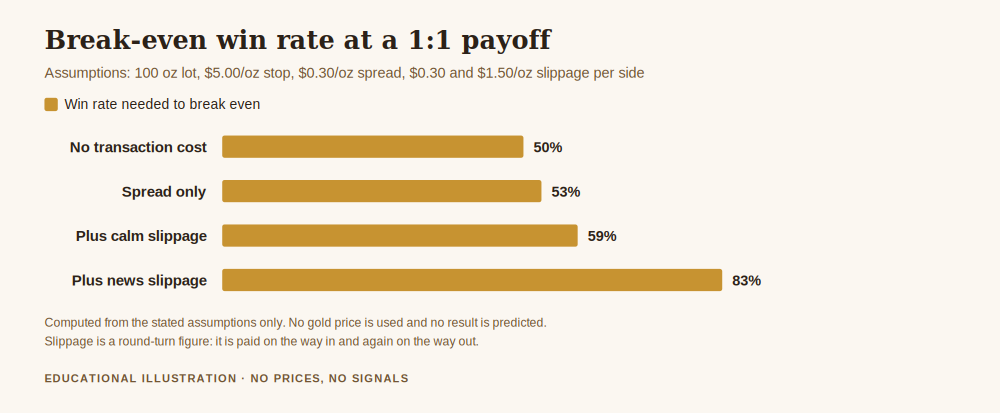
Assume a stop of five dollars an ounce, a target the same distance away, and therefore a one to one payoff. With no transaction cost at all, one to one breaks even at a fifty percent win rate, which is the textbook figure everyone carries around.
Add round turn slippage of sixty cents an ounce, which is the thirty cents per side used above. That is twelve percent of the distance to your stop, so twelve percent of one risk unit. Break-even moves from fifty percent to fifty six percent.
Now take the release-window case, a dollar fifty an ounce per side, three dollars on the round turn. That is sixty percent of a five dollar stop. Break-even moves from fifty percent to eighty percent.
Read that last figure slowly. A strategy that genuinely wins six times in ten, which would be a good strategy, is losing money if it is habitually executed into conditions like that. The edge did not fail. It was spent on execution before it ever reached the account.
This is the real argument against trading every release for its own sake. Not that news is unpredictable, although it is, but that the execution cost in that window is a tax large enough to consume an ordinary edge whole.
Which Orders Slip and Which Ones Do Not
Order type is the one lever here that is entirely yours.
A market order asks for a fill at whatever is available. It will fill, and it accepts whatever price that takes. Market orders are the ones that slip.
A limit order names a worst acceptable price and refuses anything beyond it. A limit order cannot slip against you by definition. What it can do instead is not fill at all, which is a different cost and one people consistently underrate, because a missed entry is silent while a bad fill is loud. The trade-off is covered in market order versus limit order.
A stop order is the one that surprises people. A stop is not a limit. When it triggers it becomes a market order, which means a stop loss is a slippage-exposed instrument at precisely the moment conditions are worst, because the thing that triggered it was a fast move. This is not a flaw to be fixed. It is what a stop is, and knowing it changes how you size rather than whether you use one. The mechanics of combining the two are in stop limit order explained.
There is a related event worth naming, because traders often file it under slippage and it is not. A requote is the platform refusing your price and offering a new one, which leaves the decision with you. Slippage takes the decision away. The distinction is covered in what is a requote in forex.
One protection is worth knowing about at the extreme end. Under the European product intervention measures published by ESMA, retail clients of firms in that regime have negative balance protection and a margin close out rule, which cap what a catastrophic gap can do to you beyond the account. That is a floor under the worst case, not a cost control, and it does nothing about the ordinary erosion described above.
Get the free Black Gold Market blueprint, a short document on measuring what your execution actually costs before it quietly reprices your edge, including the arithmetic used on this page. One email, no spam, unsubscribe anytime.
Get the free blueprint →How to Measure Your Own Slippage Instead of Guessing
You do not need anyone's average. You need yours, and it takes one extra column.
Record the price you intended when you sent the order, next to the price you were filled at. The difference is your slippage on that trade. Keep it signed, so improvements count as well as costs, and the column will tell you the truth within about thirty trades.
Then sort it. Sort by hour of day and the thin sessions will identify themselves. Sort by whether a scheduled release was inside the next fifteen minutes and you will have your own answer to whether trading the release is worth it, computed on your own fills rather than on somebody's opinion. Sort by position size and you will see whether you have outgrown the liquidity you were relying on, which is the quiet failure mode for accounts that are growing.
Where do you read the contract size to make this arithmetic correct? In the platform, not in a forum. In MetaTrader 5, the specification is reached through the Market Watch window, and it states the contract size, execution mode, margin and commission that your broker has actually set for your account. Two firms can use the same instrument name with different conventions behind it, so it is worth reading once rather than assuming.
What You Can Control, and What You Cannot
You cannot control the depth of the book. You cannot control what a release does to it, you cannot control the weekend gap, and you cannot negotiate your way out of the fact that a stop becomes a market order when it fires.
What you control is the size you send, the hours you send it in, the order type you use, and whether you have measured any of this. Those four are enough. They are, in fact, most of the distance between an edge that survives contact with a real broker and one that only worked in the backtest, where every fill was perfect and free.
Protect comes first here, as usual. Slippage is not a headline risk, it does not blow accounts in an afternoon, and it does not feel like anything at the time. It simply removes a few percent a year from the top of your results, silently, for as long as you decline to look at it.
Frequently Asked Questions
What is slippage in gold trading, in one sentence?
It is the difference between the price you expected when you sent an order and the price you were actually filled at, which appears on the confirmation rather than on the quote screen.
Is slippage the same as the spread?
No. The spread is quoted to you before you commit and can be compared between firms. Slippage is discovered afterwards and cannot be refused once the order is sent. They are separate costs and they add together.
Can slippage ever work in my favour?
Yes, positive slippage is real and worth recording with a sign in your journal so you see the net figure rather than only the painful half. It does not usually offset the negative side, because the conditions that cause large slippage are also the conditions in which orders cluster.
Does a stop loss protect me from slippage?
No, and this is the most expensive misunderstanding on the page. A stop becomes a market order when it triggers, so it is filled at whatever price exists at that moment. It caps the level at which you exit, not the price you get.
Should I just stop trading the news?
That is a decision for your own record rather than for an article. Measure your fills in the fifteen minutes around scheduled releases, compare them with the rest of your trading, and let the column decide. The arithmetic above shows why the answer is often yes, but it should be your arithmetic.
Where did the numbers in this article come from?
Negative balance protection and the margin close out rule are quoted from the ESMA measures linked above, checked live before publication. Every other figure is computed from assumptions stated in the text, namely a one hundred ounce lot convention, a five dollar an ounce stop, thirty cents an ounce of slippage per side in calm conditions and a dollar fifty in a release window. None of them depends on the price of gold, and none of them is a prediction.
Where Black Gold Market Fits
Black Gold Market is free to follow. Daily XAU/USD analysis with the level, the context and the risk stated before the trade, losing days included, on Telegram. There is a free blueprint for anyone who wants the capital protection material in one place, and an optional Kit for people who want the full method. Nothing here promises a profit, and nothing here is a signal service.
Execution cost belongs to Protect, because it removes capital before any of the interesting work begins. How to protect your capital when gold gets volatile is the pillar this article sits under, commission versus spread in forex covers the visible half of what you pay, and how to trade around high impact news deals with the window where these numbers get worst. More about who writes this is on the about page.
About the author. Raphael writes Black Gold Market. He works on the part of this business that happens before the entry, the level, the context, and the risk, and he has a particular interest in the costs that never appear on a statement under their own name. Nothing in this article is a recommendation to trade, and no entry, stop or target discussed should be treated as a signal.
Disclaimer: This article is general educational content about execution cost, order types and transaction costs in retail gold trading. It is not financial advice, not investment advice and not a recommendation to buy, sell or use any product, venue or firm. Regulatory wording is quoted from the source linked in the text and may change. Trading leveraged products carries a substantial risk of loss and most retail accounts lose money. Figures are illustrative calculations from stated assumptions, not predictions or performance claims.