


Somebody in the group described a trade last month that has been on my mind since. They had a position on, they had protection set, and the market moved hard against them overnight. In the morning the position was still open and the loss was several times what they had planned. Their protection had not failed in the sense of a broken platform. It had worked exactly as designed. They had used a stop-limit, and they had never been told what the second word in that name is for. So this is a stop limit order explained from its failure mode backwards, because that is the end of it that costs money.
Doing it properly means starting from what the people who write the rules actually say the thing does, and then doing the arithmetic on what that costs. This is a Protect article. It is not about finding better trades. It is about knowing which of your safety equipment is capable of failing, and under what conditions, before the conditions arrive.
A Stop Limit Order Explained in the Words of the People Who Define It
Two definitions sit next to each other in the CFTC's own glossary, and reading them one after the other tells you everything.
A stop order, in their words, "is an order that becomes a market order when a particular price level is reached." A stop limit order "goes into force as soon as there is a trade at the specified price. The order, however, can only be filled at the stop limit price or better."
Read that second sentence again, and specifically the word "only". A plain stop turns into a market order, and a market order takes whatever the market is offering, which may be an ugly price but it is a price. A stop-limit turns into a limit order, and a limit order is an instruction with a condition attached. If the condition cannot be met, nothing happens. Not a bad fill. No fill.
The platform documentation says the same thing without any softening. In the MetaQuotes reference for order types, a sell stop-limit is described like this: upon reaching the order price, a pending Sell Limit order is placed at the StopLimit price. The stop does not close your trade. The stop places another order, and that other order may sit there unfilled while the market walks away from it.
The Two Prices, and the Distance Between Them
A stop-limit needs two numbers where a stop needs one. There is the trigger, the price at which the order wakes up, and there is the limit, the worst price you will accept once it does. The distance between them is the band, and the band is the whole story.
Set the band at zero and you have an order that only fills if the market politely stops exactly where you told it to. Set the band very wide and you have something that behaves almost like a plain stop, at which point you may as well have used one. Every choice in between is a trade you are making, whether or not you know you are making it: you are buying a better price in the ordinary cases by accepting no price at all in the violent ones.
Throughout what follows I measure everything in R, where 1R is the distance from your entry to your trigger, in other words the loss you planned for. Working in R means none of these numbers depend on the gold price, on your account size or on your lot size, which is exactly why I use it. It also means every figure below is arithmetic on stated assumptions rather than a claim about what any market did.
When the Band Holds, and When It Simply Is Not There
Call the band b, measured as a fraction of your stop distance, and call the adverse jump past the trigger j, in the same units. The limit fills if, and only if, the market trades at your limit price or better, which means it fills if and only if j is no larger than b. That is not a rule of thumb. It is the CFTC's sentence, restated with letters.
Lay that out and the pattern is uncomfortable. With a band of 0.05, a jump of 0.05 fills and everything larger misses. With a band of 0.10, jumps of 0.05 and 0.10 fill and everything larger misses. With a band of 0.50, you are protected all the way out to a jump of half your stop distance, and then you are not.
Notice what that means about timing. The band only has to be wider than the jump, and jumps are small in calm markets and large in violent ones. So the stop-limit protects you reliably in exactly the conditions where a plain stop would have cost you almost nothing extra, and abandons you in exactly the conditions that a stop exists for. The protection and the need for protection are inversely related. That is the design, not a malfunction.
What a Missed Stop Costs, Counted in Planned Risks
Suppose the limit misses. What happens next is not that you lose a bit more. What happens is that you are still in the trade, with no protection in the book, in a market that is moving.
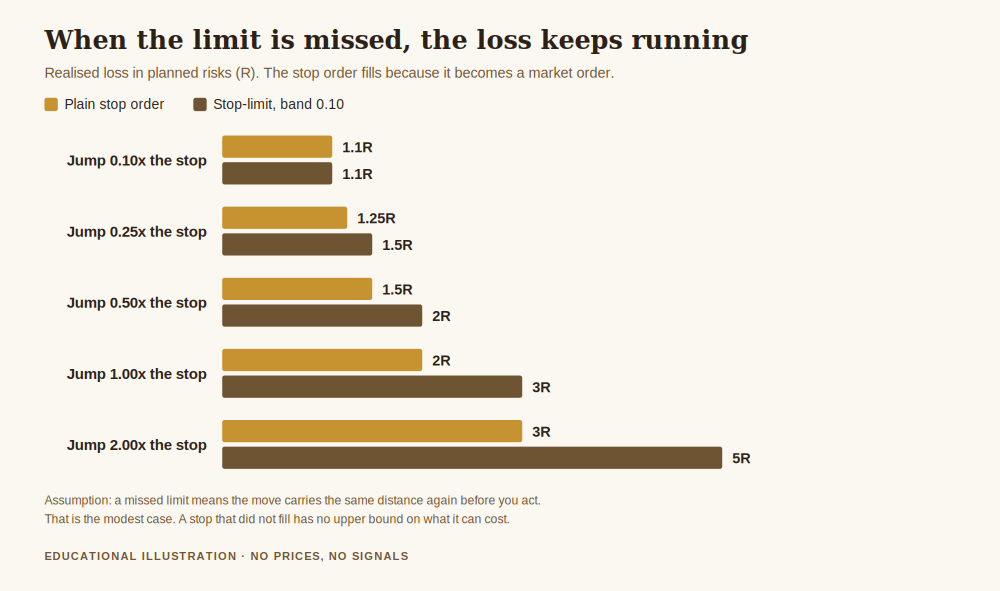
If you notice immediately and exit at the jump price, which is the kindest assumption available and better than most people manage at three in the morning, a jump of 0.25 costs 1.25R, a jump of 0.50 costs 1.50R, a jump of 1.00 costs 2.00R and a jump of 2.00 costs 3.00R. That is already the good outcome. The chart above uses a slightly more realistic assumption, that the move carries the same distance again before you act, and on that basis the same jumps cost 1.50R, 2.00R, 3.00R and 5.00R.
Sit with the last one. A trade you sized to lose 1R has cost 5R, and it did so with your protection in place, working as specified. Five of your planned losses in one position. If you are running the kind of ceiling I keep arguing for, that is your whole month, spent in the hours you were asleep. And unlike a plain stop's bad fill, there is no upper bound here. The 5R is an assumption I chose to be modest with. Nothing in the mechanism caps it.
The Fill Rate It Needs Just to Break Even
Now let me be fair to the stop-limit, because there is a real argument for it and it deserves the arithmetic rather than a dismissal.
The argument is that a plain stop pays slippage every single time it fires, while a stop-limit pays none. So the stop-limit trades a small certain cost for a large uncertain one, and whether that is a good trade depends on how often it misses.
Put numbers on it. A plain stop costs 1R plus slippage s. A stop-limit costs somewhere between 1R and 1R plus the band when it fills, so call it 1R plus half the band on average, and costs M when it misses. Set the two expectations equal and solve for the fill rate p at which they break even, and you get p equal to M minus 1 minus s, all divided by M minus 1 minus half the band.
Run that with a miss costing 2R. Against a stop that slips 2 percent of your stop distance, there is no fill rate at all that makes the stop-limit worthwhile, at any band width; the arithmetic returns a required rate above 100 percent. Against a stop that slips 10 percent, a band of 0.05 needs to fill 92.31 percent of the time and a band of 0.10 needs 94.74 percent. Against a stop that slips a punishing 20 percent, the requirements fall to 82.05 and 84.21 percent.
Those are requirements, not achievements. And here is the part that decides it: the misses are not distributed randomly across your trades. They are concentrated in the fast markets, the news reactions and the weekend re-openings, which is precisely where the slippage on the plain stop would also have been at its worst. The two sides of the comparison move together, and the stop-limit's requirement rises exactly when its performance falls.
The Order That Always Fills Is Not Yours
There is one more actor in this, and people forget about it until they meet it.
Under the measures ESMA agreed for retail CFD clients, a provider must close out positions when account equity falls to 50 percent of the margin required to maintain them, and must offer negative balance protection on a per account basis. The same measures cap retail leverage at 20:1 on gold and 30:1 on major currency pairs.
That close-out is executed at the market. It does not have your stop-limit's fill problem, because it is not a limit order. It cannot decline.
Work out how far away it sits. If a position is opened using the full leverage available, the margin posted is one over the leverage, and losing half of that margin means an adverse move of one over twice the leverage. At the 20:1 gold cap that is a 2.50 percent move. At 30:1 it is 1.67 percent. So a stop-limit that quietly declines to fill somewhere inside that distance has not saved you from the close-out. It has only removed your say in when and where it happens, and handed the decision to a system that is protecting the broker's balance sheet rather than your plan. The same ESMA analysis found that 74 to 89 percent of retail accounts typically lose money, with average losses per client between 1,600 and 29,000 euros. Those close-outs are not a rare edge case in that population.
So When Would You Actually Use One
I am not going to tell you never to use a stop-limit, because there is a place where it makes sense and pretending otherwise would be the same overclaiming I am objecting to.
A stop-limit is a reasonable tool for getting in, where not being filled is a non event. If a breakout runs away from your price, missing the entry costs you nothing except a trade you did not take, and refusing a terrible fill is genuinely worth something. That is a use where the failure mode is harmless.
For getting out of a losing position, the failure mode is the entire problem. There, what you want is the order that cannot refuse, and that is a plain stop, accepting that it will sometimes fill at a price you dislike. A price you dislike is a completed transaction. An unfilled limit is an open position.
The deeper point, and the one I would rather you take away than any of the tables, is this. Protection you have never tested against its own failure mode is not protection, it is a feeling. Before you rely on any order type, ask the same question I ask of any check: under what specific conditions would this fail, and are those conditions correlated with the times I need it? For the stop-limit the answer is yes, tightly, by construction. Knowing that in advance is worth more than the slippage you were trying to avoid. If you want the ground floor of this, market order vs limit order works through what each of the two basic types charges you, and this article is the third case those two produce when you combine them.
Get the free Black Gold Market blueprint, a short document on protecting capital before the trade rather than after it, including how to tell protection that can fail from protection that cannot refuse. One email, no spam, unsubscribe anytime.
Get the free blueprint →Frequently Asked Questions
Stop limit order explained in one sentence, what is the catch?
A stop-limit turns into a limit order when it triggers, and a limit order can only fill at your price or better, so in a fast market it can decline to fill at all and leave your position open.
Is a normal stop loss a stop order or a stop-limit?
On most retail platforms the plain stop loss field is a stop order, which the CFTC defines as becoming a market order when the price level is reached. The stop-limit is a separate order type you have to choose deliberately, which is why many people have never thought about the difference.
How wide should the band be?
I will not give you a number, because a number would be a signal dressed up as education, and the honest answer is that any band you can name is a bet that the next jump is smaller than it. If you find yourself widening the band to make misses unlikely, you have reasoned your way back to a plain stop, and you should just use one.
Does a plain stop guarantee my price?
No, and nothing does. A plain stop guarantees an exit, not a price. That is the trade you are making, and it is the right way round for protection: certainty about whether, uncertainty about where.
Do stop-limits have any legitimate use?
Yes, for entries. If a breakout runs past your limit and you are not filled, you have lost a trade you never took, which costs nothing. The failure mode is harmless there, and that is the test.
What if my broker closes the position anyway?
They will, eventually, and on worse terms than you would have chosen. Under the ESMA rules a retail account is closed out when equity reaches 50 percent of required margin, and that close-out is executed at the market. Your unfilled limit does not prevent it, it only removes your say in when it happens.
Where Black Gold Market Fits
Black Gold Market is free to follow. Daily XAU/USD analysis with the level, the context and the risk stated before the trade, losing days included, plus an optional Kit for people who want the method written down in one place. There is no promise of profit here, because nobody can honestly make one.
Protect comes first. How to protect your capital when gold gets volatile is the pillar this article sits under, what a margin call is and how to avoid one covers the close-out from the other side, and position sizing so one trade cannot hurt you is the control that decides how much a missed stop can actually cost you.
About the author. Raphael writes Black Gold Market. He works on the part of this business that happens before the trade, the level, the context, and the risk, and on the conviction that a method you can follow through a quiet quarter is worth more than a better one you cannot.
Disclaimer: This article is general educational content about order types and how they behave. It is not financial advice and not a recommendation to use or avoid any order type, platform or broker. The definitions of a stop order and a stop limit order are quoted from the CFTC glossary, the description of how a stop-limit is implemented is from the MetaQuotes order type reference, and the leverage caps, the 50 percent margin close-out rule, the negative balance protection and the 74 to 89 percent retail loss range are from the measures agreed by ESMA, which apply to retail clients in the European Union and may not apply to your account. Every figure in R, every band width, every jump size and every break-even fill rate is my own arithmetic on assumptions stated in the text, not a measurement of any market and not a description of anyone's results. No gold price level is quoted anywhere in this article. Trading gold, CFDs and leveraged products carries a high risk of losing money rapidly, and no entry, stop or target discussed should be treated as a signal. Readers should consider their own circumstances and speak to a licensed professional in their jurisdiction.