
You click to sell. The platform pauses for what feels like a long time and comes back with a box: the price has changed, do you accept the new one. By the time you have read the sentence, the number in the box has moved again.
Every trader meets this eventually, and almost everyone files it under bad luck. It is not bad luck. What is requote in forex has a precise answer, and the important half of that answer is not the mechanism, which is dull, but the direction. A requote can be an honest report of a market that moved. It can also be a filter that only ever runs one way. The two look identical on your screen and they cost very different amounts of money.
This article is about telling them apart, with arithmetic that needs no gold price and a rule you can read yourself.
What Is Requote in Forex, in Plain Terms
A quote is an offer to trade at a price. When you accept it, a short interval passes while your instruction reaches the dealing desk and the desk answers. That interval is small, but it is not zero, and the market does not stop moving during it.
If the price is still available when your instruction arrives, you are filled. If it is not, the desk has two choices. It can fill you at whatever price is now available, which is slippage. Or it can refuse and offer you a new price, which is a requote. Either way the original price is gone. The difference is who decides what happens next: slippage decides for you, a requote hands the decision back and starts the clock again.
Requotes cluster in the same conditions that make everything else difficult. Around a scheduled release. In the first minutes after one. In thin hours when the desks that normally quote size are not there. They also cluster around larger than usual orders, for the ordinary reason that there is less of the other side available.
So far this is just a market being a market. Here is where it stops being neutral.
The Question That Actually Matters: Which Way Does It Go
Think about what a requote costs the desk on the other side of you.
You click to buy at a quoted price. During the delay, the true price either moves up or it moves down. If it moves down, the desk is now selling to you above the market, which is good for the desk. If it moves up, the desk would be selling to you below the market, which is bad for the desk.
A desk that requotes in both directions is behaving symmetrically. Sometimes you get a worse price, sometimes you get a better one, and over a long series the two cancel. Your expected cost from the delay is zero.
A desk that only requotes when the move went against it is behaving asymmetrically. When the drift favours the desk, it fills you quietly at the original price. When the drift favours you, it comes back and asks whether you would like the new, worse number. You are not being cheated on any individual trade. You are being handed a coin that only lands one way.
The Arithmetic of a One Sided Requote
Put numbers on it, in a way that needs no price at all.
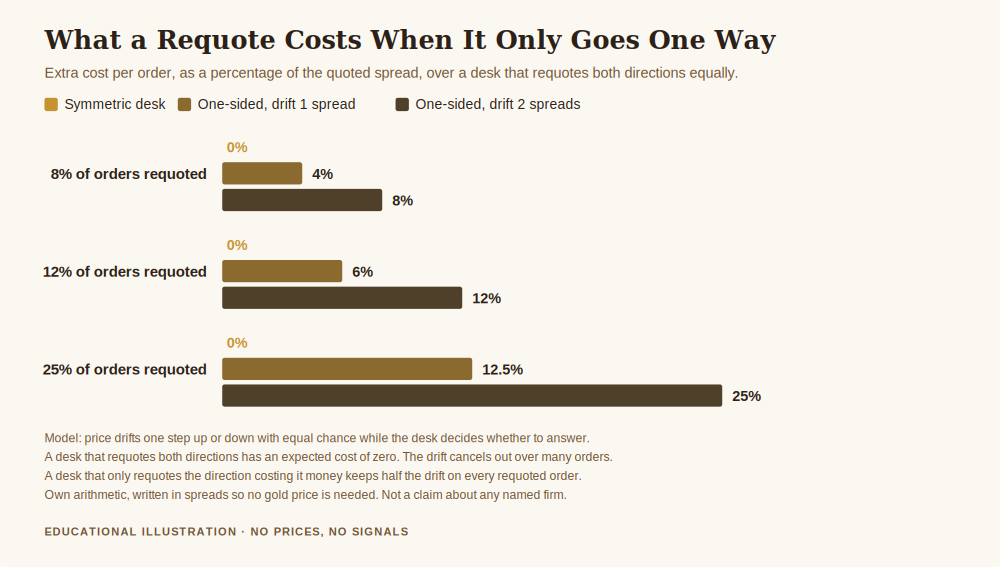
Assume that during the desk's delay the price drifts one step up or one step down, each with equal chance. Call that step X, and write it in units of the quoted spread so the result works on any instrument at any price level. Assume a share q of your orders get requoted.
The symmetric desk costs you nothing. The upward and downward drifts arrive equally often and cancel out. That is not an opinion, it is what an unbiased coin does.
The one sided desk keeps half the drift on every requoted order. Your expected cost per order is q multiplied by X, divided by two. Run that:
- If eight percent of your orders are requoted and the drift is one spread, you pay an extra four percent of the spread on every order. Your transaction costs are four percent higher than advertised.
- If twelve percent are requoted at the same drift, six percent higher.
- If twenty five percent are requoted at the same drift, twelve and a half percent higher.
- If the drift is two spreads instead of one, double each of those.
Carry the middle case across a year. Two hundred round turns at a baseline cost of one spread each is two hundred spreads. The one sided requote policy adds twelve spreads, for a total of two hundred and twelve. Six percent above the number you compared brokers on.
Six percent is not a catastrophe. That is exactly why it survives. Nobody changes broker over six percent, nobody notices it in a monthly statement, and it does not show up on any comparison table, because comparison tables list spreads and this is not a spread. It is a small tax on the difference between the price you were shown and the price you were given, collected only in the direction that suits the party collecting it.
Substitute your own numbers. If you have never counted your own requote rate, that is the first useful thing to come out of this article.
What the Rulebook Says, and What It Does Not
Traders assume this area is unregulated. In the United States it is not, and the rule is worth reading because of how narrowly it is drawn.
NFA Compliance Rule 2-43, adopted effective 15 May 2009 and amended five times since, most recently on 15 September 2022, deals with exactly this. Its first section is headed "Price Adjustments" and it begins: "A Forex Dealer Member may not cancel an executed customer order or adjust a customer account in a manner that would have the direct or indirect effect of changing the price of an executed order except when: (i) the cancellation or adjustment is favorable to the customer."
Read the exception clause. The permitted adjustment is the one that helps you. And the rule closes the obvious loophole in the same breath, requiring that a firm correcting a problem "must adjust all customer orders adversely affected and may not, except as provided in section (a)(1)(ii), adjust any order that received a favorable price due to the problem."
In other words, a firm may not go back through the day's trades, keep the ones that went its way and reverse the ones that did not. That is the asymmetry described above, written into a rule and prohibited.
Now the limits, because they matter more than the rule. That provision governs executed orders, and the same rule defines execution as the earlier of you being told the price or the position appearing in your account. A requote happens before either. It applies to Forex Dealer Members, which is a category of firm registered in one jurisdiction, and most retail traders reading this are not with one. And it is not a promise that you will be filled, which no rule anywhere provides.
So the rule tells you what a well governed desk looks like. It does not tell you that your desk is one.
How to Find Out Which Desk You Are On
You do not need access to anyone's systems. You need a record, which is the answer to most questions in this business.
Add two columns to whatever you already keep. Was this order requoted, yes or no. If yes, was the new price better or worse than the one you clicked. That is it. Thirty or forty orders is enough to see the shape of the thing.
A symmetric desk will show you a mix. Not fifty fifty exactly, because samples are noisy, but both kinds will be present and you will remember being offered an improvement at least once. A one sided desk produces a column with a suspicious consistency to it. If you have been trading for a year and have never once been requoted in your favour, you have your answer, and it did not require a regulator.
Two related things worth knowing while you are looking:
Where the delay bites hardest is on the way out. A requote on an entry costs you an opportunity. A requote while you are trying to close a losing position costs you real money, because the position keeps moving while the box sits on your screen asking a question. Any firm's behaviour is more revealing on exits than on entries.
Requotes and margin interact. Under the European product intervention measures announced on 27 March 2018, retail leverage is capped at 30 to 1 on major currency pairs and 20 to 1 on gold and non major pairs, with an automatic margin close out at 50 percent of the minimum required margin and negative balance protection on a per account basis. That close out is a backstop, and it fires on the firm's schedule rather than yours. A position that you are trying to reduce, and cannot because you keep being asked to accept a new price, is a position moving towards someone else's trigger.
What Actually Protects You
Three things, in order of how much they matter.
Size, before anything else. A requote is only frightening when the position is large enough that thirty seconds of delay changes your account meaningfully. This is the same answer as almost every other execution problem, which should tell you something. Nothing that happens in a requote box can hurt a correctly sized position very much.
Order type, understood rather than assumed. A market order accepts whatever price exists and will not be requoted, but can be slipped. A limit order refuses a worse price and can go unfilled. Neither is superior. They fail in different directions, and choosing between them is choosing which failure you would rather have on a given trade.
The record. Everything above depends on knowing your own requote rate rather than my assumed eight or twelve percent. A firm's execution quality is a fact about your account that you can measure yourself, and it is one of the few facts in this business you can establish without arguing with anybody.
Protect comes first here for the same reason it comes first everywhere. This is not an exciting subject and it will not improve any single trade. It is a small persistent leak, and the traders who last are the ones who found the leaks while they were still small.
Get the free Black Gold Market blueprint, a short document on protecting capital before the trade rather than after it, including the execution costs that never appear on a comparison table. One email, no spam, unsubscribe anytime.
Get the free blueprint →Frequently Asked Questions
What is requote in forex, in one sentence?
It is a dealer declining to fill your order at the price you clicked and offering a new price instead, because the market moved during the short interval between your instruction and the desk's answer.
Is a requote the same as slippage?
No, and the difference is who decides. Slippage fills you at a different price without asking. A requote refuses the fill and hands the decision back to you, which also means the clock keeps running while you decide.
Are requotes illegal?
No. A requote is a dealer declining to trade at a price that is no longer available, which is not in itself improper. What is restricted, at least for firms registered as Forex Dealer Members in the United States, is going back and adjusting orders that have already been executed, and NFA Compliance Rule 2-43 permits that only when the adjustment is favourable to the customer.
How do I know if my broker's requotes are one sided?
Log them. Record whether each requoted order came back better or worse than the price you clicked. Over thirty or forty orders the pattern is visible without any special access, and a trader who has never once been requoted in their favour has the answer already.
Can I avoid requotes entirely?
You can avoid the requote box by using order types that accept whatever price exists, but then you accept slippage instead. The choice is between two different failure modes rather than between a problem and no problem, and no entry, stop or target discussed should be treated as a signal.
Where did the numbers in this article come from?
The quoted rule text, the adoption date of 15 May 2009 and the most recent amendment date of 15 September 2022 come from NFA Compliance Rule 2-43, linked above. The 30 to 1 and 20 to 1 leverage caps, the 50 percent margin close out and negative balance protection are quoted from the ESMA product intervention measures of 27 March 2018, also linked. The four, six, twelve and twelve and a half percent cost figures, and the two hundred and twelve spreads a year, are my own arithmetic under the assumptions stated in the text: an equal chance of an upward or downward drift, a drift of one or two spreads, requote rates of eight, twelve and twenty five percent, and two hundred round turns a year. No gold price appears anywhere in this article.
Where Black Gold Market Fits
Black Gold Market is free to follow. Daily XAU/USD analysis with the level, the context and the risk stated before the trade, losing days included, on Telegram. There is a free blueprint for anyone who wants the capital protection side written down, and an optional kit for people who want the full process. No profit is promised anywhere, because nobody can promise one.
Protect comes first, and an execution cost you have never measured is a risk you have never sized. How to protect your capital when gold gets volatile is the pillar this article belongs under, commission vs spread in forex covers the visible half of your transaction costs that comparison tables do list, market order vs limit order covers the choice between the two failure modes described above, and the about page explains who writes this and why. The rule quoted here is NFA Compliance Rule 2-43, and the leverage measures are the ESMA product intervention measures.
About the author. Raphael writes Black Gold Market. He works on the part of this business that happens before the entry, the level, the context, and the risk, and he has a particular interest in the costs that are too small to argue about and too persistent to ignore. Nothing here is a recommendation, and no entry, stop or target discussed should be treated as a signal.
Disclaimer: This article is general educational content about order execution in retail foreign exchange and gold trading. It is not financial advice, not investment advice, not legal advice and not a recommendation to buy, sell or use any product, venue or firm. The regulatory wording is quoted from the NFA and ESMA sources linked in the text, which were checked and reachable at the time of writing; it is a summary written for general readers rather than a statement of the law, and the rules that apply to you depend on your residency and on the legal entity holding your account. Nothing here describes the conduct of any named firm, and the requote rates used in the arithmetic are illustrative assumptions rather than measurements of any broker. All cost figures are my own arithmetic under the assumptions written out in the text and are expressed in spreads rather than currency, so no gold price is used anywhere. Leveraged trading in currencies and in gold carries a high risk of losing money rapidly, and a majority of retail accounts lose money. Past behaviour of any market does not indicate future behaviour. No entry, stop or target discussed should be treated as a signal, and you should consider taking independent professional advice before making any financial decision.