

Market order vs limit order is taught as a definition and then dropped, which is why most traders pick one out of habit and never find out what the habit costs. The definition itself is correct and nearly useless: a market order takes whatever price is available right now, a limit order waits for the price you named. Fine. Nobody disputes it. But a definition tells you what the two orders do, not what they charge you, and they both charge.
The market order charges a fee you can see. The limit order charges a fee you cannot see, because it is billed in trades that never happened, and an account statement has no line for those. So I went and measured both against the published gold benchmark over the last ten and a half years, and put the two bills side by side. One of the numbers surprised me. The other one was worse than I expected, and it was the one that never shows up in anyone's journal.
Market Order vs Limit Order, the Trade You Are Actually Making
Strip both instructions back and you find you are choosing between two kinds of certainty, and the market will only sell you one at a time.
A market order buys certainty of execution. You will be in. Whatever is happening, whoever else is queuing, however fast it is moving, your order fills. What you surrender is certainty about the price, and you surrender it completely. You are agreeing in advance to accept whatever the book offers at the moment your instruction lands, including on the days when what the book offers is ugly.
A limit order buys certainty of price. You will not pay worse than your number. What you surrender is certainty about whether anything happens at all. Your order may sit there through the entire move you were trying to catch and expire having done nothing except make you feel disciplined.
That is the whole trade. Not a preference, not a style, a genuine either or, and Protect comes first here as always: whichever one you choose, the job is to know what you just agreed to pay.
The Market Order's Bill, Paid Every Single Time
The market order's cost is the spread you cross plus whatever slippage the moment hands you. It is small, it is certain, and it is charged on every round turn whether the idea was right or wrong. Small and certain is a dangerous combination, because it is exactly the shape of cost that people stop noticing.
So compare it to the thing you are chasing. I took the published afternoon gold benchmark, 2,665 sessions from 4 January 2016 to 18 August 2026, and measured the size of each one session move. The median absolute move is 0.4997 percent, near enough half a percent a day.
Now hold a round turn cost against that distribution and ask how often the cost was larger than the entire day's move:
- At 10 basis points, 0.10 percent, the cost exceeded the whole session's move in 12.20 percent of sessions.
- At 20 basis points, in 24.14 percent of sessions.
- At 30 basis points, in 33.86 percent.
- At 50 basis points, 0.50 percent, in 50.08 percent of sessions.
Read the last one slowly. If your round turn costs half a percent, then on half of all sessions in the last decade the cost of opening and closing was larger than everything the market did that day. You are not trading a market at that point. You are trading a coin flip with a fee attached, and the fee is the only thing you can be certain of.
This is why frequency and cost are the same conversation. The cost per trade does not need to be large to be fatal. It only needs to be paid often enough, against a move small enough, and both of those are decisions you make.
The Limit Order's Bill, Paid in Trades That Never Happened
Now the other side, and this is the part that never gets measured because the evidence is invisible by construction.
I placed a hypothetical limit buy a fixed distance below each session's benchmark, then looked forward and asked whether any later session ever reached it. Same test at five distances and three levels of patience.
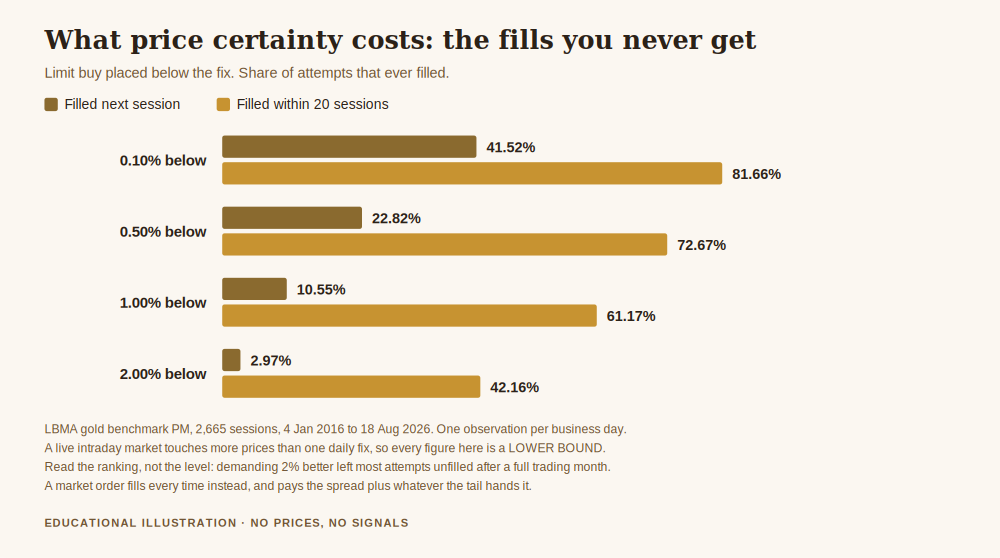
A limit 0.10 percent below filled the very next session 41.52 percent of the time, and within twenty sessions 81.66 percent of the time. Reasonable. Push it out to 0.50 percent and next session fills drop to 22.82 percent, with 72.67 percent filling inside twenty sessions. At 1.00 percent below, 10.55 percent and 61.17 percent.
At 2.00 percent below, the numbers turn brutal. The next session filled it 2.97 percent of the time. After a full trading month of waiting, only 42.16 percent had filled at all. The majority of those intended trades simply did not occur.
Note the assumption honestly, because it cuts in one direction and I would rather say so than have it discovered: this measures against one benchmark fix per business day, and a live market trades through many prices inside a day that a single daily fix never records. Real intraday fill rates are higher than these. Every figure above is a lower bound. What survives the caveat is the ranking and the shape, and the shape is unambiguous: patience is not free, it is charged in participation.
But Did Waiting Actually Buy a Better Trade?
Here is the obvious defence of the limit order, and I wanted it to be true. Yes, you miss some trades, but the ones you get are better, because you bought lower. Let us test it rather than assert it.
For every limit buy that did fill within twenty sessions, I measured what the market did over the twenty sessions after the fill, and compared it against the unconditional twenty session move across the same sample, which was 0.645 percent. One methodological note first: many different starting days resolve to the same fill session, so counting every attempt separately would count one day's outcome over and over. Each distinct fill session is counted once.
The results, as differences from that 0.645 percent baseline: at 0.10 percent below, plus 0.059. At 0.25 percent, plus 0.005. At 0.50 percent, minus 0.008. At 1.00 percent, minus 0.167. At 2.00 percent, plus 0.211.
Plus, plus, minus, minus, plus. It does not grow as you demand a better price, it does not shrink, it wanders around zero and changes sign twice. A real effect would line up in one direction as the discipline gets stricter. This one does not line up at all, which is what noise looks like when you put it in a table.
So the honest verdict, and it is not the one I expected to write: insisting on a better entry did not buy a better outcome afterwards. It bought fewer trades. At 1.00 percent below, 38.86 percent of attempts never filled inside twenty sessions. At 2.00 percent, 57.83 percent never filled. That is the entire return on the patience, and it is negative.
Which does not make the limit order bad. It makes the usual justification for it wrong. The good reason to use a limit order is control over cost and over the ugly moments, not a belief that the market rewards you for haggling.
The Tail, and Why a Stop Is a Market Order in Disguise
One more measurement, and it is the one that matters most for Protect, because it concerns the day things go wrong rather than the day they go normally.
A stop is not a third kind of order in any way that helps you. It is an instruction that becomes a market order the moment it is touched, and it hands over price certainty at the exact moment price certainty is most expensive. So the question is not how often the market moves further than your level. It is how far past your level it travels when it does.
Measured on the same sample, conditional on a session moving more than a given amount:
- Beyond 0.5 percent, which happened in 49.92 percent of sessions, the average move was 1.193 percent, an overshoot of 0.693.
- Beyond 1.0 percent, in 23.65 percent of sessions, average 1.715 percent, overshoot 0.715.
- Beyond 2.0 percent, in 5.74 percent of sessions, average 2.806 percent, overshoot 0.806.
- Beyond 3.0 percent, in 1.28 percent of sessions, average 4.139 percent, overshoot 1.139.
Look at the overshoot column, because it is doing something people find counterintuitive. It does not shrink as the level gets further out. It grows. Moving your stop further away does not buy you a proportionally gentler experience when it is finally hit, because the events out there are not just rarer, they are also bigger. The largest single session move in the sample was 7.83 percent, the 99th percentile 3.23 percent, the 95th 2.09 percent.
This is the real argument for caring about order types at all. Not the half percent you save on a normal Tuesday. The day the market moves 4 percent while you are holding a position sized as though 0.5 percent were the worst case.
What This Does Not Say
It does not say limit orders are better. The fill table is the bill for using them, and it is a real bill paid in trades that never happened.
It does not say market orders are better either. The cost table and the overshoot table are what those cost, and the overshoot table is the more dangerous of the two.
It does not tell you which to use, because that depends on whether you are entering or exiting, whether you are early or late, and whether the thing you cannot afford is a bad price or a missed move. Those are your circumstances, not mine.
Every fill figure is measured against one daily benchmark fix and is therefore lower than a live intraday market would produce. Use the ordering, not the level. And none of it is a forecast. It is a description of a sample that has already happened.
Get the free Black Gold Market blueprint, a short document on sizing a position so that the tail described above stays survivable rather than final. One email, no spam, unsubscribe anytime.
Get the free blueprint →Frequently Asked Questions
In market order vs limit order, which one should a beginner use?
Whichever one makes the mistake you can survive. A beginner using market orders will pay more than they realise and will always be in the trade. A beginner using limit orders will pay less and will miss trades, including the good ones. The second failure is cheaper, and that is the only sense in which there is a general answer.
Does a limit order guarantee I get my price?
It guarantees you will not get a worse price. It guarantees nothing about getting filled at all, which is exactly what the fill table above is measuring.
Is a stop loss a market order or a limit order?
A standard stop becomes a market order when it is touched, so it inherits every market order property including the overshoot in the last table. A stop limit will not fill worse than your number, and in a fast move that can mean it does not fill at all while the position keeps losing. Neither is free.
Why does the cost table use basis points instead of real spreads?
Because a spread belongs to a broker and an account, not to the market, and quoting someone else's spread as though it were yours would be misleading. Basis points let you find your own row.
Why measure everything in percentages instead of prices?
Because a percentage is comparable across time and across account sizes, and because a price level from a particular day tells you nothing useful and invites people to read it as a target. No gold price appears anywhere in this article.
Where did these figures come from?
I computed all of them from the published LBMA afternoon gold benchmark, 2,665 sessions from 4 January 2016 to 18 August 2026. The assumptions are listed in the disclaimer below.
Where Black Gold Market Fits
Black Gold Market is free to follow. Daily XAU/USD analysis with the level, the context and the risk stated before the trade, losing days included, plus an optional Kit for people who want the full method written down. Nothing here promises a profit and nothing here ever will.
Protect comes first, as usual. The order type only matters once the position is small enough that the tail cannot end you, which is what position sizing so one trade cannot hurt you is about. How do you calculate risk reward ratio is the companion piece to the overshoot table, because a ratio measured against a stop the market steps over is not a ratio. Why managing the trade matters more than the entry makes the case that this whole argument is smaller than people think it is. And how to protect your capital when gold gets volatile is where the habit is written out in full.
About the author. Raphael writes Black Gold Market. He works on the part of this business that happens before the trade, the level, the context, and the risk, and on the conviction that a method you can follow through a quiet quarter is worth more than a better one you cannot.
Disclaimer: This article is general educational content about order types and their measurable costs. It is not financial advice and not a suggestion to open any particular position. Trading gold, CFDs and leveraged products carries a high risk of losing money rapidly. No entry, stop or target discussed should be treated as a signal. Every figure was computed by me from the published LBMA gold benchmark, afternoon fix, across the 2,664 steps between the 2,665 published sessions from 4 January 2016 to 18 August 2026, using closing benchmark values only, with no intraday data and no dealing costs. Because the sample contains one observation per business day, the fill rates are lower bounds: a live intraday market touches prices that a single daily fix never records, so real fill rates are higher and only the ordering between distances should be read. Fills assume no partial execution, no queue position, no order expiry and no cancellation. The round turn costs in the cost table are stated assumptions expressed in basis points of notional, not quotes from any broker. The forward outcome comparison counts each distinct fill session once rather than once per attempt, because overlapping windows would otherwise count a single session's outcome many times. No gold price is quoted anywhere in this article and no trading results are represented. Past behaviour of a public benchmark is not a prediction.