

Two rings sit in the same case. One is stamped 18K, the other 22K, and the 22K one costs more. A reasonable person concludes that higher is better and pays the difference. Sometimes that is the right call and sometimes it is money handed over for a property you will never use, so the honest answer to is higher k gold better is that it depends entirely on whether you are buying metal or buying an object. Those are two different purchases, and the karat mark serves them in opposite directions.
What the karat mark actually measures
Karat is a ratio, not a grade. A karat mark of k means k parts gold in 24 parts of alloy, measured by weight. That is the whole definition, and everything else follows from dividing by 24.
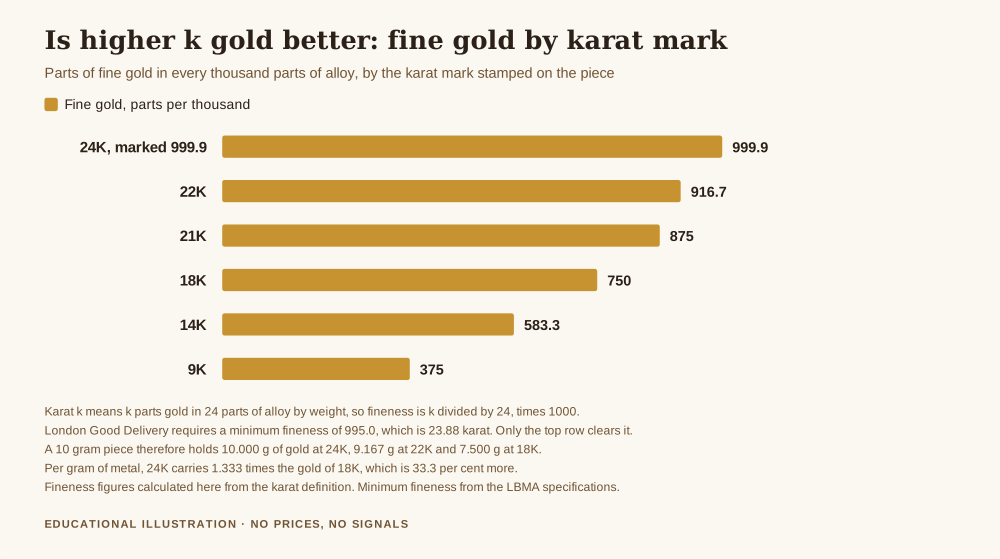
So 18K is 18 parts in 24, which is 750 parts of gold in every thousand parts of metal. That is why you see 750 stamped on European pieces where an American piece says 18K. They are the same statement in two notations, and neither one is telling you anything about craftsmanship, brand, or whether the price is fair. It is a purity measurement and nothing more.
Run the division across the marks you will actually meet:
- 24K is 999.9 fine in practice, which is 99.99 per cent gold
- 22K is 916.7 fine, so 91.67 per cent gold
- 21K is 875.0 fine, common in the Gulf markets
- 18K is 750.0 fine, three quarters gold
- 14K is 583.3 fine, a little over half
- 9K is 375.0 fine, which is more alloy than gold
Note that 24K is quoted as 999.9 rather than 1000. Pure gold in a commercial sense means four nines, not a perfect absence of everything else, because the last fraction of a part per thousand cannot be refined away at any sensible cost.
Is higher k gold better, and better at what
Split the question in two and it answers itself.
If you are buying gold as a store of value, then yes, higher is better, and the reason is not aesthetic. You are buying metal by weight, so a higher karat means more of what you came for in every gram you carry home. Anything below 24K means you are also buying copper, silver or zinc at the price of a gold transaction.
If you are buying an object to wear, higher is frequently worse. Pure gold is soft enough to deform against a desk edge. The alloy metals in 18K and 14K exist precisely to make the piece survive being worn, and a 24K ring is a piece of jewellery that will record every day of its life on its surface. Here the lower karat buys hardness, and hardness is the property you actually need.
The two cases pull in opposite directions, which is why "better" cannot be answered without saying better for what. The mistake worth avoiding is paying investment logic for an object you intend to wear, or wearing logic for metal you intend to hold.
The line the investment market draws, and where it falls
The wholesale market settles this with a number. The LBMA technical specifications for a London Good Delivery gold bar require a minimum acceptable fineness of 995.0 parts per thousand fine gold, on a bar holding between 350 and 430 fine troy ounces, which is roughly 10.9 to 13.4 kilograms.
Convert that threshold back into karat and it sits at 23.88K. Read the table again against that line and something becomes clear: of every karat mark in common use, only 24K clears it. Even 22K, which most people think of as very pure gold, is 916.7 fine and falls well short of the wholesale standard.
That does not make 22K bad. It means 22K is a retail format rather than a wholesale one, and it will be priced, resold and refined through different channels than a good delivery bar. If your plan involves eventually selling metal into the professional market, the karat mark decides which door you are walking through, and that is worth knowing before you buy rather than after. The same logic sits behind what a 10 tola bar is, where the format is familiar at retail and unknown at wholesale.
Most of the world's gold is not investment grade, and that is deliberate
It helps to see where the metal actually sits. The World Gold Council puts the total above ground stock at 224,200 tonnes at the end of the third quarter of 2026. Of that, roughly 98,700 tonnes is jewellery, which is 44 per cent of all the gold ever mined. Bars and coins account for about 48,100 tonnes, or 21 per cent. Central banks hold around 39,300 tonnes, 18 per cent, and gold exchange traded funds about 4,300 tonnes, which is 2 per cent.
So the single largest use of gold on earth is the one where lower karats dominate, and it has been that way for centuries. Jewellery is not a lesser form of gold that people settle for. It is the application the alloying was invented to serve. The 44 per cent figure is a useful corrective to the idea that 24K is simply the correct answer and everything else is a compromise.
The investment share, bars and coins plus central banks plus funds, is where the purity discipline lives, and it is a minority of the metal by weight.
What the karat difference costs you, gram for gram
Now the arithmetic that should drive the decision. Take a 10 gram piece and ask how much gold is inside it:
- at 24K, 10.000 grams of gold
- at 22K, 9.167 grams
- at 21K, 8.750 grams
- at 18K, 7.500 grams
- at 14K, 5.833 grams
- at 9K, 3.750 grams
Gram for gram of metal, 24K carries 1.333 times the gold of 18K, which is 33.3 per cent more. Turn it around and the number gets sharper: to end up owning 10 grams of actual gold you need 13.33 grams of 18K, or 10.91 grams of 22K.
This gives you a test you can run in a shop without a calculator argument. Divide the asking price by the fine gold content rather than by the gross weight. A 10 gram 18K piece and a 7.5 gram 24K piece contain exactly the same quantity of gold, so if the 18K piece costs meaningfully more than the 24K one, you are paying for workmanship, brand, or nothing at all. That is a legitimate thing to pay for, as long as you know that is what you are doing.
The failure mode is comparing two pieces by their sticker price and their gross weight while ignoring the stamp, which is the same error as comparing a tola price with a gram price. Weight without fineness is not a quantity of gold. It is a quantity of alloy.
Where higher karat stops helping
Three places, and they are all worth checking before you decide purity is the only axis.
Premium over metal value. Small 24K items often carry a larger percentage premium than larger ones, because minting and handling costs are spread over less metal. A high purity piece bought at a heavy premium can hold less value than a lower purity piece bought near the metal price. Purity and price are separate questions, and the premium is where most of the money is actually won or lost.
Resale in your own market. The format that resells cleanly is the one your local market considers standard. In much of South Asia and the Gulf, 22K and 21K are the normal investment formats and move easily. Buying 24K into a market that prices 22K can mean a wider spread when you sell, which quietly eats the extra purity you paid for.
Durability, if the thing will be worn. A 24K chain will stretch and a 24K ring will scar. If the object is going to live on a body rather than in a safe, the alloy is doing necessary work, and insisting on purity buys you a piece that needs protecting from ordinary life.
Reading a piece before you pay for it
Four steps, in order, and none of them require equipment.
- Find the stamp and read it as a number. 750 and 18K are the same claim. If there is no fineness mark at all, you are being asked to take the purity on trust, which is a different transaction from the one you thought you were in.
- Multiply gross weight by fineness. That product is the fine gold content, and it is the only part of the object a refiner will ever pay you for.
- Divide the price by the fine gold content, not the gross weight. This single division makes every piece in the case directly comparable, whatever the karat mark says.
- Ask the buy back spread before you pay. A dealer who will quote you the sell side price today is telling you what the piece is really worth to you. One who will not has answered the question anyway.
If the stamp itself is what you are unsure about, getting gold tested for purity covers the methods a buyer can actually use, and the difference between hallmarked and non hallmarked gold explains who is standing behind the number when a piece is marked.
Get the free Black Gold Market blueprint, a one page guide to protecting capital before trying to grow it, including the habit of pricing a purchase by its fine content rather than by its sticker weight. One email, no spam, unsubscribe anytime.
Get the free blueprint →Frequently asked questions
Is higher k gold better for investment specifically?
For holding metal, yes, because you are buying gold by weight and a higher karat means less of the purchase is other metals. The practical caveat is the premium. A 24K item bought at a steep markup can be a worse store of value than a 22K item bought close to the metal price, so purity settles what is inside the object and the premium settles what you paid for it.
What is the difference between 24K and 999.9 gold?
They describe the same thing in different notations. 24K is the karat form, 999.9 is the fineness form, meaning 999.9 parts of gold in every thousand. You will see both on bars and coins, sometimes together, and neither is a higher grade than the other.
Is 22K gold good enough to be investment gold?
It is widely held as investment gold, particularly in South Asia and the Gulf, but it does not meet the wholesale standard. At 916.7 fine it falls short of the 995.0 minimum the LBMA specifications require for a London Good Delivery bar. In practical terms that means it trades in retail channels rather than professional ones, which usually shows up as a wider buy back spread.
Why is 24K gold not used for most rings?
Because it is soft. Pure gold deforms and scratches under ordinary wear, so a ring meant to be worn daily is normally alloyed to 18K or 14K to give it hardness. The alloy metals are doing structural work rather than diluting the piece to save money, although they do that too.
How do I compare an 18K piece with a 24K piece on price?
Multiply each piece's gross weight by its fineness to get the fine gold content, then divide the asking price by that figure. A 10 gram 18K piece holds 7.500 grams of gold and a 7.5 gram 24K piece holds 7.499 grams, so the two are the same quantity of metal. Any price difference between them is workmanship and margin.
Does a higher karat mean the gold will hold value better?
Not by itself. Value retention depends on the premium you paid, the spread your market charges to buy it back, and the format being one local dealers handle routinely. Purity determines how much metal is in the object, and those three other factors determine how much of the metal's value you get back when you sell.
Where this leaves you
The short answer to is higher k gold better is that higher karat means more metal and less object. For a bar or a coin that is exactly what you want and 24K is the right answer. For something that will be worn, the alloy is a feature and 18K or 14K is the right answer. The expensive mistake is not choosing wrong, it is choosing without doing the one division that tells you how much gold you are actually buying.
The minimum acceptable fineness of 995.0 parts per thousand and the good delivery range of 350 to 430 fine troy ounces are from the LBMA good delivery technical specifications. The above ground stock of 224,200 tonnes and the splits of roughly 98,700 tonnes of jewellery at 44 per cent, 48,100 tonnes of bars and coins at 21 per cent, 39,300 tonnes held by central banks at 18 per cent and 4,300 tonnes in exchange traded funds at 2 per cent, as at the end of the third quarter of 2026, are from the World Gold Council's how much gold data page. The fineness figures of 999.9, 916.7, 875.0, 750.0, 583.3 and 375.0, the karat equivalent of 23.88K for the 995.0 threshold, the fine contents of 10.000, 9.167, 8.750, 7.500, 5.833 and 3.750 grams in a 10 gram piece, the 1.333 times ratio and 33.3 per cent figure, and the 13.33 and 10.91 gram equivalents were all calculated here from the karat definition of k parts in 24 by weight. No gold price was used anywhere in this article, which is why the ratios hold whenever you read it.
If you want the layer underneath this one, protecting your capital when gold gets volatile is where the sizing of any gold position gets decided, and the difference between real and fake gold covers the case where the stamp itself is the thing in question.
Black Gold Market publishes daily gold analysis with the level, the context and the risk written out, and the free blueprint above is the one page version of the capital rules used here. Following along is free, the Kit is optional, and nothing here promises a profit.
About the author. Raphael writes Black Gold Market around three ideas in a fixed order: protect, master, grow. Capital that survives the bad month is the only capital that gets to compound, and the published work shows the level, the context, and the risk so you can judge the reasoning yourself. This is education and not financial advice, and no entry, stop or target discussed should be treated as a signal.