

Ask about the difference between hallmark and non hallmark gold and you will usually be told that one is real and the other is not. That answer is wrong in both directions, and both directions cost money. A hallmark is a legal mark applied by an independent assay office, not a verdict you can read off the metal itself, and British law lists whole categories of genuine gold article that are allowed to carry no mark at all. Knowing which is which is the difference between walking away from a legitimate piece and paying a 22 carat rate for metal that holds 18.18 percent less fine gold than you assumed.
The difference between hallmark and non hallmark gold, stated plainly
Hallmarked gold has been sent to an assay office, tested independently of whoever is selling it, and struck with a set of marks. One of those marks is a number stating the fineness of the metal in parts per thousand. Non hallmarked gold has not been through that process. That is the entire difference. It is a statement about process, not about honesty.
The reason the distinction matters is the identity of the person making the claim. On an unmarked piece, the only party telling you what the metal is, is the party who wants your money. On a hallmarked piece, a third party with no stake in the sale has tested the metal and put its own mark next to the number. You are not being asked to trust the seller. You are being asked to trust an assay office, and assay offices can be identified and checked.
That is a meaningful upgrade, and it is also a narrow one. The mark speaks about the metal. It does not speak about the price, the weight you are being charged for, the stones, or whether the person holding it came by it honestly.
What a hallmark actually is
In the United Kingdom, hallmarking runs on the Hallmarking Act 1973. The compulsory part of a modern UK hallmark is three marks struck together: the sponsor's mark, which identifies who submitted the article, the fineness mark, which is a number in parts per thousand, and the assay office mark, which identifies which office did the testing.
The fineness number is the one that carries all of the arithmetic. Everything else on the mark tells you who was involved. The number tells you what you are holding. A piece marked 750 is telling you that 750 parts out of every thousand, by weight, are gold, and the other 250 are something else, usually copper and silver in a mix chosen for colour and hardness.
This is why the number matters more than the carat word people actually use in conversation. Carat is a ratio out of 24 and it rounds. Parts per thousand is the figure the law works in, and it is the figure that multiplies cleanly against a weight.
The fineness standards the law actually uses
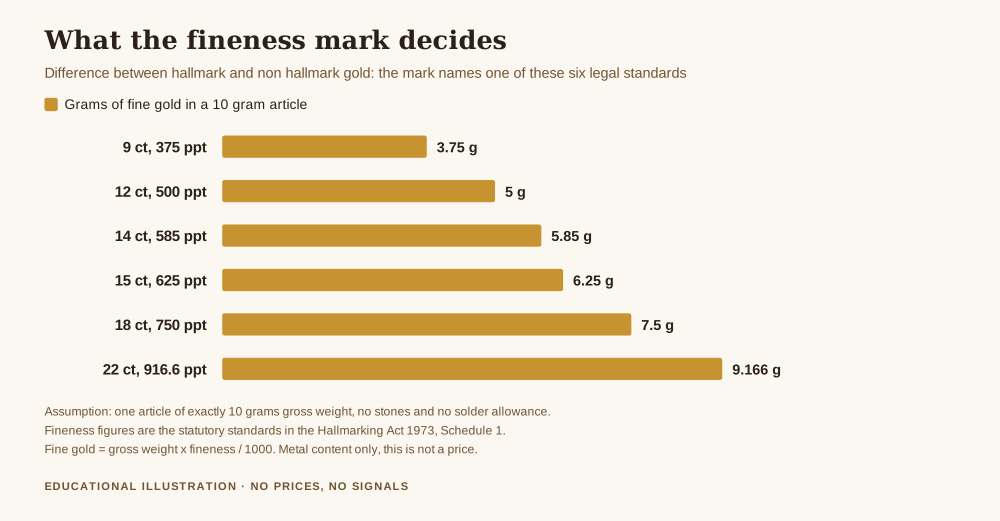
Schedule 1 of the Act sets out exactly how many parts per thousand each carat figure means. The table is short and worth knowing by heart, because the whole market talks in carats while every calculation happens in thousandths:
- 9 carat is 375 parts per thousand
- 12 carat is 500 parts per thousand
- 14 carat is 585 parts per thousand
- 15 carat is 625 parts per thousand
- 18 carat is 750 parts per thousand
- 22 carat is 916.6 parts per thousand
Run those against a single gross weight and the spread becomes concrete. Take an article of exactly 10 grams, with no stones and no allowance for solder, purely so the arithmetic stays visible. At 9 carat it holds 3.75 g of fine gold. At 14 carat, 5.85 g. At 18 carat, 7.5 g. At 22 carat, 9.166 g. Same object on the scale, same weight on the receipt, and nearly three times the gold content from one end of the table to the other. If you want the unit underneath that sum, it is set out in how many grams equal a troy ounce of gold, and the specific mark most people meet first is explained in what 750 means stamped on a gold chain.
Why a genuine gold article can legally carry no mark
This is the part that reverses most people's assumption, and it is the most useful thing in this article. The same Schedule that sets the fineness standards also lists articles that are exempt from being hallmarked at all. Three of those exemptions turn up constantly in real life.
Weight. An article of gold below a threshold weight does not require a hallmark. For gold that threshold is 1 gram. For silver it is 7.78 grams, for platinum 0.5 gram, and for palladium 1 gram. A fine gold chain, a small pair of earrings, a thin charm, any of these can weigh less than a gram, and an unmarked example of one is not evidence of anything at all.
Age. Articles manufactured before 1950, that assay at not less than 375 parts per thousand in all their gold parts, and that have not been altered since, are exempt. A great deal of genuine antique jewellery carries no UK hallmark for exactly this reason.
Destination. An article intended for despatch to a destination outside the United Kingdom is exempt. So is an article that is already outside the UK.
Absence of a hallmark is not proof of fake. It is an absence of proof, which is a different and much weaker statement.
That distinction is the practical core of the whole question. A missing mark moves an item from the verified pile into the unverified pile. It does not move it into the fake pile. What you have lost is independent confirmation, and the correct response is to go and get some, not to assume the worst or, far more dangerous, to assume the best.
The arithmetic of guessing wrong
Here is why the unverified pile deserves respect. The fineness standards sit close enough together in appearance that the eye is useless, and far enough apart in content that the error is expensive.
Compare 22 carat at 916.6 against 18 carat at 750. An 18 carat article holds 18.18 percent less fine gold than a 22 carat article of the same gross weight. Turn that around to the side you actually pay on, and it is worse: paying a 22 carat rate for an article that is really 18 carat means overpaying for the metal present by 22.21 percent. The two percentages are different because they are measured against different bases, and the one that applies to your wallet is the larger one.
Stretch it to the ends of the table and it stops being a rounding question. A 9 carat article holds 59.09 percent less fine gold than a 22 carat one. Pay a 22 carat rate for 9 carat metal and you have overpaid for the metal present by 144.43 percent. Those figures are ratios of metal content computed from the statutory table, nothing more. They are not forecasts, and they say nothing about what any item should sell for.
Notice what the mark is doing in that calculation. It is not making you money. It is removing a term from the equation that you otherwise have to guess, and guesses in this range are not small. This is the same logic that runs through how to protect your capital when gold gets volatile: you do not get paid for carrying uncertainty you could have cheaply removed.
What a hallmark does not tell you
Four limits, and each of them has caught someone.
It does not state the weight. The mark certifies fineness, not mass. Fine gold content is fineness times gross weight, and you supply the second number yourself with a scale. A correct mark on an item weighed generously in the seller's favour still leaves you short.
It does not cover everything in the object. Stones, clasps, pins and fittings are not necessarily part of what was assayed. On a piece where the stones carry most of the asking price, the gold mark is answering a question nobody was really asking.
It does not prove the mark itself is genuine. Marks can be counterfeited, and a struck mark has a depth and crispness that a laser or cast copy usually lacks. If the mark is the only thing standing between you and a large payment, the mark is exactly what a forger would work on. The broader version of this problem is in the difference between real and fake gold, and the behavioural warning signs are collected in how to spot a gold trading scam.
It says nothing about price. A hallmark is a statement about composition. It is not a valuation, and it carries no promise that anyone will buy the item from you later at any particular figure.
For bars rather than jewellery the equivalent document is a card rather than a struck mark, and it has its own set of limits, laid out in what an assay card for gold actually certifies.
What to do with an unmarked piece
Treat it as untested, then test it. An unmarked article can be submitted to an assay office and hallmarked, and that is the clean answer whenever the value involved is worth the fee. Short of that, non destructive testing exists and is widely available. What you should not do is let the absence of a mark become an argument, in either direction, conducted entirely inside your own head.
The failure that costs real money is not misreading a mark. It is paying a verified price for unverified metal, because the seller was pleasant and the piece looked right and asking felt rude. A seller dealing honestly has no reason to resist independent testing. A reaction to that request is information in itself.
Get the free Black Gold Market blueprint, a one page guide to protecting capital before trying to grow it, in the kind of market this article describes. One email, no spam, unsubscribe anytime.
Get the free blueprint →Frequently asked questions
Is non hallmarked gold fake?
No. A missing hallmark means the article has not been independently tested and marked in the UK system. Several categories of genuine gold are exempt by law, including gold articles weighing under 1 gram and pieces made before 1950. The mark's absence removes proof, it does not supply proof of the opposite.
What does the number on a hallmark actually mean?
It is the fineness in parts per thousand. 750 means 750 parts of every thousand by weight are gold. The statutory equivalents are 375 for 9 carat, 500 for 12, 585 for 14, 625 for 15, 750 for 18 and 916.6 for 22 carat.
Which gold articles are exempt from hallmarking?
The main everyday exemptions are articles of gold weighing less than 1 gram, articles manufactured before 1950 that assay at 375 parts per thousand or better in all gold parts and have not been altered since, and articles intended for despatch outside the United Kingdom.
How much does getting the carat wrong actually cost?
Measured on metal content alone, an 18 carat article holds 18.18 percent less fine gold than a 22 carat one of equal weight, and paying the 22 carat rate for it means overpaying for the metal present by 22.21 percent. At the far end, 9 carat against 22 carat is 59.09 percent less fine gold and a 144.43 percent overpayment.
Can I have an unmarked item hallmarked?
Yes. An assay office can test and mark an article, for a fee. Whether that is worth doing is a straightforward comparison between the fee and the value at stake, and the larger the item, the more obviously it is worth doing.
Does a hallmark tell me what a piece is worth?
No. It certifies composition, not value. Fine gold content still needs the weight, which you take yourself, and what anyone will pay is a separate question again, so no entry, stop or target discussed should be treated as a signal.
Where this leaves you
The useful version of the difference between hallmark and non hallmark gold is not real against fake. It is tested against untested. A hallmark hands you one number, fineness, confirmed by somebody who is not selling you anything. You still bring the scale, the arithmetic and the judgement. An unmarked piece hands you nothing and asks you to supply the number yourself, which is fine if you test it, and expensive if you guess.
The foundation under this piece is how to protect your capital when gold gets volatile. Beside it, the mark most people meet first is decoded in what 750 means stamped on a gold chain, the testing question is in the difference between real and fake gold, the bar market equivalent is in what an assay card for gold certifies, and the mineral that fools the eye most often is in the difference between gold and pyrite.
The fineness table and the exemptions quoted here are set out in the Hallmarking Act 1973, Schedule 1, which lists both the carat to parts per thousand conversions and the categories of exempted article, with the prohibition on describing unhallmarked articles as gold in section 1. Both are worth reading once, because they are shorter and clearer than most of what is written about them.
About the author. Raphael writes Black Gold Market around three ideas in a fixed order: protect, master, grow. The order is the point, because the traders who last are the ones who treated capital as the thing to be defended before it was the thing to be grown. Everything here is education, not advice, and nothing on this site is a recommendation to buy or sell any instrument. Read what is written, then make the decision for yourself, with the level, the context, and the risk in front of you, and no entry, stop or target discussed should be treated as a signal.