

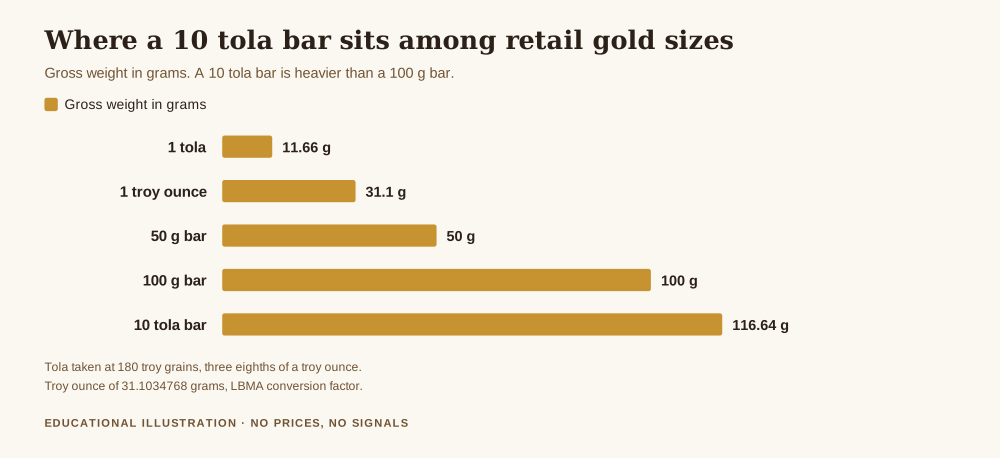
A shop quotes you a price per tola, a second shop quotes per gram, and a third quotes per ounce. All three are selling the same metal, and you cannot compare any of them until you know what weight you are agreeing to. So the useful answer to what is 10 tola of gold is a number you can carry around: 116.638 grams, which is exactly 3.75 troy ounces. That is heavier than a 100 gram bar, which is the detail that catches people out, because the two sit side by side in a display case and look almost identical.
What is 10 tola of gold, in grams and in ounces
The tola is a traditional South Asian unit of weight, and it survived into the modern bullion trade because the retail market in India, Pakistan, Bangladesh and the Gulf never stopped quoting in it. Its definition is borrowed from the troy system rather than the metric one. One tola is 180 troy grains, and since there are 480 troy grains in a troy ounce, a tola is exactly three eighths of a troy ounce.
That single fact does all the work. The LBMA publishes the conversion the whole wholesale market uses, one troy ounce equal to 31.1034768 grams, so the rest is arithmetic:
- 1 tola = 0.375 troy ounces = 11.6638 grams
- 10 tola = 3.75 troy ounces = 116.638 grams
- 1 kilogram = 85.735 tola
Round 10 tola to 116.64 grams and you will never be more than a hundredth of a gram out. Against a 100 gram bar, a 10 tola bar carries 16.638 grams more metal, which is 16.64 per cent more. If a dealer offers you a choice between the two at prices that differ by less than that, the cheaper looking one is not the cheaper one.
Why a tola is three eighths of an ounce and not a round metric number
The tola was the weight of a silver rupee coin, and coin weights were set in grains long before the metric system reached the subcontinent. When the bullion trade modernised, the unit was not redefined, it was simply pinned to the troy ounce at the ratio it already had. That is why the gram figure is such an awkward 11.6638 and never resolves into something tidy.
The practical consequence is that a tola price and a gram price are never directly comparable by eye. You have to divide. A reader who buys in both markets told me the habit that fixed it for him was writing the three conversions on a card and keeping it in his wallet, because a shop is a bad place to do mental arithmetic under a salesperson's attention.
The 10 tola bar as a physical object
Ten tola is not an arbitrary multiple. The 10 tola bar, often called a TT bar or a ten tola biscuit, is one of the oldest and most widely traded small bar formats in the world, and it is the standard retail and wholesale unit across much of South Asia and the Middle East. It is typically cast rather than minted, which gives it the slightly rough, rounded shape people associate with the format, and it is usually produced at a fineness of 999.0 rather than the 999.9 common on modern minted bars.
That difference in fineness is not a defect. It is the convention the format grew up with, and it is declared on the bar. What matters is that you read it rather than assume it, because the fineness, not the gross weight, is what you are actually buying.
Fine gold content, which is the number you are paying for
Gross weight is the weight of the bar. Fine gold content is the weight of gold inside it, and it is gross weight multiplied by fineness. On a 10 tola bar of 116.638 grams:
- at 999.9 fineness, the bar holds 116.6264 grams of fine gold
- at 999.0 fineness, it holds 116.5214 grams
- at 995.0 fineness, it holds 116.0548 grams
The gap between the first two is 0.1050 grams. That is a real difference and it is worth knowing about, but notice the proportion: moving from 999.9 to 999.0 costs you about nine hundredths of one per cent of the gold. Compare that with the 16.64 per cent difference between a 10 tola bar and a 100 gram bar, and you can see where the attention belongs. People argue about the fourth decimal of fineness and then mix up the bar size, which is roughly a hundred and sixty times the larger error.
Protect first means getting the big number right before polishing the small one.
How a 10 tola bar relates to the wholesale market
It helps to see where the retail format sits relative to the bars that clear the professional market. The LBMA good delivery technical specifications set a minimum acceptable fineness of 995.0 parts per thousand fine gold, and a gold content between 350 and 430 fine troy ounces, which is roughly 10.9 to 13.4 kilograms.
At 3.75 troy ounces apiece, it takes 93.3 ten tola bars to match the smallest acceptable good delivery bar. The two formats are not competing with each other. One is a wholesale settlement unit that moves between vaults, the other is a retail unit sized so an ordinary household can buy one. Knowing the ratio is useful mainly as a reality check on anyone who tells you a small bar is somehow the same product as a London bar.
The retail end is not a rounding error in the market either. The World Gold Council put total gold demand at 1,369 tonnes in the third quarter of 2026, with bar and coin demand of 268 tonnes, and India alone at 162 tonnes. Much of that physical buying happens in exactly the formats described here.
What the stamp on the bar is telling you
A cast 10 tola bar carries less information on its face than a modern minted bar, and the information it does carry is the part worth reading. You are looking for four things, and their absence matters more than their exact wording.
- The refiner's name or mark. This is what connects the bar to an accountable producer. A bar from a refiner on a recognised accreditation list resells more easily than one from a name nobody can look up.
- The fineness. Usually expressed as 999.0 or 995.0 on this format, sometimes as 24K. If it says 24K and nothing else, ask for the number, because 24K is a description rather than a measurement.
- The weight. On a tola bar this is often marked in tola rather than grams, which is exactly the ambiguity this article exists to remove.
- A serial number, on newer bars. Older cast bars frequently have none, and that is normal for the format rather than a warning sign by itself.
What you cannot read off the face is whether the interior matches the surface, and no amount of staring will tell you. That is what an assay is for, and it is also why the chain of custody, meaning who you bought it from and what they will take it back at, carries real weight in the physical market. A bar you bought from a dealer who will quote you a buy back price today is a different proposition from an identical bar with no route back to a buyer.
One more habit worth forming: weigh the bar yourself on a scale that reads to a hundredth of a gram. A 10 tola bar should come in at 116.64 grams give or take the refiner's tolerance. If it reads 100.00, you are holding a 100 gram bar, whatever the person selling it called it.
Reading a tola quote in four steps
This is the whole method, and it takes less than a minute.
- Convert to grams first. Multiply tola by 11.6638. Do this before you look at any price, so the price lands on a weight you already understand.
- Read the fineness off the bar. It will be stamped. Multiply gross grams by fineness to get fine gold content.
- Divide the asking price by the fine gold content. Now you have a price per gram of actual gold, and every shop in town is suddenly comparable.
- Ask what the buy back spread is before you pay, not after. A format that is standard in your local market will usually be easier to sell than one that is not, and that liquidity is part of what you are buying.
None of these steps needs the gold price to be any particular number, which is why the method still works whenever you happen to read this.
Get the free Black Gold Market blueprint, a one page guide to protecting capital before trying to grow it, including the habit of converting a quote to a weight you understand before you agree to it. One email, no spam, unsubscribe anytime.
Get the free blueprint →Frequently asked questions
What is 10 tola of gold in grams?
116.638 grams, or 116.64 grams rounded. It comes from the tola being 180 troy grains, three eighths of a troy ounce, and a troy ounce being 31.1034768 grams. Ten of them is exactly 3.75 troy ounces.
Is a 10 tola bar bigger than a 100 gram bar?
Yes, by 16.638 grams, which is 16.64 per cent more metal. The two look similar in a display case, so this is worth checking rather than assuming. A price difference smaller than 16.64 per cent means the 10 tola bar is the better value on weight alone, before you consider fineness and spread.
What fineness is a 10 tola bar usually?
Commonly 999.0 rather than the 999.9 seen on many minted bars. On a 116.638 gram bar that is a difference of 0.1050 grams of fine gold, under a tenth of one per cent. Read the stamp rather than assuming either figure.
How many tola are in a kilogram of gold?
85.735 tola. The number is untidy for the same reason the gram figure is untidy, because the tola is defined through the troy system rather than the metric one.
Why do dealers still quote in tola?
Because the retail market they serve has always quoted in it, and the unit is familiar to the household buying the metal. It is a pricing convention, not a quality signal. A tola quote tells you nothing about the bar beyond the weight you are being priced on.
Is a 10 tola bar accepted in the wholesale market?
Not as a good delivery bar. The LBMA specification calls for 350 to 430 fine troy ounces at a minimum fineness of 995.0, and it takes 93.3 ten tola bars to reach the lower end of that range. The retail format is sold on and refined through different channels, which is one reason the buy back spread differs.
Where this leaves you
The short version of what is 10 tola of gold is 116.638 grams, 3.75 troy ounces, and about 16.6 per cent more metal than the 100 gram bar it sits beside. Everything else follows from reading the fineness and doing one division. The traders who get hurt in physical gold are almost never the ones who paid a slightly wide premium. They are the ones who compared a tola price with a gram price and never noticed they were comparing two different weights.
The troy ounce conversion of 31.1034768 grams and the kilogram figure of 32.1507465 troy ounces are from the LBMA glossary. The good delivery minimum fineness of 995.0 and the range of 350 to 430 fine troy ounces are from the LBMA good delivery technical specifications. The demand figures of 1,369 tonnes total, 268 tonnes bar and coin and 162 tonnes for India in the third quarter of 2026 are from the World Gold Council's Gold Demand Trends. The tola figures of 11.6638 and 116.638 grams, the 85.735 tola in a kilogram, the fine contents of 116.6264, 116.5214 and 116.0548 grams, the 0.1050 gram gap, the 16.64 per cent difference and the 93.3 bars were all calculated here from those published specifications, taking the tola at its traditional definition of 180 troy grains. No gold price was used anywhere in this article, which is why the ratios hold whenever you read it.
If you want the weight side of this in a different unit, we have already walked through how many grams equal a troy ounce of gold, and the format question itself in buying gold coins versus gold bars. If the volatility of the metal rather than the weight of it is what concerns you, start with protecting capital when gold gets volatile.
Black Gold Market publishes daily gold analysis with the level, the context and the risk written out, and the free blueprint above is the one page version of the capital rules used here. Following along is free, the Kit is optional, and nothing here promises a profit.
About the author. Raphael writes Black Gold Market around three ideas in a fixed order: protect, master, grow. Capital that survives the bad month is the only capital that gets to compound, and the published work shows the level, the context, and the risk so you can judge the reasoning yourself. This is education and not financial advice, and no entry, stop or target discussed should be treated as a signal.