

The question of how to get gold tested for purity has four serious answers, and they do not measure the same thing. One reads the surface, one destroys a sample to measure the whole, one is a legal guarantee made by a third party, and one is arithmetic you can do at a kitchen table with a scale. Knowing which answer you need matters more than knowing the methods, because the cheapest test in the list will confidently pass a bar that the most expensive one would reject.
How to get gold tested for purity, the four routes
Start with what each route actually is, because the names get used loosely.
An assay office hallmark is a legal statement by an independent body that a piece meets a declared standard of fineness. In the United Kingdom it is a criminal matter to describe an article as gold in the course of trade without one, subject to exemptions. You are not buying a measurement, you are buying a third party's liability for that measurement.
X ray fluorescence, usually written XRF, is the handheld gun a dealer points at your ring. It excites the atoms in the surface and reads what comes back. It is fast, it is not destructive, and it is the standard first test in the trade. Its weakness is structural rather than a matter of quality: it reads a thin surface layer and reports what it finds there.
Fire assay is the oldest method still in professional use and remains the referee. A sample is cut from the item, melted with lead and a flux, driven off in a furnace until only precious metal remains, and weighed. It consumes the sample and answers the question completely, which is the trade it offers.
Density, or specific gravity, is the one you can do yourself. Weigh the item dry, weigh it suspended in water, and the difference gives you volume. Mass divided by volume is density, and density is a property of the whole object rather than its skin.
What the stamp on your gold already claims
Before paying for a test, read what the item says about itself. In the United Kingdom the legal standards of fineness for gold are set out in Schedule 2 of the Hallmarking Act 1973 as six numbers: 375, 585, 750, 916.6, 990 and 999, expressed in parts per thousand. Those map onto the carat language most people use, 375 being 9 carat, 585 being 14 carat, 750 being 18 carat and 916.6 being 22 carat. In India the same 916 figure is the familiar stamp for 22 carat under the Bureau of Indian Standards hallmarking scheme.
Translate a stamp into metal and it stops being abstract. Assuming the stamp is honest and the piece is evenly alloyed, a 10 gram item contains:
- at 999 fine, 9.990 g of gold and 0.010 g of other metal
- at 916.6, the 22 carat stamp, 9.166 g of gold and 0.834 g of other metal
- at 750, 18 carat, 7.500 g of gold and 2.500 g of other metal
- at 585, 14 carat, 5.850 g of gold and 4.150 g of other metal
- at 375, 9 carat, 3.750 g of gold and 6.250 g of other metal
A 9 carat chain is well under half gold by weight. That is not a trick, it is the declared standard, and it is the first thing to establish before you pay anyone to measure anything.
The density test, and exactly where it fails
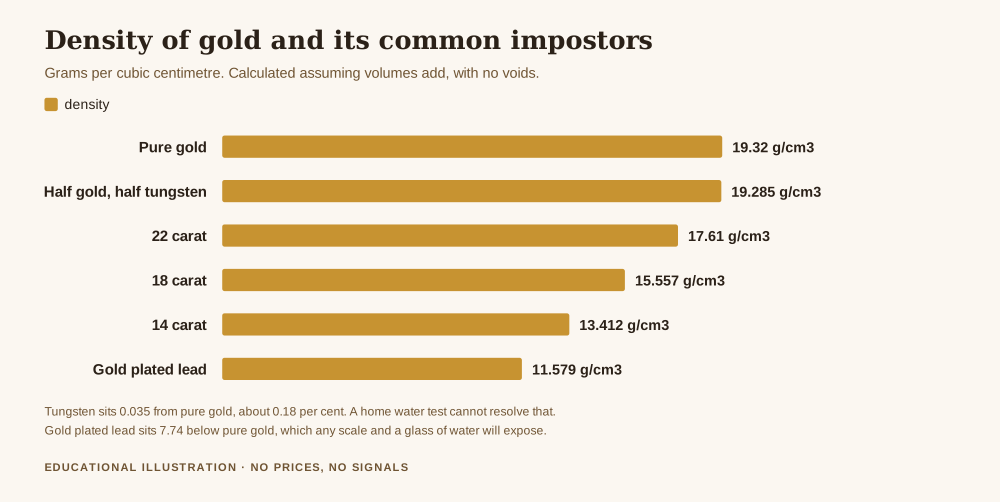
Here is where arithmetic beats intuition. Pure gold has a density of 19.32 grams per cubic centimetre. I calculated the density of several common alloys and two kinds of fake, assuming the volumes of the component metals simply add with no voids, which is close enough for this purpose:
- pure gold, 19.320 g/cm³
- 22 carat, 91.6 per cent gold with copper, 17.610
- 18 carat, 75 per cent gold with silver and copper, 15.557
- 14 carat, 58.5 per cent gold with copper and silver, 13.412
- a half gold, half tungsten blend by mass, 19.285
- gold plated lead, 5 per cent gold over a lead core, 11.579
Read the fourth and fifth lines together and the whole problem appears. Gold plated lead sits 7.74 g/cm³ below pure gold, a gap so wide that a kitchen scale and a glass of water will expose it immediately. The tungsten blend sits 0.035 g/cm³ from pure gold, a difference of about 0.18 per cent. No home density test resolves that. Tungsten is the one metal whose density is close enough to gold to defeat the method, which is precisely why it is the metal used in the serious frauds.
So the honest summary is this. A density check is genuinely useful and almost free, and it will catch plated base metal, hollow pieces and badly underkarated items. It will not catch a competent tungsten substitution, and anyone who tells you otherwise has not done the arithmetic.
That is also why the method you choose should follow the thing you are actually worried about, a habit that runs through everything written here about telling real gold from fake.
Why fire assay is still the referee
XRF's surface limitation and density's tungsten blind spot have the same solution, and it is an old one. Fire assay takes a sample from within the item, not from its skin, and reduces it to metal that can be weighed. A drilled or cut sample from the core is the only way to answer a question about the core.
The cost is obvious: a hole, or a cut, in something you may not want damaged. For a wedding ring the test is worse than the doubt. For a kilogram bar bought from a stranger, a small drill mark is a cheap answer. For anything you intend to sell into the professional market, the question is settled before you arrive, because the market only accepts metal whose chain of custody already answers it.
What the professional market demands instead
The wholesale market solves the purity problem by not relying on testing individual bars at all. The London Bullion Market Association maintains a Good Delivery List of accredited refiners, and a bar from a listed refiner that has never left the vault system is accepted on the basis of who made it and where it has been.
Getting onto that list is deliberately hard. A refiner must demonstrate a minimum production of at least 10 tonnes of refined gold, a tangible net worth of at least 15 million pounds, and sufficient market history and operating capability, with the net worth and production checks repeated annually. The standard London bar is approximately 400 troy ounces, which at 31.1034768 grams to the troy ounce is about 12.44 kilograms of metal.
That is a very different answer to the same question. The retail buyer tests the object. The wholesale market tests the producer and then protects the chain of custody, which is cheaper and stricter at the same time. A bar that leaves the vault system has to be assayed again before it can return, and the reason is exactly the tungsten arithmetic above.
Choosing a test for what you actually own
Match the test to the item and to the decision you are about to make.
For jewellery you already own and do not intend to sell, read the hallmark and stop. A stamp from a recognised assay office is already a third party's measurement, and paying to re check it buys you very little.
For jewellery you are selling, expect XRF at the counter and understand what you are getting: a fast, reasonable, surface level reading that sets the offer. If the piece is substantial and the offer depends heavily on fineness, you are entitled to ask what the dealer would do differently for a disputed result.
For small bars and coins from an unknown source, weigh them and do the density check first, because it is free and it eliminates the common fakes in minutes. Check the weight against the published specification, since many fakes are dimensionally right and lighter than they should be.
For a large bar, or anything where the sum at stake is serious, the answer is an assay office or a refiner, and accept the drill mark. The alternative is to buy only within the chain of custody that makes the test unnecessary, which is the route the professional market chose for good reasons.
Whichever route you take, the underlying habit is the one this journal keeps returning to: establish what you actually hold before you need the answer in a hurry, the same principle that sits behind protecting capital when gold gets volatile.
Get the free Black Gold Market blueprint, a one page guide to protecting capital before trying to grow it, in the kind of market this article describes. One email, no spam, unsubscribe anytime.
Get the free blueprint →Frequently asked questions
How do I get gold tested for purity without damaging it?
XRF and a density check are both non destructive. XRF reads the surface composition in seconds, and density measures the whole object using a scale and water. Between them they catch most problems. Only fire assay requires taking a sample, and only fire assay fully answers a question about the core.
Can a jeweller test gold while I wait?
Usually yes. Most dealers have an XRF unit at the counter and will read a piece in front of you. Some still use acid testing on a touchstone, which is older, cruder and slightly destructive to a tiny scratch of metal, but workable for sorting carat grades.
Is the acid test reliable?
For separating 9 carat from 18 carat it is reasonable in experienced hands. It reads the surface, so it shares XRF's blind spot, and it depends on the tester's judgement of a colour change rather than producing a number. Treat it as a sorting tool rather than a verdict.
What does a hallmark actually guarantee?
That an independent assay office tested the article and certified it meets the declared standard of fineness, one of the six legal figures for gold. It is a guarantee about fineness, not about weight, workmanship or what the piece is worth.
Why can a water test not detect tungsten?
Because tungsten's density is 19.25 grams per cubic centimetre against gold's 19.32. A half and half blend by mass works out at 19.285, which is 0.18 per cent away from pure gold. Household scales and water displacement cannot resolve a difference that small, so the test returns a pass.
How much does an assay cost?
It varies by country, by office and by the number of items submitted, and any figure quoted here would be out of date quickly, so ask your national assay office directly. The useful comparison is not the fee on its own but the fee against the value of the metal in question, which is why assay makes obvious sense for a kilogram bar and very little sense for a thin chain.
Where this leaves you
The practical answer to how to get gold tested for purity is to decide first what you are testing for. If the worry is plating or a hollow piece, a scale and a glass of water settle it tonight, because the density gap is enormous. If the worry is the alloy of a stamped item, the stamp is already a third party's answer and XRF will confirm the surface agrees with it. If the worry is a substituted core in something valuable, nothing short of a sample from inside will do, and the professional market avoids that cost entirely by buying only from accredited refiners and never breaking the chain of custody.
The fineness standards here are from Schedule 2 of the Hallmarking Act 1973, the Indian 916 stamp from the Bureau of Indian Standards hallmarking scheme, and the refiner and bar requirements from the LBMA Good Delivery pages. The density figures were calculated here from published metal densities, assuming volumes add and there are no voids, and the fine gold contents are simple arithmetic from the stamped fineness.
Beside this piece, the document that travels with tested metal is covered in what an assay card for gold is, the legal side of the stamp in hallmarked against non hallmarked gold, and the author page is here.
About the author. Raphael writes Black Gold Market around three ideas in a fixed order: protect, master, grow. The order is the point, because the traders who last are the ones who treated capital as the thing to be defended before it was the thing to be grown. Everything here is education, not advice, and nothing on this site is a recommendation to buy or sell any instrument. Read what is written, then make the decision for yourself, with the level, the context, and the risk in front of you, and no entry, stop or target discussed should be treated as a signal.