

Every few months somebody in the group sends a photograph of a small gold bar bought from a marketplace listing and asks whether it is genuine. The honest answer is that a photograph cannot tell you, and neither can most of the tests circulating online. So let us do this properly, with published physical constants rather than folklore. What is the difference between real and fake gold, in terms you can actually measure, and which of the popular home tests survive contact with the numbers?
This is a Protect article. It is not about buying bars, and Black Gold Market is not in the physical metal business. It is here because the reasoning is the same reasoning that keeps a trading account alive: know what your test can detect, know what it cannot, and never let a test that passes stand in for a test that was capable of failing.
What Is the Difference Between Real and Fake Gold, Measured Rather Than Guessed
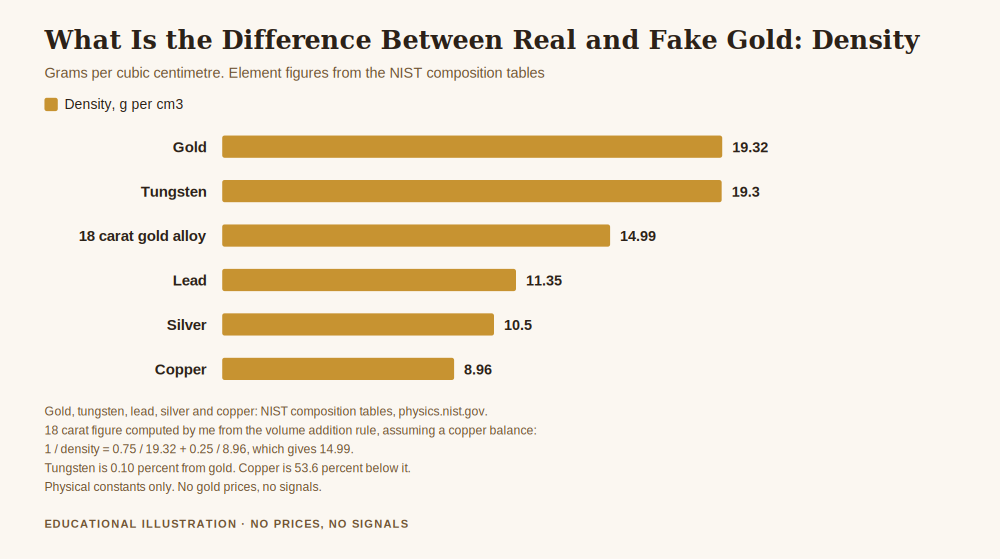
Gold has a density of 19.32 grams per cubic centimetre. That figure is not a market opinion, it is a published physical constant, and I am taking it from the National Institute of Standards and Technology composition tables so that you can check it yourself rather than take my word for it.
Density is the reason the classic tests work at all. Gold is extraordinarily heavy for its size. A given mass of gold occupies less space than the same mass of almost anything else you could plausibly substitute for it, and that is a difference you can measure at a kitchen table with a scale and a glass of water.
So the whole question comes down to one thing: how far from 19.32 does the counterfeit sit? For most fakes, very far. For one, almost not at all.
The Fakes That Density Catches Instantly
Here are the usual substitutes, all taken from the same NIST tables, with the gap from gold in the third column.
| Metal | Density, g per cm3 | Difference from gold |
|---|---|---|
| Gold | 19.32 | 0 |
| Tungsten | 19.30 | 0.10 percent |
| Lead | 11.35 | 41.3 percent |
| Silver | 10.50 | 45.7 percent |
| Copper | 8.96 | 53.6 percent |
| Iron | 7.874 | 59.2 percent |
Put 100 grams of each on a scale and measure the volume by displacement. The gold takes up 5.176 cubic centimetres. The copper takes up 11.16, more than twice as much. A brass or copper core wrapped in gold plating is not a subtle deception, it is a fake that announces itself the moment anyone weighs it and measures it, which is why the water displacement test earned its reputation.
For that entire family of counterfeits, the answer to what is the difference between real and fake gold is simply: about half the density, and any careful person with a kitchen scale can find it.
The One Metal Density Cannot Catch
Now look at the second row again. Tungsten sits at 19.30 against gold's 19.32. The gap is 0.10 percent.
Work through what that means for a measurement. Take 100 grams of each. The gold occupies 5.1760 cubic centimetres and the tungsten occupies 5.1813. The difference is 0.0054 cubic centimetres, which is 5.4 microlitres. A single drop of water from an eyedropper is roughly ten times that volume. You are being asked to detect one tenth of a droplet inside a glass of water while holding a metal bar in it.
Put it in terms of the scale instead. If you weigh the sample in air and then again suspended in water, which is the standard way to get density at home, the difference in that second reading between a real gold bar and a tungsten one is:
- 0.535 milligrams on a 10 gram sample
- 1.665 milligrams on a one troy ounce sample
- 5.354 milligrams on a 100 gram bar
A kitchen scale reads to one gram, so it is off by a factor of roughly two thousand. A jeweller's scale reads to one milligram, so on a 100 gram bar it is theoretically in range, and in practice it is not, because you also have to control for air bubbles clinging to the surface, the temperature of the water, and the string or hand holding the sample. Each of those perturbs the reading by more than the signal you are looking for.
The counterfeiter does not even have to be precise. Take a bar that is 90 percent tungsten by weight with a gold shell making up the rest, and the measured density comes out at 19.302, which is 0.09 percent below pure gold. Nine tenths of the precious metal has been removed and the density test still reads as gold to any instrument you own.
Alloys Are a Different Question Entirely
There is a category people confuse with counterfeiting, and it is worth separating. An 18 carat item is not fake gold. It is 75 percent gold by weight, alloyed deliberately, and sold as such.
Alloys are easy to identify by density because mixing in a lighter metal drags the figure down hard. Assuming the balance is copper, which is the most common yellow gold alloy, and using the volume addition rule, the numbers work out like this: 22 carat comes to 17.62, 18 carat to 14.99, 14 carat to 13.04 and 10 carat to 11.54 grams per cubic centimetre. An 18 carat item is 22 percent less dense than pure gold, which is not a subtle difference at all.
So density separates alloys from pure metal reliably. The point stands that it separates gold from tungsten hardly at all. A test can be excellent at one job and useless at the neighbouring one, and knowing which is which is the entire skill.
The Sentence the Bullion Market Itself Publishes
This is where I would stop trusting internet advice and start reading the primary source. The London Bullion Market Association sets the Good Delivery standard that the wholesale gold market runs on. On its own Good Delivery rules and governance page, under physical market guidelines, it states:
There is currently no definitive non-destructive testing solution available that we can endorse. The only way to accurately determine the fineness of a gold bar is through destructive testing of representative samples.
Read that twice. The institution that accredits the refiners, whose listed refiners must produce at least 10 tonnes of refined gold and hold a tangible net worth of at least 15 million pounds, and whose standard bar is roughly 400 troy ounces, will not endorse any test that leaves the bar intact. To be certain what is inside, you have to cut into it.
That is the real answer to the question. The difference between real and fake gold is not something you establish by a clever trick at home. Above the level of the obvious fakes, it is established by drilling the bar, or by not needing to, because of where the bar came from.
Which Means the Answer Was Never a Test
If certainty requires destroying the sample, then everyone who deals in physical metal without a laboratory is relying on something else entirely, and it is worth being explicit about what that something is. It is provenance. Accredited refiner, accredited dealer, documented chain of custody, a counterparty who has more to lose from selling one fake bar than they could gain from it.
That is not a workaround for the absence of a test. It is what the professional market actually does, which is why the Good Delivery list is a list of refiners rather than a list of approved detection gadgets.
The home tests are still worth doing, with a clear head about their range. A magnet finds iron and steel cores. Density finds copper, brass, lead and silver, and confirms whether an item is plausibly the carat it claims. An acid test reads the surface, and only the surface, so it is defeated by any plating. None of them can see a tungsten core, and none of them is a substitute for buying from someone accountable.
The Protect Lesson
I have written this in a trading journal because the structure of the problem is one every trader meets, dressed differently.
The first lesson is that a test which cannot fail proves nothing. A density check on a tungsten bar passes, and it passes precisely because it was never capable of detecting that fake. A backtest that could not have produced a losing result tells you the same amount about your strategy: nothing at all. We took that apart in how to test your trading strategy.
The second is that you should know the resolution of your instrument. The gap between gold and tungsten is 0.10 percent, and your scale reads to a gram. Traders make the same error when they draw conclusions from thirty trades, where the noise is far wider than the effect they think they are seeing, which is the argument in what expectancy in trading really measures.
The third is that when verification is impossible, the counterparty becomes the risk, and that is not solved by cleverness, it is solved by choosing carefully and not being greedy about price. The same applies to where you hold your trading capital, which is why checking a broker's licence is worth twenty minutes of anyone's life. The bar sold well below the going rate, like the broker offering terms nobody else offers, is telling you something before you have tested anything.
Get the free Black Gold Market blueprint, a short document on protecting capital before the trade rather than after it, including how to tell a check that can fail from one that was never able to. One email, no spam, unsubscribe anytime.
Get the free blueprint →Frequently Asked Questions
What is the difference between real and fake gold, in one sentence?
Real gold has a density of 19.32 grams per cubic centimetre, and most fakes are made of metals between 40 and 60 percent lighter, which a scale and water will expose. The exception is tungsten, which is within 0.10 percent of gold and which no home test can rule out.
Does the water displacement test actually work?
Yes, against copper, brass, lead, silver and iron cores, and for confirming whether an item is plausibly the carat it is sold as. No, against tungsten. On a 100 gram bar the difference between gold and tungsten in a water weighing is about 5 milligrams, which is smaller than the errors introduced by air bubbles and water temperature.
Is a magnet test useful?
It is useful and it is narrow. Gold is not magnetic, so a strong reaction indicates iron or steel. Neither tungsten, copper, lead nor silver is magnetic either, so passing the magnet test rules out one family of fakes and says nothing about the rest.
Why is tungsten the metal counterfeiters choose?
Because of the coincidence in that table. Of all reasonably available metals, tungsten is the only one whose density lands within a fraction of a percent of gold, so a tungsten core plated in real gold reproduces both the weight and the size of the genuine article at a fraction of the cost.
What do professionals do instead of testing?
They rely on provenance and accountability: bars from accredited refiners, bought from accountable dealers, with the chain of custody documented. The LBMA states plainly that it endorses no definitive non-destructive test and that accurate fineness requires destructive sampling, so the wholesale market is built on who supplied the metal rather than on a gadget.
Does any of this affect me if I only trade XAU/USD?
Not physically, because you never take delivery. It affects you as a way of thinking. Every check you run on a strategy, a broker or a signal service should be judged first on what it would be capable of detecting if something were wrong.
Where Black Gold Market Fits
Black Gold Market is free to follow. Daily XAU/USD analysis with the level, the context and the risk stated before the trade, losing days included, plus an optional Kit for people who want the method written down in full. Nothing here promises a profit and nothing here ever will.
Protect comes first. How to protect your capital when gold gets volatile is the pillar this article sits under. How to spot a gold trading scam covers the same instinct applied to people rather than metal, and how much it costs to sell gold deals with the other half of physical ownership, the part nobody mentions until you try to sell.
About the author. Raphael writes Black Gold Market. He works on the part of this business that happens before the trade, the level, the context, and the risk, and on the conviction that a method you can follow through a quiet quarter is worth more than a better one you cannot.
Disclaimer: This article is general educational content about the physical properties of gold and the limits of common tests. It is not financial advice, not advice on buying or selling physical metal, and not a recommendation to trade any instrument. The densities quoted for gold, tungsten, lead, silver, copper and iron are from the NIST composition tables. The alloy densities, the volume and weighing differences, and the 90 percent tungsten example are my own arithmetic on stated assumptions, namely the volume addition rule, a copper balance in the alloy, and water at 20 degrees Celsius; they are illustrations of a physical principle, not a testing protocol, and nothing here should be used as the basis for a purchase. The statement that no definitive non-destructive testing solution is endorsed, and that accurate fineness requires destructive testing of representative samples, is quoted from the London Bullion Market Association. No gold price level is quoted anywhere in this article. Trading gold, CFDs and leveraged products carries a high risk of losing money rapidly, and no entry, stop or target discussed should be treated as a signal. Readers should consider their own circumstances and speak to a licensed professional in their jurisdiction.