

Ask how much refined gold is there in the world and you will get a number that sounds too small to matter and turns out to explain almost everything about how the metal behaves. The best available estimate is about 224,200 tonnes of above ground stock, counted at the end of the third quarter of 2026 by the World Gold Council. Every ring, every central bank bar, every gram inside a phone that has not yet been thrown away. That is the whole inventory, accumulated across every civilisation that ever dug for it.
How much refined gold is there in the world, stated as a number
Two figures are worth holding. The World Gold Council estimates that around 222,600 tonnes of gold has been mined throughout history, and puts the total above ground stock at 224,200 tonnes at the end of the third quarter of 2026. The second number is slightly larger than the first because the stock is measured as what currently exists in refined form, while the historical total is a mining count, and the two series are assembled differently.
Converted into the unit the market actually quotes, using the US Geological Survey conversion of 32,150.7 troy ounces per metric tonne, 224,200 tonnes is about 7.21 billion troy ounces. Spread across a world population of roughly 8 billion people, which is an assumption I am stating rather than a figure from the sources, that is about 28 grams each, slightly less than a troy ounce per person alive.
The other fact worth carrying is that about two thirds of all the gold ever mined has been mined since 1950. Gold has been treasured for five thousand years, and most of the metal in existence was pulled out of the ground inside the lifetime of someone still alive today.
Why the word refined does the real work
The question is easy to answer badly because four different quantities get called gold, and they are not interchangeable.
Above ground stock is refined metal that already exists in a usable form. That is the 224,200 tonnes. Reserves are deposits that have been measured and are economic to extract under current conditions, which the USGS puts at 64,000 tonnes worldwide. Resources are a wider geological estimate, including material nobody has yet found: the same agency's assessment of the United States alone indicated 33,000 tonnes, split between 15,000 tonnes identified and 18,000 tonnes undiscovered. Annual mine production is the flow, estimated at 3,300 tonnes in 2024 against 3,250 tonnes in 2023.
Confusing stock with reserves is where most of the alarming headlines come from. Reserves divided by production gives 64,000 over 3,300, which is 19.4 years, and that figure gets reported as the world running out of gold in under two decades. It is not a countdown. Reserves are an accounting category that gets refilled by exploration and by changes in what is economic to mine, and the metal already above ground does not disappear when a mine does.
The flow is tiny next to the stock
Here is the number that actually matters for anyone holding or trading the metal. One year of global mining, 3,300 tonnes, adds 1.47 per cent to a stock of 224,200 tonnes. Even an extraordinary year of mining, one that beat the record by a wide margin, would move the total supply of gold in the world by a rounding error.
Industrial commodities do not work this way. Oil gets burned, copper gets built into things and only partly recovered, wheat gets eaten. Gold mostly persists. It is melted, resold, recovered from scrap, and rejoins the pool. That is why the supply side of gold is close to inert, and why price responds to who wants to hold the existing stock rather than to how much came out of the ground last quarter.
The practical consequence is blunt. If you are waiting for a production figure to explain a move on the chart, you will wait a long time, because the quantity that changed is too small to be the cause.
Where a year of gold actually goes
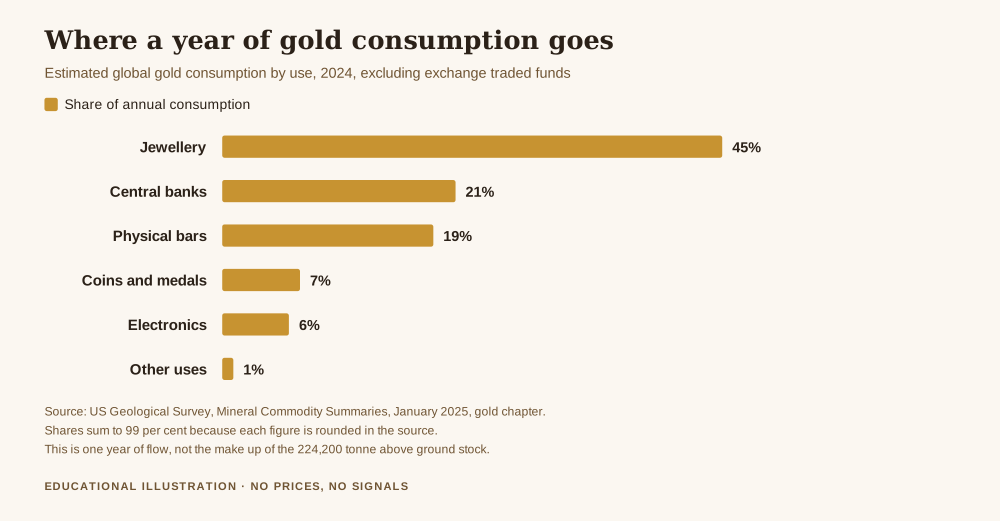
The US Geological Survey estimates the 2024 split of global gold consumption, excluding exchange traded funds and similar investments, as jewellery 45 per cent, central banks and other institutions 21 per cent, physical bars 19 per cent, official coins and medals 7 per cent, electrical and electronics 6 per cent, and other uses 1 per cent. Those shares sum to 99 per cent because each is rounded in the source.
Read that carefully, because it is a flow, not a photograph of the stock. It describes where one year of consumption went, not how the 224,200 tonnes is currently held. The two are different questions and conflating them is the single most common error in articles about this topic, including some that quote the right numbers.
What the split does tell you is that the largest single use of new gold is ornamental, that official institutions take roughly a fifth, and that genuine industrial consumption, the kind that destroys metal rather than storing it, is a small slice. A metal that is mostly worn, stored and counted rather than consumed behaves like a monetary asset wearing a commodity costume.
How anyone can possibly know this
A number like 224,200 tonnes deserves the obvious question: counted by whom, and how? Nobody has weighed the world's gold. The figure is built upward from mine production records, which are reasonably good for the modern era because mining is taxed, licensed and reported, and progressively worse the further back you go. Pre twentieth century output is reconstructed from historical records and is the softest part of the estimate.
That is why the World Gold Council presents it as a best estimate rather than a measurement, and why the sentence about two thirds of all gold being mined since 1950 carries more weight than it first appears to. The part of the total that rests on good modern records is the large part. The uncertain tail is the smaller one, which is a comfortable position for an estimate to be in.
The USGS figures come from a different direction entirely. Mine production, reserves and consumption shares are compiled annually from national statistics and company reporting, published every January in a document short enough to read in one sitting. Where the two sources disagree on definitions, which they sometimes do, the fix is to use each for what it measures rather than to average them.
Treat any source that gives you the world's gold stock to five significant figures without naming its method as decoration rather than data. The useful habit, in this and in everything else on a trading desk, is to ask where a number came from before deciding what it is worth.
The cube that keeps being drawn
You have seen the illustration where all the gold in the world sits as a single cube. It is worth doing the arithmetic yourself rather than trusting the picture, because the picture is often drawn wrong.
Assume a density of 19.32 grams per cubic centimetre, the standard figure for pure gold. 224,200 tonnes is 2.242 times ten to the eleventh grams. Divide by the density and you get about 11.6 billion cubic centimetres. The cube root of that is roughly 2,262 centimetres, so the cube is about 22.6 metres on each side. A seven storey building, give or take a floor.
Run the same calculation on one year of mine production and the cube is 5.55 metres on a side. That is the difference between the stock and the flow expressed in a way you can stand next to, and it is the reason the gold market does not behave like the copper market.
What this changes about how you hold it
Three practical consequences follow from a large, slow moving stock.
First, supply stories are mostly noise. A mine closure, a strike, a new discovery, these move the flow, and the flow is 1.47 per cent of the stock. When a move needs explaining, the explanation is almost always on the demand side, in rates, in the dollar, in official buying, in fear. That is where to look first.
Second, the form you hold matters more than the quantity that exists. Of the whole stock, the portion you can claim is only the portion that is specifically yours, which is the distinction between allocated and unallocated gold. The world total is a comforting number that confers nothing. Your claim is a contract.
Third, recycling is a real and underrated source of supply, because the stock is not locked away. When conditions change, metal comes back out of drawers and into refineries, which is covered in how much gold is recycled. A stock of 224,200 tonnes is also a standing reservoir of potential sellers.
None of this tells you what to do on any given day. It tells you which explanations to discard, which is usually more valuable, and it is the reason the supply side of gold rewards reading once and then ignoring for a decade.
Get the free Black Gold Market blueprint, a one page guide to protecting capital before trying to grow it, in the kind of market this article describes. One email, no spam, unsubscribe anytime.
Get the free blueprint →Frequently asked questions
How much refined gold is there in the world right now?
About 224,200 tonnes of above ground stock at the end of the third quarter of 2026, according to the World Gold Council, which also estimates that around 222,600 tonnes has been mined across all of history. In troy ounces, using the USGS conversion of 32,150.7 ounces per tonne, that is roughly 7.21 billion ounces.
Is the world running out of gold?
Not in the sense the phrase implies. Reported reserves of 64,000 tonnes divided by annual production of 3,300 tonnes gives 19.4 years, but reserves are a moving economic category rather than a fixed total, and the 224,200 tonnes already refined does not vanish. What can change is how expensive the next tonne is to produce.
How much gold is mined each year compared with the total?
Mine production was an estimated 3,300 tonnes in 2024, which adds 1.47 per cent to the existing stock in a year. That ratio is why supply news moves the gold price far less often than people expect.
How big would all the gold in the world be as one cube?
About 22.6 metres along each edge, assuming a density of 19.32 grams per cubic centimetre and a stock of 224,200 tonnes. A single year of mine production would be a cube about 5.55 metres on a side.
Is most of the world's gold held as bars?
The honest answer is that the split of the existing stock is estimated rather than counted, and the figures most often quoted, jewellery 45 per cent and so on, describe one year of consumption rather than the composition of the stock. Treat any precise sounding breakdown of the whole 224,200 tonnes with suspicion.
Does knowing the total supply help me trade gold?
It helps mostly by telling you what to ignore. A near fixed stock means demand explains moves, so supply headlines deserve less of your attention than they get. It does not generate entries, and no entry, stop or target discussed should be treated as a signal.
Where this leaves you
The answer to how much refined gold is there in the world is about 224,200 tonnes, a cube roughly 22.6 metres on a side, growing by around 1.47 per cent a year. Memorise the ratio rather than the total. A market whose entire supply moves that slowly is a market where the interesting questions are all on the other side of the trade, and that is where your attention belongs on any ordinary week.
The foundation under this piece is how to protect your capital when gold gets volatile. Beside it, the flow side is in how much gold is mined each year in the world, the question of whether that flow has peaked is in what peak gold means, the official holdings are in what gold reserves are, and the author page is here.
The stock figures here come from the World Gold Council's how much gold has been mined dataset, and the production, reserves, conversion and consumption figures from the US Geological Survey's Mineral Commodity Summaries, January 2025, gold chapter. Both are short, free, and worth reading once at source rather than through anybody's summary, including this one.
About the author. Raphael writes Black Gold Market around three ideas in a fixed order: protect, master, grow. The order is the point, because the traders who last are the ones who treated capital as the thing to be defended before it was the thing to be grown. Everything here is education, not advice, and nothing on this site is a recommendation to buy or sell any instrument. Read what is written, then make the decision for yourself, with the level, the context, and the risk in front of you, and no entry, stop or target discussed should be treated as a signal.