

Ask what is an assay card for gold and the answer you usually get is that it proves the bar is real. That is not quite what it does, and the gap between those two statements is where people lose money. A card is a statement of two numbers written down by the party that produced the metal. The numbers are weight and fineness, both of them useful, both of them checkable, and neither of them a guarantee that the object in your hand is the object the card describes. Understanding exactly which claims a card makes, and which it does not, is the difference between buying a specification and buying a story.
What is an assay card for gold, stated plainly
An assay card is the certificate a refiner issues with a bar, usually sealed alongside it in tamper evident packaging on the smaller retail sizes. It carries the bar's serial number, its weight, its fineness, and the name and mark of the refiner or assayer standing behind those figures. On a small bar the card and the bar are often sold as one sealed unit, which is where the phrase comes from.
So the card is a claim made by a named party, with their reputation attached, about two measurements. That is genuinely valuable. It is also strictly less than proof, and the honest way to use one is to treat it as the start of your checking rather than the end of it.
The useful move is to look at how the wholesale market handles exactly the same problem, because that market has had to solve it at scale and has written the rules down. The London Bullion Market Association publishes the Good Delivery rules that govern bars moving between professional counterparties, and those rules tell you what a serious statement of weight and fineness actually involves. Measure the card in your hand against that standard and you can see what it is doing well.
The two numbers that do all the work
Fineness is the share of the metal that is gold, written in parts per thousand. The LBMA rules set the minimum acceptable fineness for a Good Delivery gold bar at 995.0 parts per thousand fine gold. A bar marked 999.9 is a much purer piece of metal, and both are legitimate.
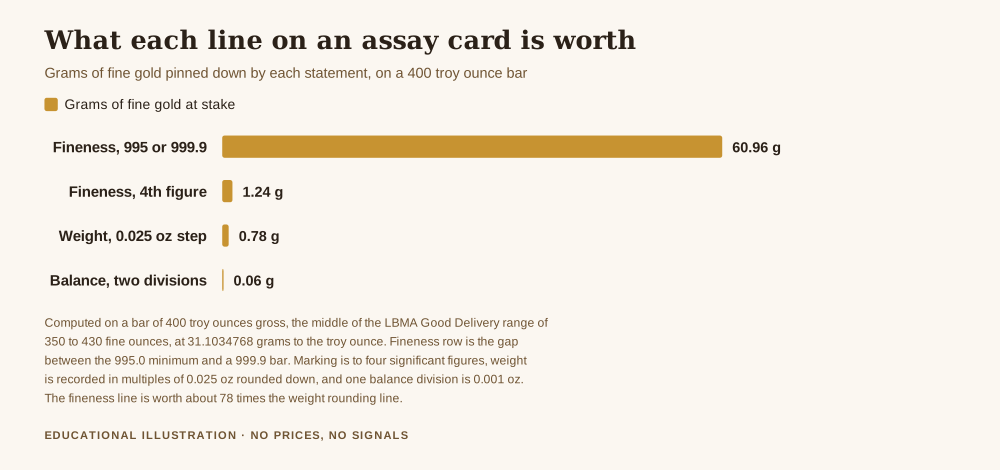
Here is what that difference is worth. Take a bar of 400 troy ounces gross, which sits in the middle of the accepted range. At 995.0 fineness it contains 398.000 troy ounces of fine gold. At 999.9 it contains 399.960. The difference is 1.960 troy ounces, which at 31.1034768 grams to the troy ounce is 60.96 grams of gold. Two bars of identical gross weight, two perfectly honest cards, and sixty grams of gold between them.
This is why the fineness line is the single most important thing on the card, and why a card that states a weight but is vague about fineness is not worth much. Gross weight tells you how heavy the object is. Fineness tells you how much of it is the thing you are buying. You need both, and only the product of the two is comparable between one piece of metal and another, which is the same arithmetic set out in how many grams equal a troy ounce of gold.
What four significant figures actually buys you
The LBMA rules do not simply require a fineness to be stated. They require it to be marked to four significant figures, which is why you see 999.9 and 995.0 rather than 999 or 995.
That extra digit is not decoration. Four significant figures means the smallest step the marking can express is 0.1 parts per thousand. On a 400 ounce bar, 0.1 parts per thousand is 0.040 troy ounces, which is 1.24 grams of gold. So the precision of the marking itself puts a boundary on how much gold the statement can be wrong by, and that boundary is about a gram and a quarter on a large bar.
Compare that with a card that rounds to three figures, or a stamp on a piece of jewellery that gives you a broad category rather than a measurement. The looser the statement, the more gold hides inside the rounding. The same logic drives the stamping conventions on smaller objects, covered in what 750 means stamped on a gold chain.
The weight line, and the rounding nobody mentions
Weight sounds like the simple half. It is not, and the London rules are unusually candid about it.
Under those rules the gross weight of a bar is expressed in troy ounces in multiples of 0.025, rounded down to the nearest 0.025 of a troy ounce. Rounded down, not to the nearest. One step of 0.025 troy ounces is 0.7776 grams, so the convention can quietly round away up to about three quarters of a gram of metal on every bar, in the buyer's favour rather than the seller's.
The weighing procedure is specified as tightly as the marking. A division on a gold beam balance corresponds to 0.001 of a troy ounce, and a bar must weigh at least 0.002 of a troy ounce over the stated multiple of 0.025 to be said to turn the scale. Fail that and the recorded weight drops by a full 0.025. In grams, the market is drawing its line at 0.0622 of a gram.
Set those numbers beside each other and the hierarchy on the card becomes obvious. The fineness statement decides 60.96 grams on that 400 ounce bar. The last significant figure of it decides 1.24 grams. The weight rounding step decides 0.7776 grams. The balance tolerance decides 0.06. The fineness line is worth roughly seventy eight times the weight rounding line. If you only have the attention to check one number carefully, that tells you which one.
Who is allowed to stamp a bar in the first place
A statement is only as good as the party making it, which is the part a card cannot show you on its face. Here the wholesale rules are instructive about what credibility costs.
To be listed as a Good Delivery refiner, a company must have a minimum tangible net worth of fifteen million pounds and an annual refined production of at least ten tonnes of gold. Ten tonnes a year is 321,507 troy ounces, which across 260 working days is about 1,237 troy ounces a day, or roughly three 400 ounce bars every working day without pause. Refiners are also required to have the ability to assay as well as refine, so the party casting the bar can measure what it has cast.
Then there is the part that matters most and is easiest to overlook: somebody checks, repeatedly, forever. Under the Proactive Monitoring programme a listed refiner must on request provide a dip sample from a normal production melt, which is check assayed by one of the market's appointed referees. That process runs once every three years, which is once every 1,095 days, and a refiner that fails two consecutive rounds is immediately suspended.
That is the real difference between a strong certificate and a weak one. A weak certificate is a claim made once. A strong one comes from a party whose right to make such claims is re-tested on a schedule by somebody with no stake in the answer. The wider standard this sits inside is covered in what LBMA gold is.
What an assay card does not prove
Three limits, and they are the reason this article exists.
It does not prove the bar in front of you is the bar on the card. This is the central one. A card and a bar are two objects. Separate them, or substitute one, and the card describes something that is no longer there. This is precisely why the better refiners seal the two together and why a broken or re-made seal changes the question entirely. A card that has been removed from its packaging is a document about a bar, not evidence about this bar.
It does not prove the card is genuine. A counterfeit bar is worth counterfeiting a card for, and the card is by far the easier of the two to copy. Any serial number can be printed. Verification means checking against the refiner's own records and testing the metal independently, which is a separate exercise set out in the difference between real and fake gold. If a seller treats your wish to verify as an insult, that reaction is itself information, and it appears on the list in how to spot a gold trading scam.
It says nothing about price, and nothing about what you can sell it for. The card fixes the metal content. The premium over that content is a commercial matter that varies by product, by dealer and by day, and the spread between buying and selling is the second number to ask for. The card gives you a denominator. It does not give you a market.
What the card does do, and this is not a small thing, is turn a vague object into a specification. You stop owning "a gold bar" and start owning a stated number of grams of fine gold from a named refiner, which is a thing you can price, compare and check.
Get the free Black Gold Market blueprint, the capital protection material in one place, for anyone who would rather check a number than take it on trust. One email, no spam, unsubscribe anytime.
Get the free blueprint →Frequently asked questions
What is an assay card for gold, in one sentence?
A certificate issued by the refiner and usually sealed with the bar, stating the bar's serial number, weight, fineness, and the mark of the party vouching for those figures, which makes it a checkable specification rather than a proof of authenticity.
Does an assay card mean the gold is real?
No. It means a named party states that a bar with that serial number has that weight and that fineness. Whether the metal in front of you is that bar is a separate question, answered by an intact seal plus independent testing, not by reading the card.
What fineness should the card say?
Whatever is true, marked to four significant figures. In the London wholesale market the minimum acceptable fineness is 995.0 parts per thousand and many retail bars are 999.9. Both are legitimate, they are simply different quantities of gold: on a 400 troy ounce bar the gap between them is 1.960 troy ounces, which is 60.96 grams.
Why is the weight written in such odd steps?
Because the London market records gross weight in multiples of 0.025 of a troy ounce and rounds down, so weights land on those steps rather than on round numbers. One step is 0.7776 grams. A bar must also exceed the stated multiple by at least 0.002 of a troy ounce to turn the scale, or its recorded weight falls by a full step.
Is a bar without a card worth less?
Often it is harder to sell, which tends to show up as a wider spread rather than as a different metal content. The gold has not changed. What has changed is how much work the next buyer has to do to satisfy themselves, and somebody usually pays for that work.
How do I check the refiner is credible?
Look for whether they are accountable to somebody on an ongoing basis rather than self certified once. The Good Delivery system is the clearest example: a minimum tangible net worth of fifteen million pounds, at least ten tonnes of refined gold a year, the ability to assay as well as refine, and a check assay of a production sample by an appointed referee every three years, with immediate suspension after two consecutive failures.
Where this leaves you
Black Gold Market is free to follow and stays free. The daily work on Telegram writes out the level, the context and the risk, so you can judge the reasoning rather than copy a number, and there is a free blueprint for anyone who wants the capital protection material in one place. There is an optional kit for people who want the longer version. Nothing here promises a return, because a return is not something anybody can promise you, and nothing here is a recommendation to buy, sell or hold any asset, or to deal with any dealer, mint or refiner.
The foundation under this piece is how to protect your capital when gold gets volatile. Beside it, the wholesale standard behind all of these numbers is in what LBMA gold is, the testing question is in the difference between real and fake gold, the unit underneath the arithmetic is in how many grams equal a troy ounce of gold, the ownership question that a card cannot answer is in allocated against unallocated gold, and the warning signs are in how to spot a gold trading scam.
Outside sources used here: the minimum acceptable fineness of 995.0 parts per thousand fine gold, the requirement that fineness be marked to four significant figures, the gold content range of 350 to 430 fine troy ounces, and the recording of gross weight in multiples of 0.025 of a troy ounce rounded down, are from the London Bullion Market Association, Good Delivery Rules, Technical Specifications. The minimum tangible net worth of fifteen million pounds, the minimum throughput of ten tonnes of gold a year, the requirement that refiners be able to assay as well as refine, the beam balance divisions of 0.001 of a troy ounce and the two division rule, and the Proactive Monitoring programme with its three year cycle, dip sample check assay by a referee and immediate suspension after two consecutive failures, are from the Good Delivery List Rules, 2026. Every gram figure, ounce conversion, daily production estimate and ratio in this article is computed from those published rules using a troy ounce of 31.1034768 grams and a bar of 400 troy ounces gross, so you can reproduce all of it.
About the author. Raphael writes Black Gold Market. He came to gold through the macro side rather than the chart side, and his standing complaint is that most commentary states a conclusion without ever showing where the number came from. He would rather hand you a smaller claim you can check yourself than a large one you have to trust. Figures here are quoted from the official rules linked above or computed from the stated conversion on the stated bar weight, the 400 ounce bar is an illustrative example rather than a quote for any particular product, nothing in this article forecasts the price of gold or recommends any dealer, mint, refiner, fund or purchase, it is not investment, legal or tax advice, and no entry, stop or target discussed should be treated as a signal.