

Ask what the difference between gold and pyrite is and you will usually be told that one is precious and the other is worthless. That answer is wrong in both halves, and it is part of why people still pay gold money for a brass coloured lump every year. The useful difference is not a matter of taste or of a trained eye. It is a matter of how much a given lump weighs for its size, and of how hard its surface is, and both of those can be settled at a kitchen table in about ten minutes with things you already own. What follows is the two measurements that decide it, the arithmetic underneath them, and the one fact about pyrite that most warnings leave out.
What pyrite actually is
Pyrite is iron sulfide. The formula is FeS2, and it is the most common sulfide mineral on the planet. It forms at high temperatures and at low ones, and it occurs in igneous, metamorphic and sedimentary rock alike, which is why it turns up almost anywhere anyone digs. Its published description reads uncomfortably close to the thing it gets mistaken for: brass yellow, often tarnished to a dull brass, metallic luster, opaque, crystallising in the isometric system so that it frequently shows up as neat cubes.
The nickname fool's gold is centuries old, and it was not coined to mock beginners. It was coined because the mistake is genuinely easy to make by eye. Colour and shine are the two properties a human being assesses instantly and badly. Everything that separates the two minerals reliably is a property you have to measure rather than admire.
Gold, by contrast, is an element rather than a compound. It does not need a partner atom to exist, it does not tarnish, and it is the most malleable and ductile of the metals. That last property matters more than it sounds, and I will come back to it.
The difference between gold and pyrite is a density problem
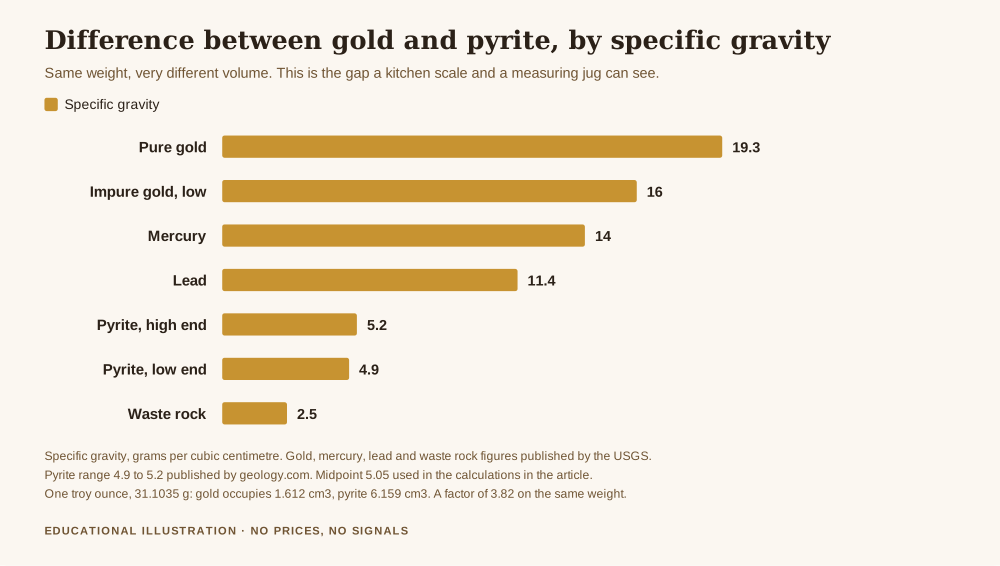
The single most useful number here is specific gravity, which is simply how many grams a cubic centimetre of the stuff weighs. The United States Geological Survey puts the specific gravity of pure gold at 19.3, and sets it next to two comparisons most people have a feel for: mercury at 14.0 and lead at 11.4. Gold is heavier than both. The same source notes that impure gold, as it commonly occurs in deposits, runs between 16 and 18, while the waste rock it sits in, the gangue, runs about 2.5.
Pyrite's published specific gravity is 4.9 to 5.2. I will use the midpoint, 5.05, for every calculation below, and I will say so each time, because a figure quoted without its assumption is a figure you cannot check.
So the headline is this. Gold is roughly 3.8 times as heavy as pyrite for the same volume. Not a few per cent heavier, which would need laboratory equipment to resolve. Nearly four times heavier, which needs a kitchen scale.
That ratio is the whole game, and it is why the eye fails. Your hand is a poor scale and your eye cannot see density at all. A pyrite cube and a gold cube of the same size do not look different in a photograph. They differ by a factor you could feel if you held them side by side, and that is exactly the comparison a seller will never offer you.
Test one, the measuring jug
Here is the arithmetic, with the assumptions stated so you can redo it with your own figures. One troy ounce is 31.1035 grams. Take a sample that weighs exactly that on a scale, and ask what volume it should occupy.
If the sample is pure gold, its volume is 31.1035 divided by 19.3, which is 1.612 cubic centimetres. If it is pyrite at the midpoint specific gravity of 5.05, its volume is 31.1035 divided by 5.05, which is 6.159 cubic centimetres. The difference is 4.548 cubic centimetres, and since one cubic centimetre is one millilitre, that is 4.548 millilitres of displaced water.
Put a number on how visible that is. A cheap ten millilitre measuring cylinder is graduated every 0.2 millilitres. The gap between the gold answer and the pyrite answer is 4.548 divided by 0.2, which is roughly 23 graduations apart. You are not squinting at a borderline reading. You are looking at two results that sit at opposite ends of the cylinder.
Run it the other way if you prefer. Take one cubic centimetre of each. Gold weighs 19.3 grams, pyrite weighs 5.05 grams, a difference of 14.25 grams on a lump the size of a sugar cube. Any kitchen scale that reads to one gram settles that instantly.
Two honest caveats. First, the test tells you the density of whatever you dropped in the water, so a gold plated base metal, or an alloy, will return an answer somewhere in between, and in between is a result that should stop the transaction rather than complete it. Second, trapped air bubbles and a porous sample both corrupt the reading, so tap the cylinder and repeat the measurement before you trust it.
Test two, glass and a streak plate
Hardness is the second measurement, and it runs in the opposite direction to density, which is a useful cross check. Pyrite's Mohs hardness is published at 6 to 6.5. Ordinary window glass sits at about 5.5. So pyrite scratches glass.
Gold does not. The USGS describes pure gold as relatively soft, with about the hardness of a penny, which puts it near 2.5 to 3 on the same scale. It will not mark glass, and a copper coin will mark it.
This is the test that catches the person who has only read about the density check, because it needs no scale at all. A sample that gouges a clean line across a pane is not gold, whatever it looks like.
The streak test is the third and the cheapest. Dragged across unglazed porcelain, pyrite leaves a greenish black to brownish black line. Gold leaves a golden yellow one. The powdered mineral shows its true colour in a way the polished surface does not, which is precisely why the test has survived for two hundred years.
There is also a behaviour test, and it goes back to malleability. Pyrite is brittle and breaks with a conchoidal fracture, the curved shell shaped break you see in flint. Gold does not break under a tap, it deforms. A sample that shatters into fragments was never gold.
What a pyrite lump is actually made of
It is worth knowing what you would be holding. Iron has an atomic mass of 55.845 and sulfur 32.06, so FeS2 has a molar mass of 55.845 plus two times 32.06, which is 119.965 grams per mole. Iron's share of that is 55.845 divided by 119.965, which is 46.55 per cent.
So a troy ounce of pyrite contains about 14.48 grams of iron. Iron is one of the cheapest industrial metals on earth and is produced in the hundreds of millions of tonnes. A fourteen gram portion of it bound up in a sulfide is not a store of value by any definition, and I am deliberately not putting a currency figure on either metal here, because the point does not depend on today's price and would stop being checkable the moment the price moved.
Why your eye is the worst instrument you own
Every property that distinguishes these two minerals reliably is invisible. Every property that is visible is shared. Colour, brass yellow in both cases. Metallic luster, present in both. Opacity, the same. Even the tarnish works against you, since pyrite dulls to a deeper brass that reads, to a hopeful eye, as age.
The one visual clue with any weight is crystal habit. Pyrite is isometric and often forms sharp cubes with striated faces, which is a shape native gold essentially never takes. But habit only helps when the sample is a crystal. A nugget, a flake or a lump that has been tumbled in a stream gives you nothing to read.
This is the same failure that shows up elsewhere in this market and the reason I keep returning to measurement. A claim that can only be assessed by looking at it is a claim you are accepting on trust. A claim that can be weighed is one you can settle yourself, and the cost of settling it here is a scale, a jug and ten minutes.
The part most warnings leave out
Here is where the usual advice goes wrong. Pyrite is not worthless rock. The two minerals often form together, and in some deposits pyrite carries enough included gold to be worth mining. It is listed among the ores of gold for exactly that reason.
That matters in two directions. A prospector who throws out every pyrite bearing sample may be throwing out the ore. And a buyer who is told the lump is valuable because it is associated with gold is being told something that is true of the deposit and irrelevant to the sample in their hand. The gold in auriferous pyrite is locked inside the sulfide in quantities measured per tonne of rock, recovered by industrial processing. It is not something a buyer extracts from a souvenir.
So the honest version is narrower and more useful than the slogan. Pyrite can be ore. The lump you are being offered at a gold price is almost certainly not, and the two measurements above will tell you which one you are looking at.
Get the free Black Gold Market blueprint, the capital protection material in one place, for anyone who would rather check a claim than take it on trust. One email, no spam, unsubscribe anytime.
Get the free blueprint →Frequently asked questions
What is the quickest difference between gold and pyrite to test at home?
Hardness, because it needs no scale. Pyrite is 6 to 6.5 on the Mohs scale and will scratch window glass, which sits at about 5.5. Gold is about 2.5 to 3 and will not. If the sample marks the glass, stop there.
Can a scale alone tell gold from pyrite?
Not on its own, because weight without volume tells you nothing. A scale plus a measuring jug does settle it. Gold is about 3.8 times denser, so the same weight of pyrite displaces roughly 3.82 times more water, a gap of about 4.5 millilitres on a one troy ounce sample.
Does pyrite contain any real gold?
Sometimes. The two minerals often form together and some deposits carry enough gold inside the pyrite to be mined for it. That is a statement about tonnes of ore and industrial recovery, not about an individual lump, and it is not a reason to pay a gold price for a specimen.
Why does pyrite fool experienced people?
Because the properties that are shared, colour and metallic luster, are the ones a human assesses in a second, and the properties that differ, density, hardness and streak, all need an instrument. Tarnish makes it worse by reading as age.
What if the density reading comes out in between?
Treat an in between reading as a failure rather than a partial pass. Gold plating over a base metal, and alloys of various purities, both land between the two figures. An ambiguous number is a reason to get a professional assay, not a reason to proceed.
How to check any of this yourself in ten minutes
None of the figures above need to be taken from me.
- Open the USGS prospecting publication linked below and search it for the phrase specific gravity. You will find 19.3 for pure gold, next to 14.0 for mercury and 11.4 for lead, and the note that gangue runs about 2.5.
- Open the pyrite reference linked below and read the physical properties table. Specific gravity 4.9 to 5.2, Mohs hardness 6 to 6.5, streak greenish black to brownish black, composition iron sulfide.
- Divide 31.1035 by 19.3, then by 5.05. You should get 1.612 and 6.159 cubic centimetres. The ratio is 3.82.
- Weigh your sample, drop it into a measuring cylinder of water, read the displacement, and divide the weight in grams by the millilitres displaced. Compare that answer with the two figures above.
- Scratch a piece of scrap glass with it. Then drag it across the unglazed base of a ceramic mug and look at the colour of the line.
Every number in this article comes out of those five steps. That is the standard I would like applied to anything else you read about this market, including what I write.
Where Black Gold Market fits
Black Gold Market is free to follow. Daily XAU/USD analysis with the level, the context and the risk stated before the trade, losing days included, on Telegram. There is a free blueprint for anyone who wants the capital protection material in one place, and an optional Kit for people who want the full method. Nothing here promises a profit, and nothing here is a signal service. The groundwork this article rests on is in protecting your capital when gold gets volatile, the same habit of verifying before paying is applied to dealers and offers in how to spot a gold trading scam, and once you own metal that is genuinely metal, the custody question is handled in the best place to store gold.
Outside sources used here: the USGS publication on prospecting for gold for gold's specific gravity and hardness, and the pyrite mineral reference for pyrite's specific gravity, hardness, streak and composition.
About the author. Raphael writes Black Gold Market. He came to gold through the macro side rather than the chart side, and his standing complaint is that most commentary states a conclusion without ever showing where the number came from. He would rather hand you a smaller claim you can check yourself than a large one you have to trust. Figures here are from the published sources linked above, the calculations state their assumptions so you can repeat them, nothing in this article forecasts the price of gold or is a recommendation to trade or buy any metal, fund or storage provider, it is not investment advice, and no entry, stop or target discussed should be treated as a signal.