

Ask what does 750 mean stamped on a gold chain and the short answer is that the chain is 750 parts gold per thousand parts metal, which is 18 karat, which is 75 percent gold by weight. That is the whole of it, and it is worth sitting with for a moment, because the number is not a brand, a model, a year or a serial. It is a composition claim, it is the one piece of information the manufacturer is legally obliged to get right, and it tells you that a quarter of the object you are holding is deliberately not gold.
What does 750 mean stamped on a gold chain, precisely
Gold purity is expressed two ways, and 750 belongs to the first.
Millesimal fineness states parts of fine gold per thousand parts of total metal. A stamp of 750 means 750 parts in 1000. A stamp of 585 means 585 in 1000. A stamp of 999 means almost nothing but gold. This is the system used across most of Europe and increasingly everywhere, because it is a plain ratio that needs no conversion.
The karat scale states parts of gold in 24. Under the United States rules on jewellery description, fine gold is 24 karat, and anything below that is an alloy which must carry a correct karat designation. So 750 parts per thousand is 0.750 of the whole, and 0.750 multiplied by 24 gives exactly 18 karat.
750, 18K and 18 Kt are therefore three spellings of one fact. A chain stamped 750 and a chain stamped 18K make the same claim. If a piece carries both, that is consistency rather than two separate assurances.
The other quarter is not filler in any derogatory sense. Pure gold is soft enough to deform in ordinary wear, so copper, silver, palladium, zinc and nickel are alloyed in for hardness and for colour. Rose, yellow and white gold at 750 all contain the same 75 percent gold and differ in what the remaining 25 percent is. That is why a white gold chain stamped 750 is not less gold than a yellow one.
What the stamp is legally required to mean
In the United States the relevant rule is 16 CFR 23.3, the Federal Trade Commission guide on misrepresentation of gold content, reproduced in full at Cornell Law School. Two provisions matter to anybody holding a stamped chain.
First, the word gold used without qualification is reserved for metal that is fine gold throughout. If a product is an alloy, the karat fineness designation must accompany the word and must be equally conspicuous. The regulation gives the acceptable forms directly, including 14 Karat Gold, 14 K. Gold, 14 Kt. Gold and 9 Karat Gold, or the karat designation standing alone.
Second, and this is the part almost nobody knows, the stamp is not required to be exact. The rule defers to the tolerances of the National Stamping Act. A gold article containing no solder has a permissible tolerance of three parts per thousand. If the part tested contains solder, the permissible tolerance is seven parts per thousand.
Chains contain solder. Links are closed, clasps are attached, and that is ordinary construction rather than a defect. So for most chains the wider tolerance is the one in play.
What the tolerance costs in grams
Take a chain that weighs 10 grams on a scale and carries a 750 stamp. Assume nothing beyond the stamp and the weight, and work in grams of fine gold, which is the only unit that does not move when the gold price does.
| Case | Fineness | Fine gold in a 10 g chain | Shortfall against 750 |
|---|---|---|---|
| Stamp taken at face value | 750 | 7.500 g | 0 |
| Legal floor, no solder | 747 | 7.470 g | 0.030 g |
| Legal floor, with solder | 743 | 7.430 g | 0.070 g |
In proportional terms the unsoldered floor costs 0.40 percent of the fine gold you thought you were buying, and the soldered floor costs 0.93 percent. Both are small. Neither is zero, and both are perfectly legal.
This is the correct way to hold the number in your head. A 750 stamp is a claim with a legal floor beneath it, not a guarantee of an exact figure. On a single chain the difference is a rounding error. On a dealer buying and selling continuously, the same tolerance is a systematic edge, which is precisely why the tolerance is written down and why assay exists.
Where 750 sits next to investment metal
Now the comparison that matters if you are thinking of the chain as a store of value rather than as an object you wear.
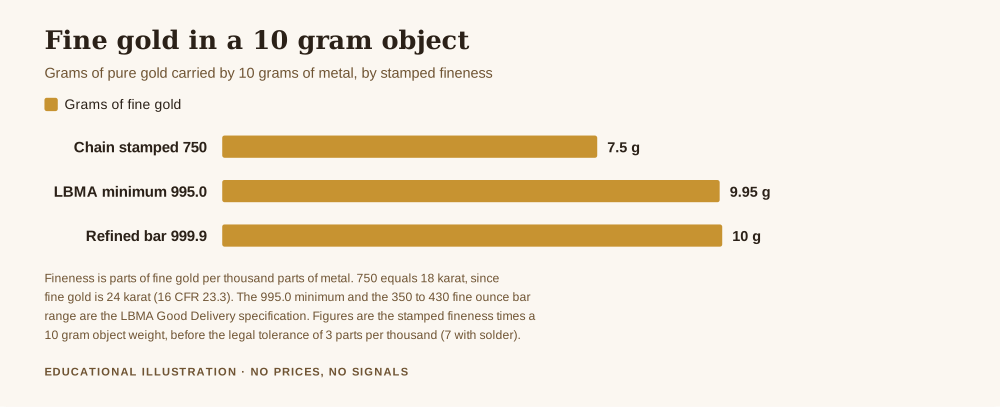
The wholesale standard for gold bullion is the London Good Delivery specification. The LBMA states that the minimum acceptable fineness is 995.0 parts per thousand, with each bar containing between 350 and 430 fine troy ounces and carrying a serial number, a refiner's assay stamp, the fineness to four significant figures and the year of manufacture. Smaller retail bars are commonly refined finer still, at 999.9.
Per gram of object, the arithmetic is unforgiving:
- 750 jewellery carries 0.750 g of fine gold per gram of object.
- Metal at the LBMA minimum carries 0.995 g.
- A 999.9 bar carries 0.9999 g.
So a gram of 750 chain holds 75.01 percent as much fine gold as a gram of 999.9 bar, and 75.38 percent as much as metal at the Good Delivery minimum. Put the other way round, to hold the same quantity of fine gold as a 100 gram bar of 999.9 you would need 133.32 grams of 750 jewellery, which is 33.32 grams of extra object to store, insure and carry.
None of that makes jewellery a mistake. It makes jewellery a different thing. You are buying design, labour, brand and wearability alongside metal, and those have genuine value that simply is not gold value. The error is not owning a chain. The error is counting the chain's full weight when you tot up what you hold.
What the stamp does not tell you
A 750 mark is a statement about composition and nothing else. In particular it is silent on three things people routinely read into it.
It says nothing about whether the piece is solid. The regulation deals with this separately, noting that a product made throughout of gold alloy but containing a hollow centre may mislead unless the hollow centre is disclosed, and that such a product should not be described as solid. A hollow 750 chain and a solid one of the same stamp hold very different quantities of gold at the same length.
It says nothing about plating. Terms such as gold plate, gold filled, rolled gold plate and gold overlay describe a surface layer on a base metal, and under the rule each must be preceded by the karat fineness of that layer. Gold filled requires the plating to be at least one twentieth of the weight of the metal in the article, and gold overlay or rolled gold plate at least one fortieth. A karat number next to one of those terms describes the coating, not the object.
It says nothing about who applied it. A stamp is a manufacturer's claim. In jurisdictions with compulsory assay offices an independent hallmark is added alongside it, which is a different and stronger kind of evidence. Where assay is not compulsory, the number rests on the maker's integrity and on the regulator's willingness to enforce.
What to check on a chain you already own
- Weigh it. Grams on a scale, then multiply by 0.750. That product, not the gross weight, is the fine gold you hold.
- Read the whole stamp, not just the number. Look for an accompanying word. A bare 750 claims the object. A 750 beside plated, filled, overlay or a fraction claims only a layer.
- Look for a separate maker's mark and any assay mark. More independent marks mean more parties staking something on the claim.
- Treat the number as a floor, not a certificate. If the quantity is large enough that a one percent difference matters to you, the answer is an assay, not a magnifying glass.
- Record it once. Weight, stamp, construction and date, written down. Years later that note is worth more than the memory of what the shop said.
Get the free Black Gold Market blueprint, the capital protection material in one place, for anyone who would rather check a number than take it on trust. One email, no spam, unsubscribe anytime.
Get the free blueprint →Frequently asked questions
What does 750 mean stamped on a gold chain in karats?
18 karat. The karat scale counts parts of gold in 24, so 750 parts per thousand is 0.750 of the whole and 0.750 times 24 is 18. A chain stamped 750 and a chain stamped 18K are making the same claim in two notations.
Is 750 real gold?
Yes, provided the stamp describes the object rather than a coating. It is a gold alloy that is three quarters gold by weight, which is real gold in exactly the way that 18 karat is real gold. What it is not is fine gold, and it is well below the 995.0 minimum fineness that wholesale bullion has to meet.
How much gold is actually in a 10 gram 750 chain?
7.5 grams of fine gold if the stamp is exact. The legal tolerance allows slightly less, down to 7.47 grams for an article with no solder and 7.43 grams for one containing solder, which most chains do. The difference is under one percent either way.
Why is my 750 chain white rather than yellow?
Because of what the other 25 percent is. Colour comes from the alloying metals, not from the gold content, so white, yellow and rose gold stamped 750 all contain the same three quarters gold. Colour tells you about the alloy recipe and sometimes about a rhodium plating on the surface, never about purity.
Should I buy 750 jewellery as a way of holding gold?
That is a decision only you can make, and this article is not advice on it. What can be said factually is that you are buying two things at once, metal and workmanship, and only one of them tracks the gold market. If the metal is the point, the thing to compare is fine gold per unit of cost, not the weight of the object. If wearing it is the point, the metal content is a floor under something you were going to buy anyway.
Where this leaves you
Black Gold Market is free to follow and stays free. The daily work on Telegram writes out the level, the context and the risk, so you can judge the reasoning rather than copy a number, and there is a free blueprint for anyone who wants the capital protection material in one place. There is an optional kit for people who want the longer version. Nothing here promises a return, because a return is not something anybody can promise you, and nothing here is a recommendation to buy or sell any item.
The foundation under this piece is how to protect your capital when gold gets volatile. Beside it, the fineness standard that 750 is being measured against is in what LBMA gold is, the difference between a coating and an object is in what gold filled base metal is, the tests that separate real metal from convincing imitations are in the difference between real and fake gold, and the comparison with investment formats is in buying gold coins vs gold bars.
Outside sources used here: the definition of fine gold as 24 karat, the requirement that an alloy carry an equally conspicuous karat designation, the hollow centre and plating provisions and the National Stamping Act tolerances of three and seven parts per thousand are from 16 CFR 23.3, as published by Cornell Law School and checked against the official eCFR text. The minimum fineness of 995.0 parts per thousand and the 350 to 430 fine ounce bar range are from the LBMA Good Delivery specification. Every gram figure is computed from the stated assumptions, so you can reproduce it.
About the author. Raphael writes Black Gold Market. He came to gold through the macro side rather than the chart side, and his standing complaint is that most commentary states a conclusion without ever showing where the number came from. He would rather hand you a smaller claim you can check yourself than a large one you have to trust. Figures here are quoted from the regulation and specification linked above or computed from assumptions stated in the text, nothing in this article forecasts the price of gold or recommends any dealer, mint, product or purchase, it is not investment, legal or tax advice, and no entry, stop or target discussed should be treated as a signal.