

Ask how many grams equal a troy ounce of gold and you get a number that looks like a rounding artefact: 31.1034768. It is not. That figure is exact by definition, it has not moved in your lifetime, and it is not going to. Almost every other number in this market is an opinion with a timestamp on it. This one is a definition, and the difference matters, because a definition is something you can check and then stop worrying about.
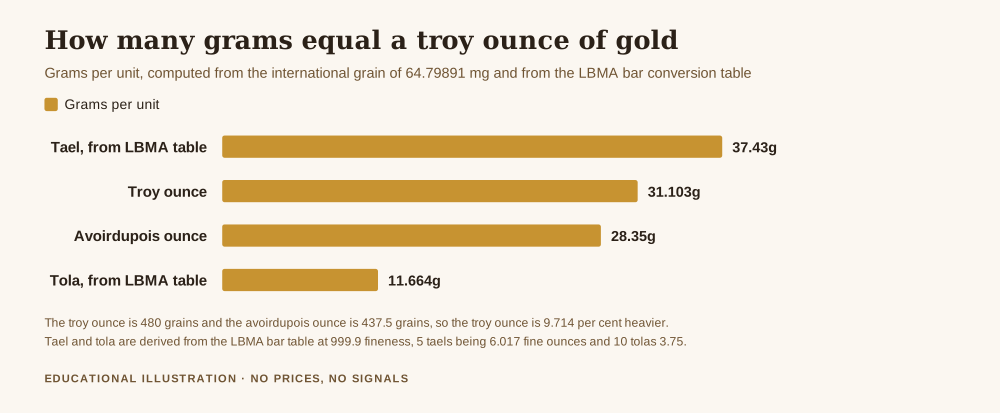
How many grams equal a troy ounce of gold, the exact figure
One troy ounce of gold is 31.1034768 grams, exactly. Not approximately, not to a tolerance. The United States National Institute of Standards and Technology prints it in its own conversion tables in Special Publication 811, where the entry reads "ounce (troy or apothecary) (oz) ... gram (g) ... 3.110 348 E+01". That is the same number rounded to seven figures, which is all a conversion table needs.
If you want the working figure for mental arithmetic, 31.1 grams is close enough to within three hundredths of a per cent. If you are settling an invoice, use the full value, because the gap between 31.1 and 31.1034768 on a kilogram of metal is about a tenth of a gram, and somebody is paying for that tenth.
Where the number actually comes from
The troy ounce is not defined in grams directly. It is defined in grains, and the grain is defined in milligrams. One international grain is exactly 64.79891 milligrams, and a troy ounce is 480 grains.
Multiply it out: 480 multiplied by 64.79891 milligrams is 31,103.4768 milligrams, which is 31.1034768 grams. That is the whole derivation, and it is worth doing once by hand, because it shows you the figure is not a measurement anybody took. Nobody weighed a reference ounce and got lucky. The grain was fixed by international agreement in 1959, the troy ounce was already 480 grains, and the gram figure fell out of the arithmetic.
This is why the number has no error bar. A measured quantity has uncertainty. A defined one does not.
The ounce on your kitchen scale is a different ounce
Here is the trap that catches people buying their first physical gold. The ounce used for food, post and body weight is the avoirdupois ounce, and it is a different unit with a different grain count: 437.5 grains rather than 480.
Run the same multiplication and the avoirdupois ounce is 28.349523125 grams. The troy ounce is therefore heavier by 2.753953675 grams, which is 9.714 per cent more metal. Nearly a tenth.
That is not a trivial discrepancy, and it runs in the direction that flatters a careless seller. If somebody quotes you a price per ounce and weighs the item on a scale set to ordinary ounces, the reading will be too high by almost ten per cent, and the error favours whoever is selling. The instruction that follows is simple: before you discuss price, establish which ounce is being used. One question, asked early, removes the entire category of problem.
A kilogram, for the record, is 1000 divided by 31.1034768, which is 32.1507466 troy ounces. That constant is worth memorising if you deal in kilo bars at all.
Checking the figure against the market's own table
A number is worth more when you have verified it somewhere independent, so here is the check I actually ran. The London Bullion Market Association publishes a conversion table giving the fine gold content of standard bars at each purity. It lists a one kilo bar at 999.9 fineness as holding 32.148 fine troy ounces.
Take my constant and compute it independently: 1000 grams multiplied by 0.9999, divided by 31.1034768, gives 32.1475 fine troy ounces. The LBMA prints 32.148. The two agree to within five ten thousandths of an ounce, which is their table rounding and nothing more. Do the same for a kilo bar at 995.0 fineness and the computation gives 31.990 against their printed 31.99, an exact match.
Two independent routes to the same figure is the standard I would want before using a number in anything that costs money, and it took about a minute.
What a Good Delivery bar weighs, and why the range is wide
People often assume the large bar in the vault photographs is "a 400 ounce bar". It is approximately that, and the approximation is official. The LBMA's Good Delivery specification sets a minimum of 350 fine troy ounces and a maximum of 430, which the guide itself glosses as approximately 10.9 to 13.4 kilograms.
Check that against the constant: 350 multiplied by 31.1034768 grams is 10.8862 kilograms, and 430 gives 13.3745 kilograms. The guide's rounded figures land exactly where the arithmetic says they should.
The range is wide on purpose. These bars are cast, not machined to a target weight, so each one is weighed individually after the fact and its actual fine content is recorded. The bar is identified by what it contains, not by a nominal label. That is the opposite of how a retail coin works, and it is the first thing to understand about wholesale metal.
Fine weight and gross weight, the distinction that costs money
Two different weights exist for every bar and conflating them is expensive. Gross weight is the mass of the whole object. Fine weight is the mass of pure gold inside it. The link between them is fineness, and the Good Delivery minimum is 995.0 parts per thousand, which means a conforming bar may legitimately be half a per cent other metal.
There is a second detail that rewards reading the rules carefully. The guide specifies that gross weight is reported in troy ounces "in multiples of 0.025, rounded down to the nearest 0.025 of a troy ounce". Rounded down, every time, never to nearest.
In grams, 0.025 of a troy ounce is 0.7776 grams. So up to about three quarters of a gram of real metal in any given bar sits below the reported figure and is simply not counted. On one bar that is small. It is also entirely systematic, always in the same direction, and it tells you something about how a professional market handles ambiguity: it writes the rule down and applies it consistently rather than arguing case by case.
Tael and tola, the units that never went away
The troy ounce is not universal. Two older units remain in daily use across Asia, and the LBMA bar table quietly records both.
The table lists 5 taels at 999.9 fineness as 6.017 fine ounces, so one tael is 1.2034 troy ounces, which is 37.430 grams. It lists 10 tolas at 999.9 as 3.75 fine ounces, so one tola is exactly 0.375 troy ounces, or 11.6638 grams.
Note what the tola figure implies: three eighths of a troy ounce exactly. These are not folk measures that happen to be nearby. They have been pinned to the same system and are manufactured to it.
If you buy physical metal in a market that quotes taels, converting through the published bar table rather than through a search engine is the safer habit, because the search result will give you one of several regional tael definitions without telling you which.
Why a conversion factor belongs in a trading journal
You might reasonably ask what any of this has to do with a screen trader who never touches metal. Two things.
First, the quote you trade is denominated per troy ounce. When a contract specification says 100 ounces, it means 100 troy ounces, or 3.11034768 kilograms. Knowing that converts an abstract contract size into a physical quantity you can picture, and a position you can picture is harder to misjudge.
Second, and more useful: this is the cheapest available exercise in checking a number instead of accepting it. The whole discipline this journal argues for is measuring rather than assuming, and here the measurement is free. You can verify every figure above with a calculator in five minutes, against two independent published sources. Most claims in this industry cannot survive that treatment. The habit you build on an easy case is the one you will still have on a hard one.
Get the free Black Gold Market blueprint, the capital protection material in one place, for anyone who would rather check a claim than take it on trust. One email, no spam, unsubscribe anytime.
Get the free blueprint →Frequently asked questions
How many grams equal a troy ounce of gold, in one number?
31.1034768 grams, exactly, by definition. It comes from the troy ounce being 480 international grains and the grain being exactly 64.79891 milligrams. For rough work 31.1 grams is within three hundredths of a per cent, but for anything you are paying for, use the full figure.
Why is gold weighed in troy ounces and not ordinary ounces?
Historical continuity, mostly. The troy system was the established standard for precious metals in the London market long before the avoirdupois ounce became the general commercial unit, and the bullion trade never switched. The practical consequence is the one that matters: the two ounces differ by 9.714 per cent, so the unit has to be stated explicitly.
How many grams are in a kilo gold bar, and how many ounces?
A kilo bar is 1000 grams gross. Its fine gold content depends on purity: at 999.9 fineness the LBMA table gives 32.148 fine troy ounces, and at 995.0 fineness it gives 31.99. A full troy ounce of pure gold is 32.1507466 ounces per kilogram, which is the ceiling those figures approach.
Is a 400 ounce Good Delivery bar actually 400 ounces?
Rarely exactly. The specification permits anything from 350 to 430 fine troy ounces, roughly 10.9 to 13.4 kilograms, and each bar is weighed individually with its real fine content recorded. The phrase "400 ounce bar" describes a class of bar, not a guaranteed weight.
What is the difference between fine weight and gross weight?
Gross weight is the whole bar. Fine weight is the pure gold in it. A Good Delivery bar must be at least 995.0 parts per thousand fine, so up to half a per cent can be other metal. When a price is quoted per ounce, establish which weight it applies to before agreeing to anything.
Where Black Gold Market fits
Black Gold Market is free to follow. Daily XAU/USD analysis with the level, the context and the risk stated before the trade, losing days included, on Telegram. There is a free blueprint for anyone who wants the capital protection material in one place, and an optional Kit for people who want the full method. Nothing here promises a profit, and nothing here is a signal service. The groundwork this article rests on is in protecting your capital when gold gets volatile, the same check the number yourself habit is applied to markings and purity in what gold filled base metal actually contains and to telling real metal from the convincing imitation in the difference between gold and pyrite, and the per ounce cost of getting the metal out of the ground is in how much it costs to mine gold per ounce.
Outside sources used here: the troy and avoirdupois conversion factors from the National Institute of Standards and Technology in Special Publication 811, and the bar specifications and fine content figures from the LBMA guide, both the London Good Delivery section and the conversion table.
About the author. Raphael writes Black Gold Market. He came to gold through the macro side rather than the chart side, and his standing complaint is that most commentary states a conclusion without ever showing where the number came from. He would rather hand you a smaller claim you can check yourself than a large one you have to trust. Figures here are from the published sources linked above, the calculations state their assumptions so you can repeat them, nothing in this article forecasts the price of gold or is a recommendation to trade or buy any metal, item or dealer, it is not investment advice, and no entry, stop or target discussed should be treated as a signal.