

A member asked in the group why his platform showed one gold price and the chart on a news site showed another, and which of the two was the real one. The honest answer is that neither is the benchmark. There is a benchmark, it is set twice a day in London, and almost nobody who trades gold has ever looked at how it works. So this is what is the london gold fix, what it is actually called now, who sits in the auction, and what I found when I measured how far apart the two daily prints land.
The short version: the benchmark is the LBMA Gold Price, it is run as an electronic auction twice every business day, and the two prints disagree by a median of 0.26 per cent. That is not a rounding difference. Over the 14,690 days I measured, more than one day in four had a gap of half a per cent or more between the morning print and the afternoon one.
What is the london gold fix, in the words of the people who run it
The name is the old one. It goes back to a physical meeting, and the word "fixing" has a flavour that no longer fits what happens. The current thing is called the LBMA Gold Price, and the London Bullion Market Association describes it plainly: the price "is administered independently by ICE Benchmark Administration (IBA)", and the platform is "electronic, tradeable, auditable and in line with the IOSCO Principles for Financial Benchmarks."
Read that sentence slowly, because three of those words do real work. Electronic means there is no room and no telephone. Tradeable means the participants are not offering an opinion about where gold should be, they are entering volumes they are willing to buy and sell, and they get filled. Auditable means the whole sequence is recorded. A benchmark built from real orders that someone has to honour is a different animal from a benchmark built from quotes that nobody has to stand behind.
The LBMA also publishes the timetable, and the timetable is the part that matters for anything you do on a chart. The price is "set twice daily in auctions independently operated and administered by ICE Benchmark Administration Limited (IBA) and commencing at 10:30 and 15:00 London time." Two auctions, four and a half hours apart, in US dollars per troy ounce. One other detail from the same page that surprises most people: sterling and euro prices exist, but the LBMA states they "are indicative prices for settlement only." The dollar number is the benchmark. Everything else is a conversion.
Fifteen firms, and why the number is small on purpose
Here is the fact that changed how I think about the gold market. The LBMA states that "there are fifteen direct participants who have been on-boarded to contribute to the LBMA Gold Price", and it names every one of them: Bank of China Limited London Branch, Citibank N.A. London Branch, Coins 'N Things Inc., DRW Investments LLC, Goldman Sachs, HSBC Bank USA NA, Jane Street Global Trading LLC, JPMorgan Chase Bank N.A. London Branch, Koch Supply and Trading LP, Marex, Morgan Stanley, Standard Chartered Bank, StoneX Financial Ltd, Toronto-Dominion Bank, and Virtu Financial Global Markets LLC.
Fifteen. Not fifteen hundred. The world's reference price for gold is discovered by fifteen firms entering real, binding volumes twice a day.
That is not a scandal and I want to be careful here, because "fifteen firms set the gold price" is exactly the kind of sentence that gets turned into something it is not. It is a direct participant list, published openly, for a benchmark that is overseen by a committee and built to a published methodology. The smallness is a feature of the physical market itself. Settling actual gold in London vaults requires balance sheet, vault access and credit lines that very few institutions have. The list is short because the job is narrow, not because the door is locked.
What it does mean for you is simpler and more useful. The number your platform calls "spot" is not this. Your broker's quote is its own price, from its own liquidity, and it moves continuously while the benchmark exists only twice a day. The benchmark is what contracts settle against and what a great deal of the world's gold is valued at. Those are two different objects, and knowing which one you are looking at is worth more than any indicator.
What I measured, and how
The LBMA publishes the full history of both auctions, so I took it and did the arithmetic myself. Morning and afternoon US dollar auction prices, every day where both exist, from 1 April 1968 to 25 September 2026. That is 14,690 days with both prints, and 14,689 consecutive day pairs.
From that I built two windows, and the whole article turns on them:
- The auction window: the morning print at 10:30 to the afternoon print at 15:00, the same day. Four and a half hours. This is London's own trading afternoon, overlapping the New York morning at the end.
- The overnight window: yesterday's afternoon print at 15:00 to this morning's print at 10:30. Nineteen and a half hours. This covers the American afternoon, the entire Asian session, and the London morning.
Every figure below is a median of absolute percentage change, so it describes a typical day rather than an average dragged around by a handful of violent ones. No gold price level appears anywhere in this article.
The two prints disagree more than people expect
Between the morning auction and the afternoon auction, the typical day moves 0.2608 per cent. That is the median of the absolute change. Around it:
- Half of all days, 51.4 per cent of them, move more than a quarter of a per cent between the two prints.
- 27.0 per cent of days move more than half a per cent.
- 8.6 per cent of days move more than a full per cent.
- 1.4 per cent of days, roughly three or four a year, move more than two per cent between one auction and the next.
- At the far end, the worst one per cent of days show a gap of 2.29 per cent or more.
And at the other extreme, on 551 days out of 14,690, which is 3.8 per cent, the two auctions printed exactly the same number. So on about one day in twenty six the benchmark genuinely did not move across the London afternoon, and on about one day in eleven it moved more than a full per cent. Same market, same four and a half hours.
There is no drift hiding in this. The afternoon printed above the morning on 6,859 days and below it on 7,279. That is as close to a coin flip as fifty eight years of data is ever going to give you, and it is worth saying out loud because the "afternoon is always lower" claim circulates constantly and the record does not support it.
Where gold's day actually happens
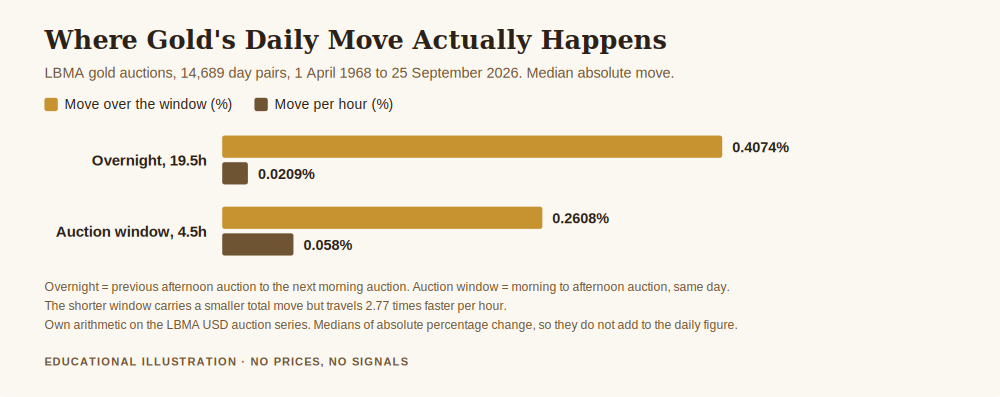
Now the comparison I find genuinely useful. Over the overnight window, the typical absolute move is 0.4074 per cent, against 0.2608 per cent for the auction window. So more of the daily motion happens while London is closed: 61.1 per cent of all absolute movement falls in the overnight window against 38.9 per cent in the auction window.
But those windows are not the same length, and dividing by the hours reverses the story completely:
- Overnight: 0.4074 per cent spread over 19.5 hours, which is 0.0209 per cent an hour.
- Auction window: 0.2608 per cent spread over 4.5 hours, which is 0.0580 per cent an hour.
The London afternoon moves 2.77 times faster per hour than the rest of the day. Over the most recent ten years of the sample that ratio widens to 3.07 times. The overnight window covers more ground simply because it is four times longer, not because it is busier.
This is why I am wary of anyone who tells you gold "goes quiet" or "gets active" without saying over what stretch of clock. Both statements are true of the same data depending on whether you divide by time. Total movement and speed of movement are different questions, and a lot of confident session advice quietly swaps one for the other.
The two halves of the day are not the same day
Three more figures, and these are the ones I would keep.
First, on 46.1 per cent of days the two windows moved in opposite directions. Gold drifted one way overnight and the other way across the London afternoon, on nearly half of all days in fifty eight years. The day-over-day number you see quoted is the net of two windows that disagree almost as often as they agree.
Second, on 15.2 per cent of days the overnight move ran opposite to where the day finished. About one morning in seven, the direction you woke up to was not the direction the day ended in.
Third, and this is the practical one: because the benchmark is set only twice a day, a single daily gold number is a sample of two, not a summary of the day. Anyone quoting "the gold price today" has picked one of two prints that disagree by a typical 0.26 per cent, and neither of them is what your broker showed you at the moment you clicked.
Get the free Black Gold Market blueprint, a short document on protecting capital before you try to grow it, including how to tell a benchmark price from the price your own platform is showing you. One email, no spam, unsubscribe anytime.
Get the free blueprint →Frequently asked questions
So what is the london gold fix called now, and did it change?
The benchmark is the LBMA Gold Price. The word "fix" survives from an era when the price was agreed by a small group on a telephone call. What exists today is an electronic auction administered by ICE Benchmark Administration, described by the LBMA as electronic, tradeable and auditable, and built to the IOSCO Principles for Financial Benchmarks. People still say "the fix" and everyone knows what they mean, but the mechanism behind the word is not the one the word was coined for.
Is the benchmark the same as the price on my platform?
No, and this is the single most useful thing on this page. The benchmark exists twice a day, at 10:30 and 15:00 London time, in US dollars per troy ounce. Your platform quotes continuously, from its own liquidity providers, with its own spread. The two track each other closely because they are about the same metal, but they are different objects with different purposes. The benchmark is a settlement and valuation reference. Your platform quote is what you can actually deal on.
Should I be worried that only fifteen firms take part?
I would say informed rather than worried. The participant list is published openly by the LBMA, the auction is overseen by a committee with representation from the wider market, and the methodology is public. The number is small because settling physical gold in London requires vault access, credit and balance sheet that few institutions have. What I would take from it is not suspicion but scale: this is an institutional market, and the price you trade against was discovered by firms operating at a size that has nothing to do with a retail account.
Does the gap between the two prints mean I should trade around 15:00 London?
That does not follow, and I would be careful with anyone who says it does. All I have measured is that the four and a half hours between the auctions carry more movement per hour than the rest of the day. More movement per hour cuts in both directions and says nothing at all about which direction. Faster is not the same as more profitable, and a wider range is also a wider range against you. There is no position anywhere in this article.
Why use the benchmark rather than a continuous price series?
Because it is public, complete, auditable and free, and because the two fixed times give clean, identical windows on every single day. A continuous feed from one broker is that broker's own record, differs from the next broker's, and is not published for anyone to check. The cost of using the benchmark is that I can only see two moments a day, which is exactly why I have been explicit throughout that these are window-to-window changes and not intraday ranges.
What are the limits of these numbers?
Three, and they matter. One, two prints a day means every figure here is a floor, not a ceiling: gold can travel a long way inside a window and come back, and my method cannot see that. Two, the 19.5 hour overnight window lumps the American afternoon, the Asian session and the London morning together, so it cannot tell you which of those three did the work. Three, the sample runs from 1968 and gold traded under very different arrangements in the early years, which is why I checked the most recent decade separately and reported it where it differs.
Where did these numbers come from?
The description of the auction, the timetable, the administrator and the fifteen direct participants are all quoted from the LBMA page linked above. Every statistic is my own arithmetic on the LBMA morning and afternoon US dollar auction series, 1 April 1968 to 25 September 2026, restricted to the 14,690 days where both auctions exist, giving 14,689 day pairs. Percentage changes are computed window to window, medians are of absolute values, and the per-hour figures divide by 4.5 and 19.5 hours respectively. No gold price level appears anywhere in this article.
Where Black Gold Market fits
Black Gold Market is a free journal about gold, written for people who want to protect capital before they try to grow it. Everything here stays free: the journal, the daily analysis on Telegram, and the Sustainable Trader's Blueprint. There is no profit promise anywhere on this site and there never will be, because nobody can honestly make one. If the articles are useful, the Telegram channel is where the same thinking gets applied to what gold is doing that day, with the level, the context and the risk stated before the outcome is known.
If you want the rest of the institutional picture, what is COMEX gold covers the futures side of the same market, and gold price in different currencies takes this same auction and shows how differently it reads in three currencies. For the measurement that sits underneath all of them, how much gold moves in a day is the one to read next. And the article this site is really built around is how to protect your capital when gold gets volatile.
About the author. Raphael writes Black Gold Market. He spent a long time trading a price without knowing where the reference version of it came from, and reading the methodology behind a benchmark turned out to explain more than any indicator he tried in the same years. Nothing in this article is a recommendation to trade, and no entry, stop or target discussed should be treated as a signal.