

A member sent me a screenshot last month of an offer he had been given: 500 to 1 leverage, no verification needed, a welcome bonus on his first deposit. He asked whether it was a good deal. My reply was a question back, which firm is it authorised by, and he did not know. That is the ordinary situation, and it is why the question what is a regulated broker is worth answering properly rather than with a slogan about choosing a trustworthy firm.
Regulation is not a badge of honour or a guarantee that you will do well. It is a specific list of things a firm is required to do and forbidden from doing, written down, with a number attached to most of them. This article is that list, with the arithmetic of what each item is worth to you.
Everything numerical here is either quoted from a regulator's own publication, linked where I use it, or my own calculation from assumptions I state as I go. There is no gold price in this article, and nothing in it is a recommendation of any firm.
What is a regulated broker, stated precisely
A regulated broker is a firm authorised by a financial supervisor in a particular jurisdiction to carry out particular activities, and bound by that supervisor's rules while it does. The important words are authorised, jurisdiction and bound, and all three carry weight.
Authorised means the firm appears on the regulator's own public register, under a licence number you can look up. Jurisdiction means the protection you get is the protection of that regulator, not of regulators in general. Bound means the obligations apply whether or not the firm finds them convenient, and a supervisor can fine it or withdraw the licence.
What regulation does not mean is equally worth stating. It does not mean the firm will be solvent forever. It does not mean your trades will go well. It does not mean a supervisor has reviewed the particular account you were offered. It is a floor, not a promise.
The five obligations, and the numbers attached to them
The clearest example of what a floor looks like in practice is the package the European Securities and Markets Authority agreed on 27 March 2018 for contracts for difference sold to retail clients. I use it because it is published, specific and numerical, and because many firms serving European clients still operate under national measures built from it.
The ESMA announcement of those measures sets out five things, and it is worth reading them as obligations rather than as regulatory language:
- Leverage limits on opening a position, scaled to the volatility of the underlying: 30 to 1 for major currency pairs, 20 to 1 for non-major pairs, gold and major indices, 10 to 1 for commodities other than gold, 5 to 1 for individual equities, and 2 to 1 for cryptocurrencies.
- A margin close out rule per account, standardised at 50 per cent of minimum required margin, at which the firm must close one or more positions.
- Negative balance protection per account, an overall guaranteed limit on what a retail client can lose.
- A restriction on incentives offered to trade, which is what the welcome bonus in my member's screenshot was.
- A standardised risk warning, including the percentage of that firm's own retail accounts that lose money.
Notice the last one. The firm has to publish its own loss rate. That obligation exists because of a number in the same document: national regulators found that 74 to 89 per cent of retail accounts typically lose money on CFDs, with average losses per client ranging from 1,600 to 29,000 euros. The midpoint of that range is 81.5 per cent, my arithmetic on their figures.
Write the leverage cap as margin and it stops being abstract
Leverage limits are the item people argue about most and understand least, usually because they read them as a restriction on ambition. Convert them into margin and they read differently.
If the cap for gold is 20 to 1, the minimum margin is one twentieth of the position value, which is 5 per cent. Under the close out rule the firm must act when your equity falls to 50 per cent of that required margin, which is 2.5 per cent of position value. So if you funded the position with exactly the minimum and nothing more, an adverse move of 2.5 per cent of the position value takes you to the close out level. That is my calculation, and it assumes no equity beyond the minimum margin and ignores spread, commission and swap.
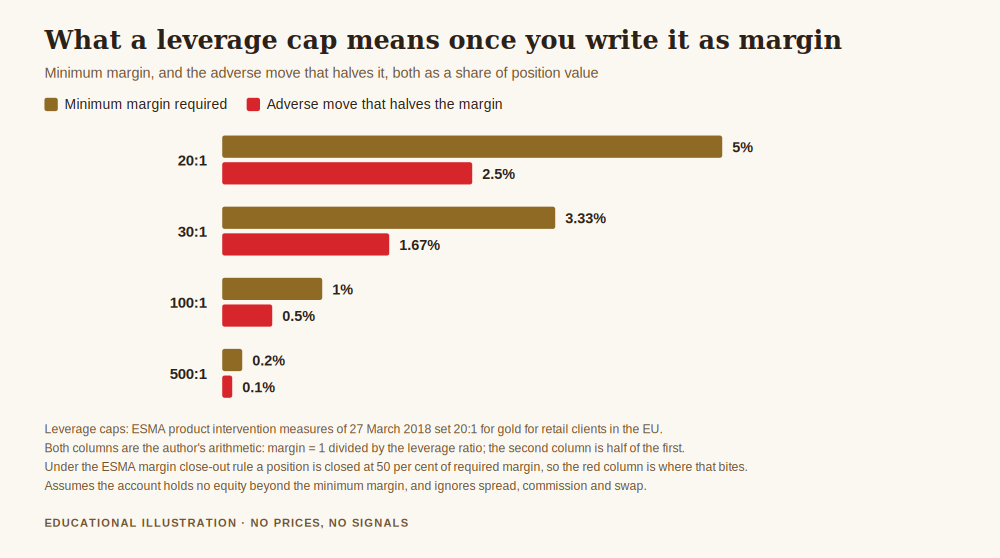
Now run the same arithmetic on the offer in the screenshot. At 500 to 1 the margin is 0.2 per cent of position value, and half of that is 0.1 per cent. A move of a fraction of one per cent, which gold can produce while you are making coffee, sits between the account and nothing.
Put plainly, a leverage cap is not a limit on how much you can make. It is a floor under how much adverse movement your account can survive before the decision is taken out of your hands.
The protection you will not notice until the one day it matters
Of the five obligations, the one I would not give up is negative balance protection, and it is the one nobody asks about.
Without it, a gap in the market can take your account past zero and leave you owing the firm money. This is not hypothetical. It is the standard outcome when a market jumps a long way without trading at the levels in between, which is precisely what happens around a surprise announcement or a weekend event. Your stop does not fail, there is simply nothing to fill it at.
Negative balance protection caps that at your account balance. You can lose what you deposited, which is bad enough, and not more. I would rather have a lower leverage cap and that guarantee than a high cap and an open-ended liability, and the trader who has lived through one gap will not need persuading.
The mechanism is covered in more detail in what negative balance protection is in forex, which is worth reading before you decide a cap is an inconvenience.
The other side: what the unregulated end of the market costs people
It is tempting to treat all this as paperwork. The alternative has a measurable price.
The FBI's Internet Crime Complaint Center publishes an annual report, and in the 2025 IC3 Annual Report investment fraud was the largest single loss category: 8,648,617,756 dollars reported lost across 72,984 complaints. That works out at about 118,500 dollars per complaint, my division. Total reported losses across all crime types were 20.877 billion dollars, so investment fraud alone was 41.4 per cent of the whole, again my arithmetic.
There is a line in that report that belongs on this site in particular. Gold courier scams accounted for roughly 725 complaints and 311.8 million dollars in losses, which is about 430,000 dollars per complaint. Criminals persuade a victim that their money is at risk and send a courier to collect cash or precious metals. People who thought they were protecting their savings handed them to a stranger at the door.
The report also notes that 72 per cent of reported investment fraud losses moved by cryptocurrency, which is worth remembering the next time a firm asks to be funded that way and explains that it is faster.
How to check, in about ten minutes
This is the part to do before you deposit, not after a withdrawal is refused.
- Find the entity name, not the brand. The trading name on the website is often not the authorised company. Scroll to the footer and read the legal entity and its registration.
- Look that entity up on the regulator's own register, by typing the regulator's address yourself rather than following a link the firm supplies. Clone sites that copy a real firm's licence number are common enough that supervisors publish warnings about them.
- Check which entity you are being onboarded to. Groups frequently hold several licences and place clients from some countries with an offshore entity carrying none of the protections above. The leverage you are offered is usually the clue: an offer far above the local cap means you are not with the regulated entity.
- Read the risk warning. If the firm is under the ESMA style rules it must publish its own retail loss percentage. A missing warning tells you something.
- Test a withdrawal early and small, before the balance is one you would mind losing.
The step by step version of the register check is in how to check a forex broker licence, and the warning signs that something is wrong before you get that far are in how to spot a gold trading scam.
What regulation will not do for you
I want to end this honestly, because overselling protection is its own kind of harm.
Regulation does not make trading safe. The regulator's own figure says 74 to 89 per cent of retail CFD accounts lose money, and those accounts were at regulated firms. That is the headline I would hang on the wall. Every protection described here operates at firms where most clients still lose, which tells you where the real risk sits. It is not in the firm. It is in position size, in frequency, and in the decision to trade an instrument you have not priced.
What regulation does is remove a specific set of catastrophes from the table: losing more than you deposited, being closed out at a level nobody told you about, being lured in by a bonus, being unable to find out who holds your money. That is worth having. It is not the same as being protected from yourself, and no supervisor has ever claimed otherwise.
Get the free Black Gold Market blueprint, a short document on protecting capital before you try to grow it, including the checks to run on a firm before you send it any money. One email, no spam, unsubscribe anytime.
Get the free blueprint →Frequently asked questions
What is a regulated broker in one sentence?
A firm authorised by a named financial supervisor to carry out named activities, listed on that supervisor's public register under a licence number, and bound by that supervisor's rules on leverage, client money, close out and disclosure while it operates.
Does regulation mean my money is guaranteed?
No. It means a defined set of obligations applies, among them negative balance protection and a margin close out at 50 per cent of required margin under the ESMA measures. Some jurisdictions add a compensation scheme with its own cap and conditions. None of that guarantees your trading results, and the regulator's own data says 74 to 89 per cent of retail CFD accounts lose money.
Is high leverage a sign a broker is unregulated?
Not on its own, because caps differ by jurisdiction and a firm may be properly authorised somewhere with higher limits. It is a reliable sign that you are not being onboarded under the European style rules, where gold is capped at 20 to 1 for retail clients. If the offer is far above your local cap, find out which entity you are actually signing with.
What does a 20 to 1 cap mean for my account in practice?
It sets the minimum margin at 5 per cent of position value. With the close out rule at half of that, an adverse move of 2.5 per cent of position value reaches the close out level if you funded the position with the minimum and nothing more. That is my calculation, ignoring spread, commission and swap. At 500 to 1 the same arithmetic gives 0.1 per cent.
How do I check a broker is really regulated?
Find the legal entity in the website footer rather than the brand name, then look that entity up on the regulator's register by typing the regulator's own address, never by following a link the firm gives you. Clone firms copy real licence numbers. Then confirm which entity your account is being opened with, because groups often place clients from some countries with an entity holding no licence at all.
Why does a gold site care about fraud statistics?
Because the people targeted are the people reading this. In the 2025 IC3 report investment fraud was the largest loss category at 8.65 billion dollars, and gold courier scams alone accounted for about 725 complaints and 311.8 million dollars. Those victims were trying to protect savings. The check that would have helped most of them takes ten minutes and happens before any money moves.
Where Black Gold Market fits
Black Gold Market is a free journal about reading gold and protecting capital, written for traders who would rather understand a mechanism than be handed a conclusion. Everything on the site is free to read and there is nothing to buy to follow along. The optional piece is the Sustainable Trader's Blueprint above, a short document on protecting capital before trying to grow it. We do not promise profits, we do not publish results, and we do not think anyone can tell you what your account will do. The piece this one sits underneath is how to protect your capital when gold gets volatile.
About the author. Raphael writes Black Gold Market. He spent his first year with a firm he could not have named the regulator of, and the thing that changed his mind was not losing money there but realising he had no idea what would happen to his balance if the firm failed. Nothing in this article is a recommendation of any firm or a recommendation to trade, and no entry, stop or target discussed should be treated as a signal.