

Ask what is COMEX gold and you will usually get an answer that is either too short to use or too long to follow. The short one is "it is where gold futures trade", which is true and tells you nothing. The long one disappears into warehouse receipts and delivery notices within two paragraphs. What I want to do here is give you the version that actually changes how you read your own screen, because the price you are trading, whatever your broker calls it, is anchored to a room with fewer people in it than you probably imagine.
I am going to work from one real report, published by a regulator, for one real week. Everything below is either quoted from it or is arithmetic you can repeat on the same numbers.
What Is COMEX Gold, in Plain Terms
COMEX is the metals arm of an exchange. It is not a vault you can visit, not a price feed, and not a company that owns gold. It is a venue with a rulebook, and the thing it lists is a standardised contract: an agreement to deliver a fixed quantity of gold of a fixed purity at a fixed future date.
That word standardised is doing the work. On COMEX nobody negotiates how much gold, or what purity, or when. Those are fixed by the contract, and the only thing left to argue about is the price. Strip away everything else and that is the whole invention. By taking every variable off the table except one, an exchange turns a thousand private bargains into a single number that everyone can see.
The US Commodity Futures Trading Commission publishes weekly position data for that venue, and its Commitments of Traders report for the COMEX division lists the gold contract under the heading "GOLD, COMMODITY EXCHANGE INC.", code 088691. Directly beneath the column headings, the report states the unit in capitals: contracts of 100 troy ounces.
So the answer to what is COMEX gold, at the level that matters, is this. It is a 100 ounce unit, traded on a regulated venue, whose price becomes the reference that almost everything else in the gold market is quoted against.
The Contract Is the Product
One hundred troy ounces is a serious quantity. That is the smallest full size unit the exchange deals in, and it is worth pausing on, because it explains why the participant list looks the way it does. You do not wander into this market. The minimum ticket is a bar's worth of metal.
The exchange does list a smaller version. In the same report, "MICRO GOLD, COMMODITY EXCHANGE INC.", code 088695, carries the line contracts of 10 troy ounces. One tenth the size, and the smallest step the venue permits. Below that, there is nothing on COMEX at all. If you are trading gold in quantities smaller than ten ounces, and most retail traders are, you are not on this exchange. You are somewhere downstream of it, which is a point I will come back to.
A futures contract is also an obligation rather than a preference. Held to expiry, it settles by delivery of metal against payment. In practice the overwhelming majority of positions are closed or rolled before that happens, but the possibility of delivery is not decorative. It is the thread that ties the traded price to physical metal, and it is why the futures price cannot drift arbitrarily away from the cash market for long. Someone would take the other side and collect the difference in metal.
Who Is Actually in the Room
Here is where the report stops being a definition and starts being interesting.
For the week ending 15 September 2026, open interest in the full size gold contract was 409,899 contracts. At 100 troy ounces each, that is 40,989,900 ounces. Converted at the standard 32,150.7466 troy ounces to the tonne, the open position in that single contract represented 1,274.9 tonnes of gold. Micro gold added 90,365 contracts, or another 28.1 tonnes, bringing the two to 1,303.0 tonnes between them.
Now the part that surprised me the first time I worked through it. The number of traders large enough to be required to report their positions in the full size gold contract that week was 296. Not 296,000. In micro gold, 44.
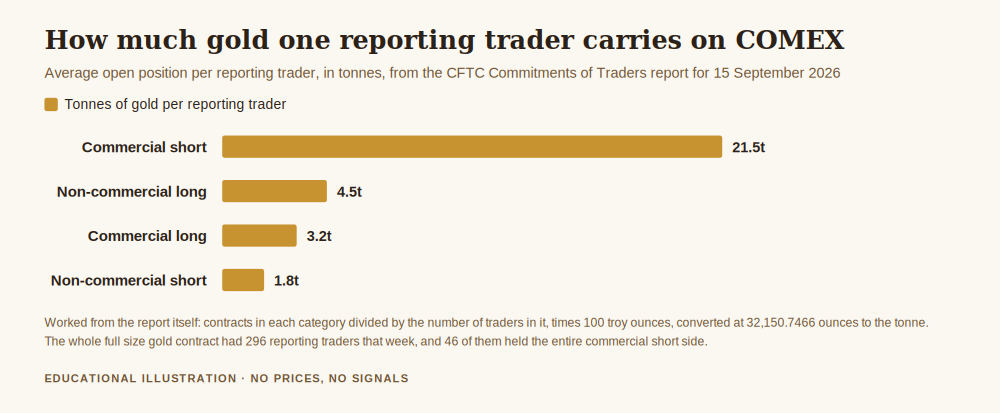
Break it down by category and the concentration is sharper still. Commercial short positions, the side typically held by producers, refiners and bullion banks hedging inventory, totalled 318,138 contracts, which is 77.6 per cent of all open interest. Those positions were spread across 46 traders. That is an average of 6,916 contracts each, or 21.5 tonnes of gold per trader.
On the other side, non commercial longs, the category that covers funds and speculative money, held 258,059 contracts across 179 traders. An average of 1,442 contracts, or roughly 4.5 tonnes each. The average commercial short is therefore close to five times the size of the average non commercial long.
Read that back slowly. Three quarters of the short side of the world's reference gold contract sat with 46 participants. This is not a crowd. It is a small number of very large operators, and everyone else, including you and me, is pricing off what they agree on.
Why COMEX Sets the Price on Your Screen
Most retail traders never touch a futures contract. You open a platform, you see XAU/USD, and you buy or sell something your broker calls spot gold. So why does a venue with 296 reporting traders decide what that shows?
Because price discovery and price distribution are two different jobs, and they happen in different places.
Discovery is the process of finding out what a thing is worth right now, and it happens where the largest, best informed, most committed orders meet. That is the futures market and the over the counter market that sits alongside it. Distribution is the process of getting that answer onto millions of screens, and that is what brokers, data vendors and CFD providers do. Your platform is not discovering the price of gold. It is relaying a price discovered elsewhere, with its own spread added.
There is a second reference point worth knowing, because the two get confused. The London Bullion Market Association runs an auction that produces a published benchmark twice each trading day, and the LBMA precious metal prices are the settlement reference used across contracts, valuations and accounting worldwide. That benchmark is a snapshot taken at a moment. COMEX futures trade nearly around the clock. They are answering related but different questions, one asking what gold is worth at this instant for future delivery, the other asking what the market agreed it was worth at a fixed hour today.
Neither of them is the number on your platform. Yours is derived from them, and it carries a spread, and on some venues a swap charge, on top. I have written separately about COMEX vs spot gold price if the gap between the two is what you are chasing.
What COMEX Means for a Retail Account
Three practical things follow, and none of them are about predicting direction.
The first is a sense of scale. When you open one standard lot of XAU/USD, you are controlling 100 ounces, the same quantity as one full COMEX contract. Your broker may only require a small fraction of its value as margin, but the exposure is a full exchange sized unit of gold. People who feel that a single lot is a modest position have usually never made the comparison. It is not modest. It is the exchange minimum, and the exchange minimum exists because the participants are institutions.
The second is a sense of who you are trading against. The Commitments of Traders report is published every Friday for positions as of the preceding Tuesday, and the CFTC's Commitments of Traders programme has done this since long before any of us had a chart. You can read, free, roughly where the largest participants sat a few days ago. That is a rare thing in any market.
The third is a warning about the second. Read the report as structure, never as a signal.
What This Does Not Tell You
I would rather give this its own section than bury it, because the Commitments of Traders report is one of the most consistently misread documents in the retail world.
It is late. Positions are reported as of Tuesday and published on Friday afternoon. By the time you read that commercial shorts grew, three days of trading have already happened on top of the picture you are looking at.
It is not directional. A commercial short is very often a hedge against physical metal the firm already owns, so calling it bearish misunderstands what the position is for. A refiner short 500 contracts against bullion in its own vault is not expressing a view about next week. It is removing a view it did not want.
And the categories are coarse. A single reported number covers producers, merchants, processors and users, all with different reasons for being there. Averaging 318,138 contracts across 46 traders, as I did above, tells you about typical scale. It does not tell you that any particular firm holds 6,916 contracts, and it would be wrong to read it that way.
What the report does give you, reliably, is a picture of the shape of the market: how much metal is committed, how few hands hold it, and how lopsided the two sides are. That is structural knowledge. It belongs in the same part of your thinking as knowing that gold reserves sit with central banks who do not trade them week to week. Useful for understanding why the market behaves as it does, useless as a reason to enter.
Get the free Black Gold Market blueprint, a short document on protecting capital before you try to grow it, including how to tell a piece of market structure from a reason to trade. One email, no spam, unsubscribe anytime.
Get the free blueprint →Frequently Asked Questions
What is COMEX gold, in one sentence?
It is a standardised 100 troy ounce gold futures contract traded on a regulated US exchange, whose price serves as the global reference that spot quotes, CFDs and broker feeds are derived from. The unit is stated in capitals in the CFTC's own weekly report: contracts of 100 troy ounces.
Is COMEX gold the same as the gold I trade as XAU/USD?
No, but they are tied together. XAU/USD at a broker is usually a contract for difference priced off the futures and over the counter markets, with a spread added. You are not trading on the exchange, you are trading a product priced from it. One standard lot happens to be the same 100 ounces as one full COMEX contract, which is worth knowing when you size.
How many people actually trade COMEX gold?
Far fewer than most expect. In the week ending 15 September 2026, only 296 traders were large enough to be required to report positions in the full size contract, and 44 in micro gold. Smaller participants exist below the reporting threshold, but the positions that move the reference price are concentrated in a small group.
Does COMEX hold all that gold in a vault?
Not in the way the open interest figure might suggest. Open interest of 409,899 contracts represents 1,274.9 tonnes of contractual exposure, not 1,274.9 tonnes sitting in storage against it. Most positions are closed or rolled before delivery. The right to take delivery is what keeps the futures price honest against physical metal, but exercising it is the exception.
Can I use the Commitments of Traders report to decide when to trade?
I would not. It is published on Friday for Tuesday's positions, so it is already three days stale when you read it, and a large commercial short is usually a hedge against metal already owned rather than a bet on the price falling. Read it to understand the market's shape, not to time an entry.
Where Black Gold Market Fits
Black Gold Market is free to follow. Daily XAU/USD analysis with the level, the context and the risk stated before the outcome is known, losing days included. There is a free blueprint for anyone who wants the capital protection material gathered in one place, and an optional Kit for people who want the full method. Nothing here promises a profit, and nothing here is a signal service. If you are building the structural picture, read COMEX vs spot gold price next for the gap between the two quotes, then how to protect your capital when gold gets volatile for what any of it should actually change about your sizing.
Knowing what is COMEX gold will not tell you where gold goes next. It will tell you whose market you are a guest in, and that is a more durable thing to know.
About the author. Raphael writes Black Gold Market. He reads exchange paperwork more often than he reads opinions, because the paperwork says who is actually committed and the opinions do not. Nothing in this article is a recommendation to trade, and no entry, stop or target discussed should be treated as a signal.