
Market mechanics

A trader closes a gold position after two weeks. Price finished almost exactly where they expected, and the trade should have paid out close to plan. The account balance tells a smaller story than the chart does, a real gain, thinner than the price move alone would suggest.
Nothing on the chart caused that gap. It sat in three costs that never show up as a red candle, the spread paid at entry, a commission line the broker never mentioned out loud, and a financing charge that added up quietly every night the position stayed open.
The idea in plain words
Every open position pays through three channels, best treated as three bills rather than one vague idea of "costs." The first is the spread, the gap between the price you can buy at, the ask, and the price you can sell at, the bid. You pay it once, at entry, because your position starts slightly underwater against the middle of that gap. The spread is not fixed. It widens around scheduled news, because market makers grow less certain of the next fair price and quote a wider gap to protect themselves. It also widens at the session rollover late in the trading day, when liquidity providers thin out, so a position opened right then can start with a bigger handicap than the same trade an hour earlier.
The second bill is commission, a stated fee per lot per side, charged on top of a narrower "raw" spread closer to the real interbank price. A raw spread plus commission account and a wider all in spread account are two ways of charging for the same service, not two different services. To compare them fairly, add the commission for both sides back into the spread and look at the total cost per lot, not the headline number. A tight spread with a stacked commission can cost more than a wider spread with none at all.
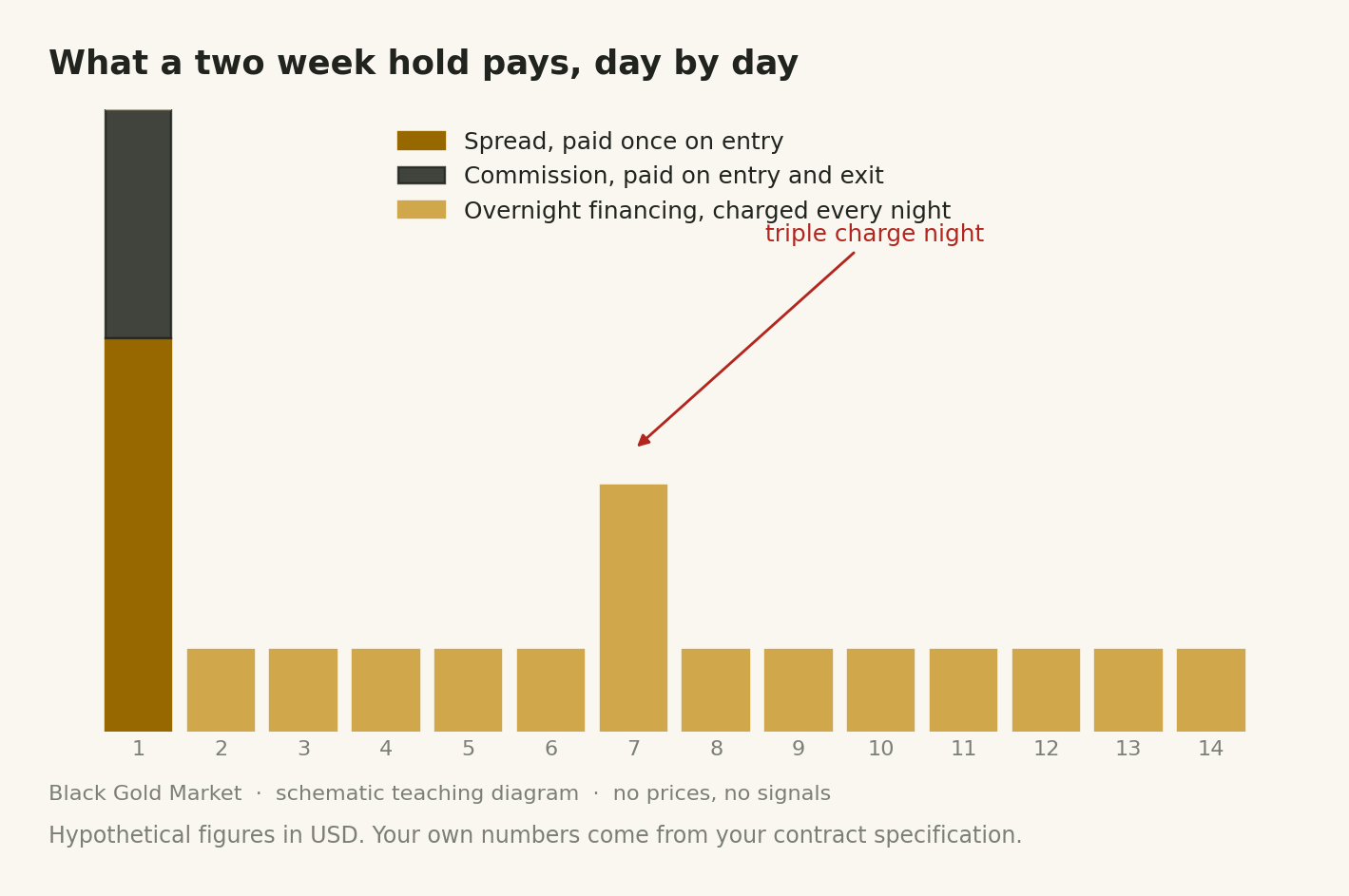
The third bill is overnight financing, sometimes called a swap or a rollover charge. Most gold and currency positions settle two business days after the trade date, so a broker holding your position open past a daily cutoff is effectively lending you, or borrowing from you, the money behind it, and charges interest for that. Since weekends do not count as settlement days, one weekday, commonly Wednesday, is charged three times over to cover Saturday, Sunday and itself. Check your own broker, some use Friday. One night is usually small. Fourteen nights on a swing trade is not, and because it never appears as one dramatic line, it is the cost traders budget for least.
None of the three is dishonest on its own. The problem is treating any one as the whole picture. True cost is the spread plus commission plus every night of financing, measured together against your plan.
A worked example
This example is entirely hypothetical, built to show the arithmetic, not a real quote or a recommendation to trade.
Suppose a trader opens one standard lot of gold, 100 ounces, on a raw spread plus commission account, held for two nights.
- Spread. Raw spread quoted at $0.12 per ounce. On 100 ounces, that is $12.00, paid once at entry.
- Commission. $3.50 per lot per side, charged on entry and again on exit, so $3.50 x 2 = $7.00.
- Financing. A hypothetical $2.10 per lot per night. Held two ordinary nights, that is $2.10 x 2 = $4.20.
Total round trip cost, all in, before any profit or loss on price, is $12.00 + $7.00 + $4.20 = $23.20.
Now put that next to a risk budget. Say the trader risks 1% of a $5,000 account, or $50.00. The $23.20 in costs is $23.20 / $50.00 = 46.4% of the risk budget, before the trade moves a single cent.
If one night fell on the triple charge day, financing alone triples to $6.30, taking the total to $25.30, or 50.6% of that budget. Stretch the hold to two weeks, fourteen nights, and financing alone reaches $29.40, more than spread and commission combined, over half the risk budget with no bad entry required.
A small table
| Cost | When it is charged | How it is quoted | How to check it before you trade |
|---|---|---|---|
| Spread | Once, at entry | Price units per ounce or per pip | Watch the live spread in a normal hour and around news |
| Commission | On entry and exit, per lot per side | A flat amount per lot | Read the fee schedule and check for a minimum per ticket |
| Financing | Per night held past the cutoff, tripled one weekday | An amount per lot per night, long or short | Look up the swap table and confirm the triple day |
Where people go wrong
Comparing a raw spread to an all in spread. A trader sees a raw spread of $0.12 and assumes it beats an all in spread of $0.20, without adding commission back in. Add the $0.07 per ounce commission and the raw account can cost more, the worse deal chosen while believing it was better.
Planning a multi week hold without pricing the financing. A strategy that looks profitable on price moves alone can turn marginal once every night of financing is subtracted, quietly bleeding even when the analysis behind it was correct.
Holding through the triple charge day without checking. A trader who does not know which weekday carries the triple charge can be surprised by a much larger overnight bill, and mistake it for a broker error instead of scheduled pricing.
Your turn
- Open your broker's fee schedule and write down the spread, the commission per side, and the overnight financing rate for one pair.
- Using a hypothetical one lot position, calculate the round trip cost, spread plus both sides of commission plus one night of financing.
- Express that total as a percentage of the risk budget you use on a single trade.
- Repeat for ten nights held, noting where financing alone overtakes the entry cost.
Check yourself
Why does the spread tend to widen around scheduled news and at the session rollover?
Market makers grow less certain of the next fair price and quote a wider gap to protect themselves, and liquidity providers thin out during the rollover, which widens it too.
How do you fairly compare a raw spread plus commission account against a wider all in spread account?
Add the commission charged on both sides back into the raw spread and compare that combined total to the other account's all in spread. Comparing headline numbers alone is misleading.
Why can a position held for several weeks quietly cost a lot in financing, even if the spread and commission were small?
Financing is charged every night the position stays open, including a triple charge on one weekday, so it accumulates steadily and can exceed the entry cost well before the position closes.
Costs are only half of what decides where a trade gets filled and how price behaves while it is open. The next lesson looks at sessions and liquidity, including when that rollover happens and why it shifts every year.