
Market mechanics

You place the same trade you have placed a dozen times before. Same size, same distance to your stop. This time the fill lands several cents worse than the price on your screen, and the spread you check afterward is three or four times wider than usual.
Nothing about your setup changed. What changed is the clock. You traded gold at three in the morning your time, when most of the desks that normally stand ready to take the other side of your order were asleep.
The idea in plain words
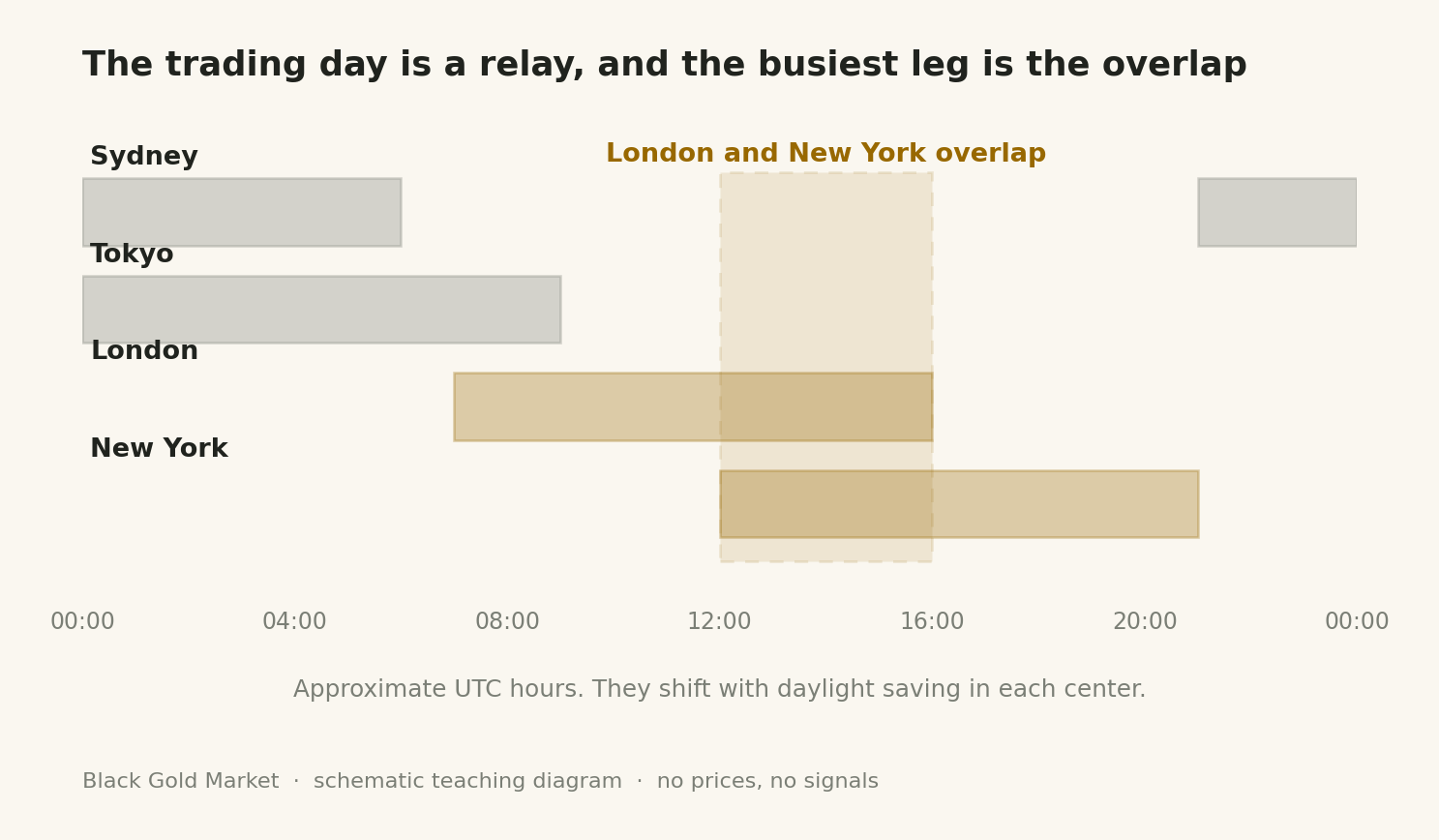
Gold trades close to twenty four hours a day through the working week, because no single country's market has to cover the whole thing alone. Traders describe the day as a relay between four financial centers, loosely named Sydney, Tokyo, London and New York. As one winds down, another is already awake, and the handoffs are not clean walls. Sydney is still trading when Tokyo opens, London is still trading for hours after New York opens, so at almost any hour, one or two centers are active together.
The reason the session clock matters is liquidity. In plain words, liquidity is how easily a given amount of buying or selling can go through without moving the price much. When it is deep, plenty of orders sit close to the current price, so a normal order fills near the price you saw and barely nudges the market. When it is thin, those orders are sparser and further apart, so the same order has to reach further to fill, and moves the price more just by existing.
Gold is quoted against the US dollar, and a large share of institutional volume, including futures, sits on American exchanges. That is why the hours when London and New York are both open usually carry the day's heaviest activity, two large centers working the book at once, with US economic data landing early in New York on top. Liquidity is not a fixed property of gold, it is a property of the hour you are looking at it.
Thin liquidity has two practical effects worth knowing. First, spreads, the gap between the price you can buy at and sell at, widen, because market makers protect themselves when a fresh opposing order is less likely to show up soon. Second, stop orders suffer. A stop becomes a market order once its trigger is touched, and fills at whatever price it can find. In a thin book that price can sit well past the trigger, so a stop can lose more than planned even when the level was read correctly.
There is also a daily rollover window worth knowing. Once a day, usually around the New York close, brokers pause briefly or widen pricing to roll positions and settle financing. Spreads often spike either side of it, even though nothing has happened in the underlying market. It is plumbing, not a signal.
A worked example
These numbers are a hypothetical illustration, not a live quote from any broker. Suppose a broker's typical gold spread during the overlap is $0.30 per ounce, and its typical spread in the quiet hour before Tokyo opens is $1.20 per ounce, four times as wide. For a hypothetical 5 ounce position, the spread cost alone works out as follows.
- Overlap hours. $0.30 x 5 ounces = $1.50 in spread cost.
- Thin hours before Tokyo. $1.20 x 5 ounces = $6.00 in spread cost.
Same trade, same size, $4.50 more just from the spread, before commission or any other cost is added.
Now add a stop to the same hypothetical trade. Planned risk is a $1.00 move against 5 ounces, or $5.00. In liquid conditions the stop fills near its trigger, so the loss lands near $5.00. In thin conditions the same stop might fill $0.40 past its trigger, adding $0.40 x 5 ounces, or $2.00, for a total loss of $7.00, forty percent more than the risk accepted.
The four sessions at a glance
| Session | Approximate UTC hours | What a trader typically notices |
|---|---|---|
| Sydney | 2200 to 0700 | Thin, quiet order books, often the first prices after a weekend or the New York close |
| Tokyo | 0000 to 0900 | Liquidity picks up modestly, ranges often stay tight outside of Asian data |
| London | 0800 to 1700 | Liquidity increases sharply as European desks come online, ranges widen |
| New York | 1300 to 2200 | Heaviest volume while London is still open, thinning after London closes |
Treat every hour above as approximate. Daylight saving changes in the US, the UK and Australia do not fall on the same date, so the overlap shifts by an hour against the clock for a few weeks each spring and fall. Check a live session clock rather than memorizing a fixed number.
Where people go wrong
Treating a busy market as a good market. A trader sees a fast candle during the overlap and assumes more movement means more opportunity, chasing an entry into a move that already happened, at a worse price than waiting would have given.
Trading through the rollover window without knowing it exists. A trader holds through the spread spike, then blames the setup for a bad fill that had nothing to do with their analysis.
Assuming session hours are fixed on the calendar. A trader keeps trading the overlap at last season's clock time after daylight saving moves it, ending up in the thin edge of the window while believing they are in the deep part.
Your turn
- On a demo account, over five sessions, note the clock time you trade and the spread on your platform, then check whether London and New York were both open.
- Place one demo market order in a quiet hour, such as the gap before Tokyo opens, and one during the overlap. Compare the expected price to the actual fill for each.
- Find your broker's daily rollover time in your local clock. Over three days, note what the spread does either side of it.
Check yourself
What does liquidity actually measure
How easily a given amount of buying or selling can be filled near the current price without moving it much. Deep liquidity means orders fill near that price, thin liquidity means the same order moves price further and fills at a worse average level.
Why does the London and New York overlap usually carry the most activity in gold
Two large financial centers trade at once, deepening the pool of resting orders, and most US economic data lands early in New York on top, so the overlap stacks both centers' activity together.
Why isn't the busiest window automatically the best time for a new trader
Fast, wide moves are harder to size and manage, and a stop can slip further even when the level was read correctly. A beginner without a tested approach to risk can come out of a loud hour worse off than a quiet one.
Once you have a feel for when the market runs deep or thin, the next useful skill is reading what price actually did inside those hours, one candle at a time, covered next in Candles and context.