
Market mechanics

You open the platform, type in a lot size, and the broker lets you place the trade without a second thought. The required margin box shows a small number, comfortably inside your balance, so you click. Nothing on that screen told you how much money you would actually lose if the price went the wrong way.
That gap, between what the broker will let you open and what a bad move actually costs, is where accounts get hurt. Getting margin and leverage straight is not about finding a bigger number to trade with. It is about seeing what each term measures, so small percentages on a screen stop hiding a large dollar risk.
The idea in plain words
Margin is a deposit, not a cost. When you open a position, the broker sets aside part of your equity as collateral while the trade runs. That collateral, called required margin, comes back to you in full when you close the position, win or lose. Nothing is spent on it. The size of the deposit is set by leverage, a ratio such as 20 to 1 or 500 to 1. A higher leverage ratio from the broker means a smaller required margin for the same position, because the broker asks you to set aside less collateral against the same position value, also called notional value.
Broker leverage and effective leverage are not the same thing, and mixing them up is the most common error in this topic. Broker leverage is the maximum ratio the firm allows. Effective leverage is what you are actually running on a trade, position value divided by account equity. A trader on a 500 to 1 account who opens a position worth twice their equity is running 2 to 1 effective leverage. A trader on a 20 to 1 account who commits all of it can also end up at 20 to 1. The broker's ceiling says what is allowed. Your own position size decides what you are exposed to.
Two more terms describe the account while a trade is open. Free margin is equity minus the margin held by open positions, what is left to open new trades or absorb a loss before anything forces you out. Margin level is a percentage showing how much room remains, equity divided by used margin, times 100. When margin level falls to a threshold the broker sets, usually near 100 percent, you get a margin call, a warning the account cannot absorb much more loss. If margin level keeps falling, the broker reaches stop out, where it closes positions itself, regardless of your own plan.
A worked example
Take a hypothetical position worth USD 20,000 in gold, held against USD 1,000 of equity. Position value divided by equity puts effective leverage at 20 to 1, whatever the broker's account settings happen to quote.
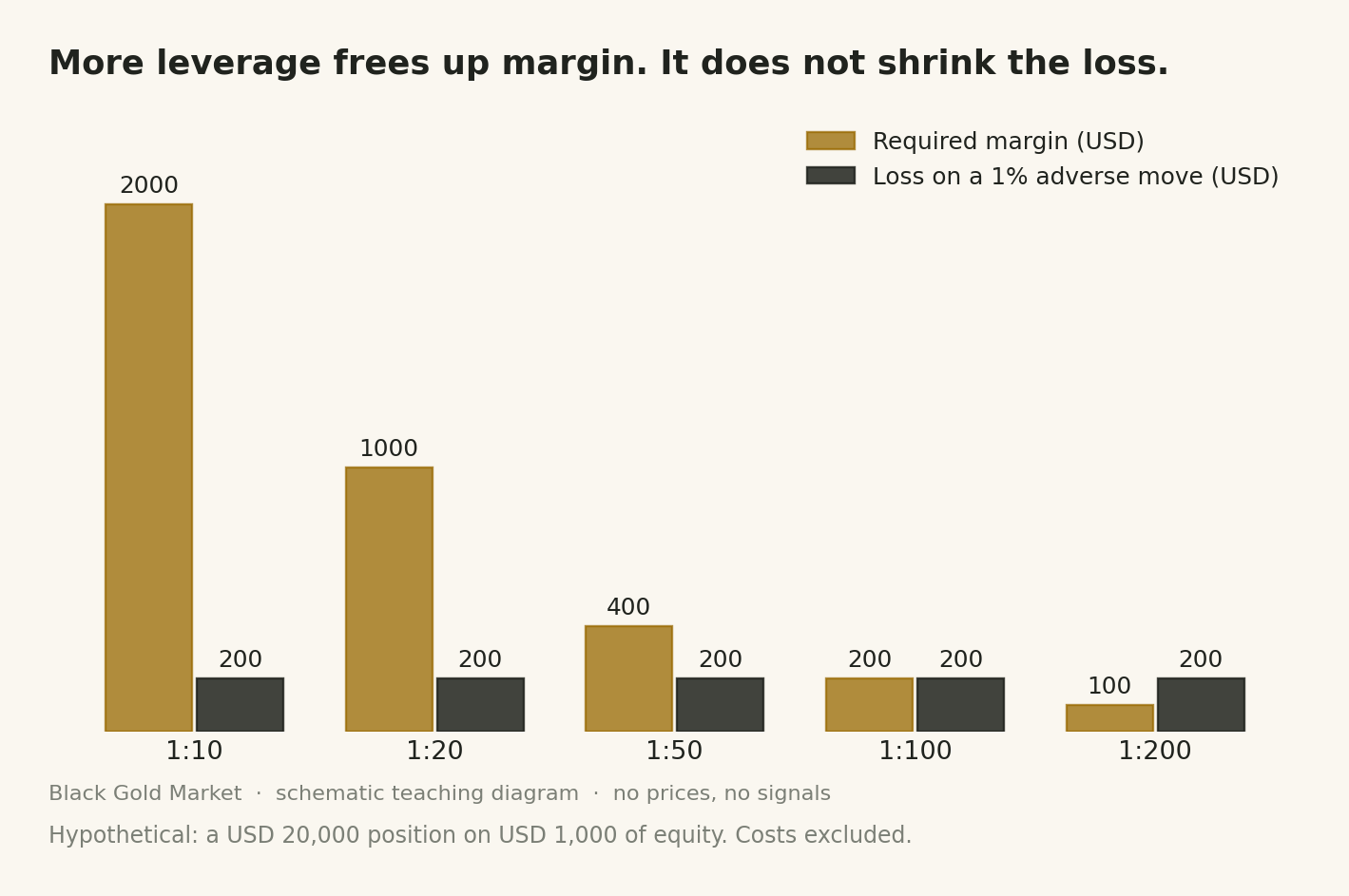
Put a broker leverage cap of 100 to 1 on that account. Required margin is position value divided by broker leverage, 20,000 divided by 100, or USD 200. Free margin is 1,000 minus 200, or USD 800. Margin level is equity divided by used margin, times 100, or 500 percent. Every number on the screen looks comfortable.
A 1 percent adverse move on the USD 20,000 position is USD 200, before spread, commission or financing. Against USD 1,000 of equity, that single move is 20 percent of the account, before any cost is added. That is the number the required margin box never shows.
Raise the broker's leverage cap to 500 to 1, keeping the position at USD 20,000. Required margin drops to USD 40, free margin rises to USD 960, and margin level climbs to 2,500 percent. Every figure tied to margin looks safer, but the position has not changed size, so the 1 percent move still costs exactly USD 200, still 20 percent of equity. Lowering required margin changed how much spare room the account appears to have, and nothing about what the position costs when the market moves.
Reduce the position itself instead, to USD 5,000 on the same USD 1,000 equity. Effective leverage is now 5 to 1. A 1 percent adverse move is USD 50, or 5 percent of equity, before costs, a quarter of the damage from the same size move on the same account. Size, not the leverage number printed on the account, is the dial a trader actually controls.
The five numbers on your account screen
| Term | What it tells you | How it is worked out |
|---|---|---|
| Required margin | Collateral held while a position is open | Position value divided by broker leverage |
| Free margin | What is left to open trades or absorb a loss | Equity minus used margin |
| Margin level | How much room remains, as a percentage | Equity divided by used margin, times 100 |
| Margin call | A warning that margin level hit the broker's limit | Set in the broker's terms, often near 100 percent |
| Stop out | Where the broker closes positions automatically | Set lower than the margin call level |
Where people go wrong
Treating a high broker leverage as a target. A trader who sees 500 to 1 available and uses more of it just because it is offered ends up running a large effective leverage on ordinary equity, so a routine price move costs a large share of the account.
Sizing a position from the margin the broker allows, not from a loss already accepted. If the platform lets a position open, that confirms the broker has enough collateral. It confirms nothing about whether the position fits the account.
Ignoring margin level until a margin call arrives. By the time the warning shows up, the account is already close to stop out, and the trader has lost the choice over which positions get closed and at what price.
Your turn
- On a demo account, record the leverage cap and required margin for one micro lot of gold.
- Calculate effective leverage for that position and compare it with the broker's cap.
- Work out free margin and margin level, then find the margin call and stop out thresholds.
- If the platform allows a different leverage setting, confirm the dollar cost of a 1 percent move stays the same at both.
Check yourself
Is required margin money spent on the trade?
No. It is a deposit held as collateral while the position is open, and it comes back to the account when the position closes, separate from any profit or loss.
If a broker raises its leverage cap, does a position become less risky?
No. A higher cap only lowers the required margin for a given position. The dollar cost of a price move on that same size stays the same, because it depends on position value, not on the leverage the broker allows.
What is the difference between a margin call and a stop out?
A margin call is a warning that margin level has fallen to the broker's threshold. Stop out is a lower threshold where the broker starts closing positions automatically, without waiting for the trader to act.
Required margin only measures whether the broker will accept a trade. What that trade costs once spread, commission and financing are added is covered next in Spread, commission and financing.