
Advanced chart reading

A trader watches gold grind under a level for two days, the same ceiling turning price back three times. Then one candle punches through, wide and confident, and the trader buys on the spot, sure they just caught the move everyone was waiting for.
Ten minutes later price is back under the line and the stop is gone. The level held exactly like it always did. That deserves a proper look, not just a shrug.
The idea in plain words
A breakout is price moving through a level that has held before, a point where price has turned back more than once. A false break is what happens when price moves through that level and comes straight back to the other side within a short time, trapping anyone who entered on the way through.
Breakouts fail more than the charts suggest, and it is not bad luck. A level that looks obvious on your chart looks just as obvious to everyone else, and two crowds gather at almost the same price, just beyond it, one holding older positions with a protective stop resting there, the other waiting to enter the moment price breaks. That cluster of resting orders is what people mean by liquidity, plainly put, a pool of orders waiting to be filled at a price. A price with plenty of resting liquidity nearby is an easy place for the market to visit, because filling those orders lets larger trades happen without moving price far. Once that pocket is filled, the push behind it often has nothing left, and price can drift back to where it started.
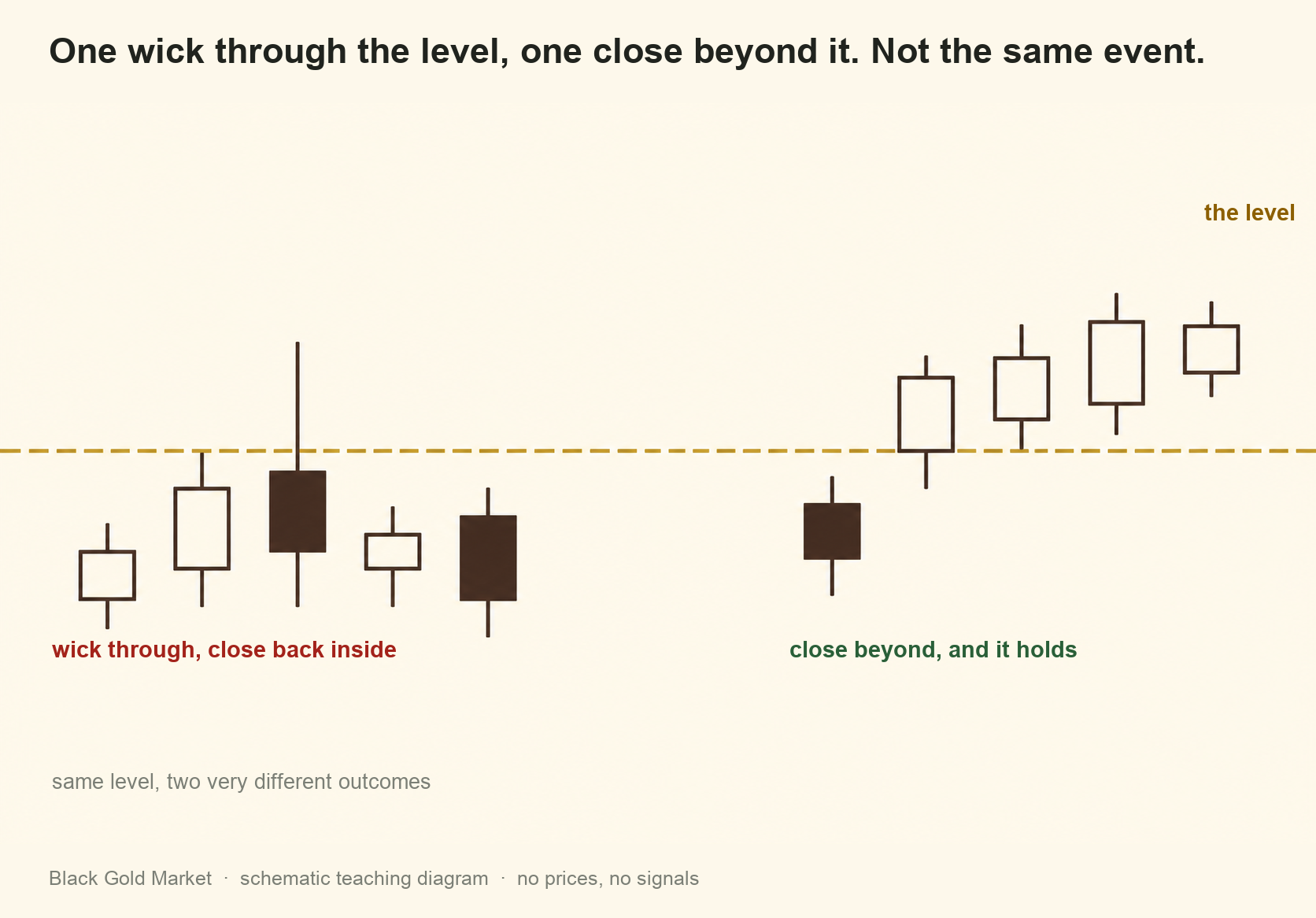
A wick is the thin line above or below a candle's body, showing the highest or lowest price reached in that period. A close is where the candle ends. Price can wick through a level and close back inside the old range in the same candle, showing only a brief visit before being turned away. A close is different, it means one side held the new ground for the whole candle, stronger evidence than a wick, though still not proof.
Before taking any breakout, write down in plain words what would prove it wrong. A workable version reads like this. If price closes back on the old side of the level before the setup has had two full candles to prove itself, the breakout is invalid and the trade is finished, not adjusted.
A worked example
The numbers below are a hypothetical illustration, not a real historical price. Assume a resistance level on XAU/USD sits at 2,400.00, already stopping three earlier rallies. On the fourth attempt, one candle prints a high of 2,404.00 and closes at 2,403.20, above the level. The next candle pulls back to 2,401.10, holds above the old resistance, then price runs on to 2,415.00.
Enter immediately. Buying the instant price touches 2,400.00 fills near 2,400.50, and if the move carries to 2,415.00 that is 14.50 points before costs, the largest of the three, but taken before any evidence the level gave way, on every similar touch including the ones that only wick and reverse.
Wait for the close. Buying once the candle closes above the level fills near 2,403.20, missing the first 2.70 points. A stop just under the level, at 2,398.00, risks 5.20 points to chase 11.80 points, roughly 2.3 to 1 before costs.
Wait for the retest. Buying once price returns and holds above the old resistance fills near 2,401.10. A stop just under that pullback low, at 2,399.00, risks only 2.10 points to chase 13.90 points, near 6.6 to 1 before costs. The cost here is the chance the retest never comes, and the trader holds nothing while price runs on without them.
A small table
| Response to the break | What you gain | What you give up | Failure mode |
|---|---|---|---|
| Enter immediately | The largest possible share of the move | Any confirmation that the level gave way | Caught in a wick that reverses before the candle finishes |
| Wait for the close | Evidence that price held the new side for a full candle | The first part of the move, and often a wider stop | A close that still reverses on the next candle |
| Wait for the retest | A tighter stop and a better reward to risk | The trade entirely if the retest never comes | Watching the move run away with no position taken |
Where people go wrong
The exact-level stop. A stop-loss placed right at the obvious level, the same round number everyone else is watching, sits inside that cluster of resting orders. A brief wick fills it, and price often makes the original move anyway, without the trader in it.
The every-touch breakout. Trading every test of a level as if it is the real breakout ignores how often a level gets tested before it finally gives way. Each touch taken this way adds one small loss before the attempt that works, wearing down capital and patience first.
The thin-liquidity breakout. Around a session open, or in the seconds after scheduled news, far fewer real orders sit on the book. Less volume is then needed to push price through a level and back again, so a decisive-looking spike can be nothing more than a brief liquidity gap.
Your turn
- On a demo chart, pick one level, a swing high or round number, tested at least twice without closing beyond it.
- Before the next test, write down what would prove a breakout there wrong, in one sentence, naming a price and a number of candles.
- When price next reaches the level, note whether it only wicked through, whether it closed beyond, and how far price had to travel to get there.
- If it closes beyond, wait for one retest before acting, and write down the entry price each response in the table above would have given you.
- Compare those outcomes against your invalidation rule, and note which response would have given the best reward to risk this time.
Check yourself
Why does a breakout often fail right at the level that looks the most obvious on the chart
An obvious level attracts two crowds at once, traders with stops from earlier trades and traders waiting to enter on the break, and both rest orders at almost the same price, the liquidity the market can reach with least effort.
What is the difference between a wick through a level and a close beyond it
A wick only shows price traded there for a moment before the candle finished elsewhere, while a close shows price held the new side for the whole candle, stronger evidence, though still not proof.
Why does waiting for a retest usually produce a better reward to risk than entering immediately
The retest lets the broken level itself become the invalidation point, so the stop can sit close by, while entering immediately usually means a wider stop or no confirmed level to measure it against.
A break that holds on one timeframe can still be noise on a bigger one. The next lesson, Multiple timeframes, covers how to check a break against the bigger picture before deciding it means anything at all.