

Ask what is a gold sovereign and you will get two kinds of answer. One is about history, kings and empire, and it is genuinely interesting. The other is about metal, and it is the one that decides whether you are paying a sensible price. A sovereign is a small coin that is not pure gold, does not weigh a round number, and does not contain a round fraction of an ounce. Every one of those three facts is deliberate, every one of them is published by the people who strike the coin, and together they explain why two dealers can quote the same coin at prices that are not comparable until you do one division.
What is a gold sovereign, stated as a specification
The Royal Mint publishes a table of sizes and weights for the sovereign family, and it is refreshingly short. For the sovereign itself: diameter 22.05 mm, weight 7.98 g, alloy 916.7 Au. The same alloy figure, 916.7, applies to every coin in the family, from the quarter sovereign to the five sovereign piece.
Three things follow from that line, and they are the whole article in miniature.
It is not pure gold. An alloy of 916.7 means 916.7 parts in a thousand are gold and the remaining 83.3 are something else, in practice copper and other metals that make the coin hard enough to survive being handled. That is the same thing as 22 carat, since 22 divided by 24 is 0.9167. So 8.33 per cent of the weight of a sovereign is not gold, by design and by specification.
The weight is of the coin, not of the gold. The 7.98 g figure is gross weight. The gold inside it is 7.98 multiplied by 0.9167, which is 7.3153 g of fine gold. Those two numbers are not interchangeable and the gap between them is 0.6647 g, which is not a rounding error, it is alloy.
It is not a neat fraction of an ounce. A troy ounce is 31.1034768 g by definition. So one sovereign holds 7.3153 divided by 31.1034768, which is 0.2352 of a troy ounce, or 23.52 per cent of an ounce of fine gold. Turn that upside down and you need 4.2519 sovereigns to hold one troy ounce of fine gold. Four sovereigns, the number most people would reach for, hold 29.261 g, which is 94.1 per cent of an ounce. Close enough to feel like an ounce, 5.9 per cent short of being one.
Every figure in that paragraph is computed here from the two published inputs, the 7.98 g weight and the 916.7 alloy, using the definitional troy ounce. Nothing in it depends on the price of gold, which is why it is still true next week.
The family, and why the small ones are the same coin
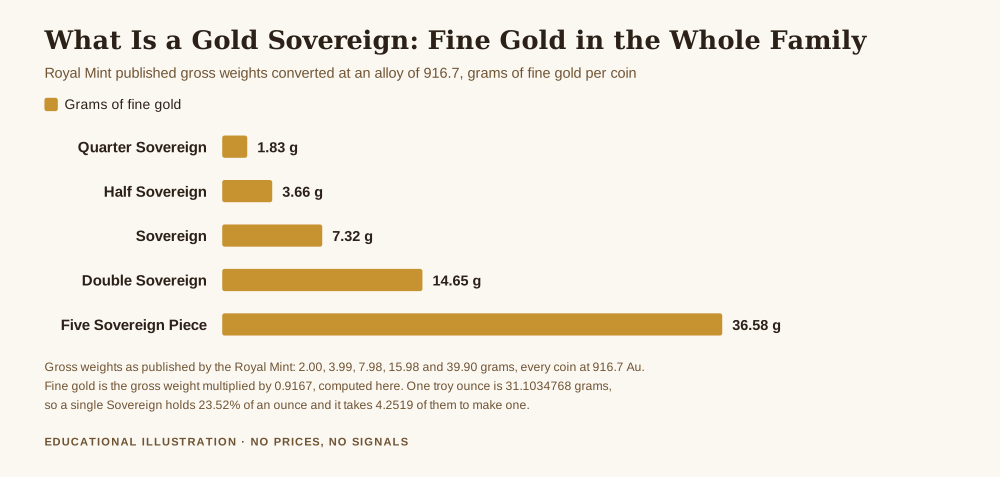
The published weights run in a simple pattern, and the alloy never changes. Converting each gross weight at 0.9167 gives the fine gold content:
- Quarter sovereign, 13.50 mm, gross 2.00 g, fine gold 1.8334 g, which is 0.0589 oz.
- Half sovereign, 19.30 mm, gross 3.99 g, fine gold 3.6576 g, 0.1176 oz.
- Sovereign, 22.05 mm, gross 7.98 g, fine gold 7.3153 g, 0.2352 oz.
- Double sovereign, 28.40 mm, gross 15.98 g, fine gold 14.6489 g, 0.4710 oz.
- Five sovereign piece, 36.00 mm, gross 39.90 g, fine gold 36.5763 g, 1.1760 oz.
Notice that the five sovereign piece is the only one that holds more than a troy ounce, and it holds 17.6 per cent more. Notice also that the half sovereign is almost exactly half the sovereign and the quarter is slightly short of a quarter, because the published 2.00 g is a rounded figure where 1.995 would be the exact half of the half. These are small discrepancies and they only matter if you are reconciling a weight on a scale against a number in a spreadsheet, which is precisely when they matter a great deal.
Why the fine content is the only number worth comparing
Here is the practical use of all this arithmetic. Dealers quote coins as objects. Metal is sold by content. Until you divide the price by the fine gold content, you are comparing prices of different things.
The premium is the part of the price that is not metal. Think of it in percentages, which works without assuming any price at all. For every 100 units of value you hand over for a coin carrying a 7 per cent premium over its melt value, 93.46 units buy gold and 6.54 units buy the coin, the minting, the distribution and the dealer's margin. That is not a criticism. Small coins cost more to make and handle per gram than large bars, and the premium is the honest price of divisibility. The error is not paying a premium. The error is not knowing which premium you paid.
Compare like this, and the comparison becomes one line of arithmetic:
- Paying 5 per cent over melt on sovereigns against 3 per cent over melt on a one ounce coin costs 1.94 per cent more for the same gram of fine gold.
- Paying 7 per cent against 3 per cent costs 3.88 per cent more.
- Paying 10 per cent against 4 per cent costs 5.77 per cent more.
Those are computed from the premium figures in each line, which are illustrative inputs rather than quotes from any dealer. The method is the point: take the asking price, divide by the fine gold content in grams, and you have a price per gram of gold that can be set against any other coin or bar on earth. A sovereign at an attractive looking price can be the expensive option, and a larger coin at a bigger headline number can be the cheaper one, and you cannot tell which without the division.
Where sovereigns sit in the actual market
It is worth keeping a sense of scale about this part of the gold market, because coin buying feels large when you are doing it and is small when measured against the whole.
The World Gold Council's Gold Demand Trends for the third quarter of 2026 reports that bar and coin investors were more circumspect, with global demand 19 per cent lower year on year at 268 tonnes, as investors waited for a clearer price trend to emerge. That single figure covers every bar and every coin bought by investors worldwide in the quarter, sovereigns included.
Two things are useful in that number. The first is that physical coin demand moves, sharply, and a 19 per cent fall in a year is not a crisis, it is a normal swing in a market where buyers can simply wait. The second is that your own decision is not special: when premiums widen or narrow, it is usually because a lot of people reached the same conclusion you did at the same time.
What the specification does not tell you
A specification is a strong thing to own and a limited one. Three gaps are worth naming.
It says nothing about the coin in your hand. The published table describes what the Royal Mint strikes. A coin that has circulated may weigh less through wear, and a coin that is not what it claims to be will happily state 7.98 g in a listing. The specification gives you a standard to test against, which is the beginning of the check, not the end of it. The density and testing question is a separate piece, linked below.
It says nothing about what you can sell it for. Content sets a floor in metal terms. The spread between what a dealer buys and sells at is a commercial matter, varies, and is the second number to ask for before you buy the first.
It says nothing about tax, and tax is jurisdictional. Whether a coin is treated as bullion, as legal tender, or as a collectable differs by country and changes over time. Anybody who tells you the answer without asking where you live is guessing.
What the specification does do is remove the vaguest part of the transaction. You are not buying "a gold coin". You are buying 7.3153 g of fine gold in a 22 carat alloy at 22.05 mm across, plus a premium you can now calculate.
Get the free Black Gold Market blueprint, the capital protection material in one place, for anyone who would rather check a number than take it on trust. One email, no spam, unsubscribe anytime.
Get the free blueprint →Frequently asked questions
What is a gold sovereign, in one sentence?
A gold coin struck by the Royal Mint to a published specification of 22.05 mm diameter, 7.98 g gross weight and an alloy of 916.7 parts gold per thousand, which works out at 7.3153 g of fine gold, or 23.52 per cent of a troy ounce, computed from those published figures.
How much pure gold is in a sovereign?
7.3153 g, computed as the published 7.98 g gross weight multiplied by the published alloy of 0.9167. The remaining 0.6647 g, which is 8.33 per cent of the coin, is other metal that makes it hard enough to handle.
How many sovereigns make a troy ounce of gold?
4.2519 of them, since a troy ounce is 31.1034768 g and each coin holds 7.3153 g of fine gold. Four sovereigns hold 94.1 per cent of an ounce, so the convenient round number of four is short of an ounce by about 5.9 per cent.
Is a sovereign 22 carat or 24 carat?
22 carat. The Royal Mint publishes the alloy as 916.7 Au, and 22 divided by 24 is 0.9167, so the two statements are the same statement. A 24 carat coin would be close to 999 fine, and a sovereign is not one.
Are sovereigns a better buy than a one ounce coin?
That depends entirely on the premium you are quoted for each, and it is answered by division rather than by opinion. Price divided by fine gold content gives a price per gram of gold for any coin, and whichever is lower on that measure is the cheaper metal. Smaller coins usually carry higher premiums, which buys you divisibility, so the question is whether that flexibility is worth the difference to you.
Does the specification prove a particular coin is genuine?
No, it gives you something to test against. A worn coin can weigh less than specification and a counterfeit listing can quote the specification perfectly. The published figures tell you what a correct coin should measure, and checking a coin you already own is a separate exercise, covered in the piece on real against fake gold linked below.
Where this leaves you
Black Gold Market is free to follow and stays free. The daily work on Telegram writes out the level, the context and the risk, so you can judge the reasoning rather than copy a number, and there is a free blueprint for anyone who wants the capital protection material in one place. There is an optional kit for people who want the longer version. Nothing here promises a return, because a return is not something anybody can promise you, and nothing here is a recommendation to buy, sell or hold any asset.
The foundation under this piece is how to protect your capital when gold gets volatile. Beside it, the format question is in buying gold coins against gold bars, the other common stamp on a piece of gold is explained in what 750 means stamped on a gold chain, the unit underneath all of this arithmetic is in how many grams equal a troy ounce of gold, the wholesale standard that coins are measured against is in what LBMA gold is, and the testing question is in the difference between real and fake gold.
Outside sources used here: the diameter of 22.05 mm, the gross weight of 7.98 g, the alloy of 916.7 Au, and the corresponding figures for the quarter sovereign, half sovereign, double sovereign and five sovereign piece, are from the Royal Mint, Gold Sovereign Sizes and Weights. The figure of 268 tonnes of global bar and coin demand, 19 per cent lower year on year, is from the World Gold Council, Gold Demand Trends, third quarter 2026. Every fine gold weight, ounce fraction, percentage and premium comparison in this article is computed from those published figures using a troy ounce of 31.1034768 grams, so you can reproduce all of it.
About the author. Raphael writes Black Gold Market. He came to gold through the macro side rather than the chart side, and his standing complaint is that most commentary states a conclusion without ever showing where the number came from. He would rather hand you a smaller claim you can check yourself than a large one you have to trust. Figures here are quoted from the official sources linked above or computed from the stated conversion, the premium percentages in the comparison are illustrative inputs rather than quotes from any dealer, nothing in this article forecasts the price of gold or recommends any dealer, mint, refiner, fund or purchase, it is not investment, legal or tax advice, and no entry, stop or target discussed should be treated as a signal.