

A reader in the channel asked me last week whether he could get gold exposure through the share dealing account he already has, instead of opening something new. He had assumed the answer was no, because everything written for people like us assumes a leveraged platform and a spot chart. The answer is yes, and there are four distinct ways to do it. Learning how to trade gold on stock market infrastructure is mostly a matter of understanding that the four routes are not four flavours of the same thing. They have different costs, different counterparties, and different ways of hurting you.
I want to be careful about what this article is. It is not a recommendation to use any of these routes, and it is not a comparison of named products. It is a description of the structures, with the arithmetic of what each one costs to hold, so that you can read any specific product's documentation and know what you are looking for.
Everything numerical below is either quoted from the World Gold Council page I link, or my own calculation from assumptions I state as I go. There are no gold prices here, nothing is a forecast, and every fee figure used as an example is a fixed illustration chosen to make the arithmetic visible.
The number that should set your expectations first
Before the routes, one piece of context, because it reframes the whole question. The World Gold Council's estimate of above ground gold stocks puts the total at 222,600 tonnes as at the end of the second quarter of 2026, worth around 29.0 trillion dollars. Of that, jewellery accounts for roughly 99,700 tonnes, or 45 per cent. Bars and coins account for about 47,800 tonnes, 21 per cent. Central banks hold around 39,000 tonnes, 18 per cent.
Gold ETFs hold about 4,000 tonnes. Two per cent.
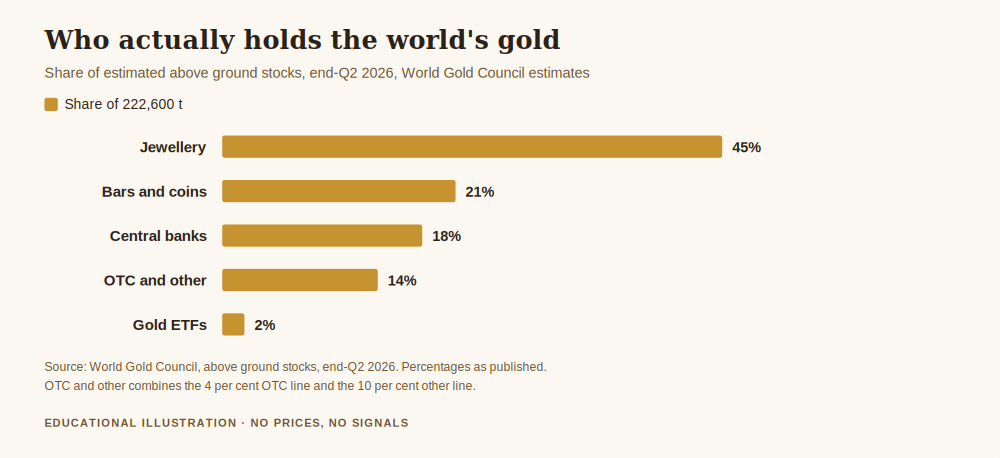
Run that against the central bank figure and you get the ratio worth remembering: central banks hold roughly 9.8 times as much gold as every gold ETF on earth combined. That is my arithmetic on the Council's two numbers, 39,000 divided by 4,000.
Why does this matter for a trading decision? Because it tells you that the stock market route is a way of tracking gold, not a way of participating in whatever sets its price. When you buy a gold fund on an exchange, you are not joining the market that moves the metal. You are buying a claim that follows it. I went through the flow side of this in how gold ETF flows affect the price of gold, and the honest summary is that ETF flows matter at the margin and are not the engine.
How to trade gold on stock market infrastructure, route by route
Four doors. Same metal behind all of them, very different rooms.
Route one, a physical backed exchange traded fund
A fund holds allocated bars in a vault and issues shares against them. You buy the shares in your ordinary brokerage account the way you would buy any listed security. There is no leverage unless you add it, no overnight financing, and no margin call mechanism, because you own a share outright.
What you pay instead is an annual management fee, deducted from the fund's assets rather than billed to you. This is the part people miss, and I will do the arithmetic on it below, because a fee you never see leave your account is still leaving your account.
What you give up is granularity and speed. You cannot size a position to the ounce, and you trade only when the exchange is open, which is a fraction of the hours the underlying metal trades.
Route two, gold mining equities
Shares in companies that dig gold out of the ground. People reach for these because they are easy to buy and because miners can move more than gold does in percentage terms.
That amplification cuts both ways, and it is not the only thing you are buying. A miner carries operational risk, political risk in whatever jurisdiction it operates, currency risk, debt, management decisions and a cost base that does not fall when the gold price does. You can be right about gold and still lose money on a miner, which is not a hypothetical, it is the normal outcome when a company has a bad year during a good market.
Calling this a gold position is a stretch. It is an equity position with a gold shaped exposure attached.
Route three, exchange traded futures
A futures contract is a standardised agreement to exchange a fixed quantity of metal at a set date, traded on a regulated exchange and margined daily through a clearing house. This is the venue where price discovery actually happens, and it is the reference most spot quotes are built around. I covered the relationship in COMEX versus the spot gold price.
A standard contract represents a large quantity of metal, which is why exchanges list smaller versions alongside it. Margin is set by the clearing house and it can be raised with little notice when volatility rises, which means a position that was comfortably funded on Monday can require more cash on Thursday without the price having moved against you at all.
For most people reading this, the honest assessment is that futures are the most transparent route and the least forgiving one.
Route four, a spot gold contract for difference
This is what most of the channel already uses, and it is worth putting in the same list so the comparison is fair. A CFD is a bilateral contract with your broker, not an exchange traded instrument, and it gives you fine position sizing, almost continuous hours, and leverage. You pay a spread, possibly a commission, and a financing charge for every night you hold.
You do not own any gold, and your counterparty is the broker rather than a clearing house. Whether that matters to you depends entirely on the broker, which is why I keep returning to what a regulated broker actually is.
The fee that does not feel like a fee
Here is the arithmetic that changes how people think about the fund route.
An annual management fee is charged on the value of your holding, every year, whether gold rises or falls. Over one year a 0.40 per cent fee costs 0.40 per cent, which sounds trivial. The point is that it compounds against you.
Take three illustrative fee levels and work out the cumulative drag, which is one minus the fee compounded over the holding period. I have chosen 0.25, 0.40 and 0.60 per cent a year as round numbers to expose the mechanism, not as a survey of what any product charges.
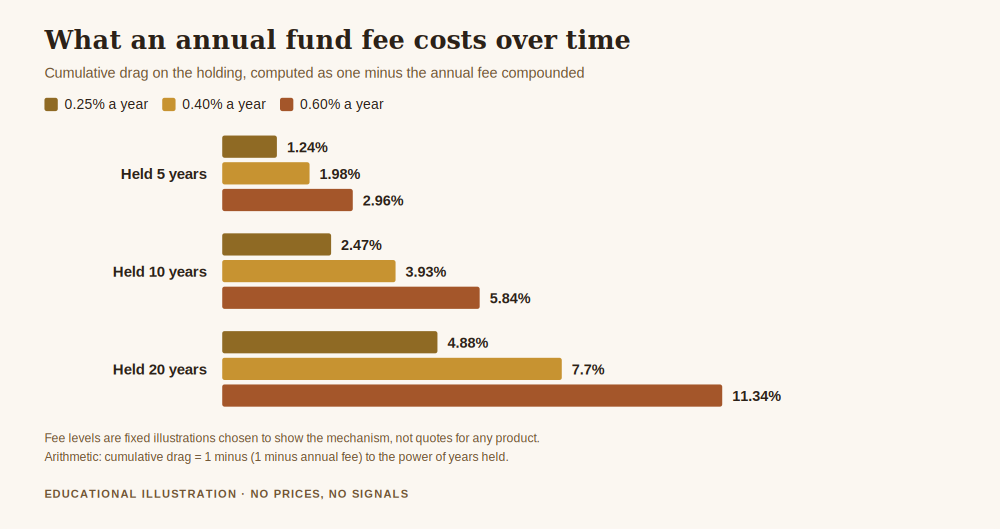
At 0.25 per cent a year the drag is 1.24 per cent over five years, 2.47 per cent over ten and 4.88 per cent over twenty. At 0.40 per cent it is 1.98, 3.93 and 7.70 per cent. At 0.60 per cent it is 2.96, 5.84 and 11.34 per cent.
Read the last figure properly. Over a twenty year holding, a 0.60 per cent annual fee consumes more than a ninth of the position, with complete certainty, before gold has done anything at all. That is not a criticism of funds. It is the price of someone storing, insuring and auditing metal on your behalf, and it is a fair price for a service that genuinely costs money to provide. It is simply a cost you should hold in your head as a number rather than a decimal point.
When a holding cost beats a financing cost
The comparison people actually need is between an annual fee and an overnight financing charge, because that is the choice between the fund route and the leveraged route for the same view.
Set it up. Assume a fund charging 0.40 per cent a year, and assume a CFD financing charge of 0.02 per cent a day on the notional. The daily cost of the fund is 0.40 divided by 365. The daily cost of the CFD is 0.02. Divide one annual fee by one daily charge and you get the break even holding period directly: 0.40 divided by 0.02 equals 20 days.
So under those assumptions, a position held for under twenty days costs less through the leveraged route, and a position held for longer costs less through the fund. At a 0.25 per cent fee against the same financing rate the crossover moves to 12.5 days. At a 0.03 per cent daily financing charge against a 0.40 per cent fee it moves to 13.3 days.
Both inputs are illustrations I picked. Substitute your own and the method still works, which is the only part of this worth copying down. The structural lesson survives any inputs: leverage is priced by the day and ownership is priced by the year, so the right instrument depends on how long you intend to be there, and most people never ask themselves that question before choosing.
What each route does to your risk
Protect comes before Master and Grow for a reason, so here is the risk reading of the four.
The fund route has no mechanism that can take more than you put in. You can lose value, and you cannot be closed out or carried negative. That is a structural property, not a judgement about whether it is a good idea.
The miner route has no forced exit either, but it introduces risks that have nothing to do with gold and that you are usually not equipped to analyse.
The futures and CFD routes both carry a forced exit. A clearing house or a broker can close your position when margin falls short, and neither waits for you to be available. Everything I have written about sizing and drawdown applies to those two and barely applies to the first two, which is itself the most useful thing in this article. The instrument decides which rules you need, and the groundwork for the leveraged ones is in how to protect your capital when gold gets volatile.
What this article is not saying
Limits, stated plainly. The fee levels and the financing rate are illustrations I fixed in advance. They are not quotes for any product and not an estimate of what you would be charged. The World Gold Council figures are theirs, as at the end of the second quarter of 2026, and estimates of above ground stocks are exactly that, estimates.
Nothing here tells you which route suits you, because that depends on your horizon, your tax position, your jurisdiction and your capital, none of which I know. Tax in particular differs enormously between these four structures and between countries, and it is a question for someone qualified where you live.
Get the free Black Gold Market blueprint, a short document on protecting capital before you try to grow it, including how to decide which instrument your horizon actually calls for. One email, no spam, unsubscribe anytime.
Get the free blueprint →Frequently asked questions
How to trade gold on stock market platforms if I only have a share dealing account?
A physical backed gold fund and gold mining shares both trade like ordinary listed securities, so an ordinary share dealing account reaches them. Futures need a futures enabled account and a margin agreement, and contracts for difference need a separate broker altogether.
Is a gold fund the same as owning gold?
Economically close, legally not the same thing. You own shares in a vehicle that holds metal, not the metal. Read the specific fund's documentation for whether the holding is allocated, who the custodian is, and what you are entitled to.
Do gold ETFs move the gold price?
At the margin, through creations and redemptions. The scale argument is the useful one here: on the World Gold Council figures, gold ETFs hold about 4,000 tonnes against 222,600 tonnes of above ground stock, which is about 2 per cent, and central banks hold roughly 9.8 times as much.
Are mining shares a cheaper way to get gold exposure?
They are a different exposure, not a cheaper one. You take on operational, political, currency and balance sheet risk alongside the metal, and those risks can dominate the gold move in either direction.
Which route is cheapest to hold?
It depends entirely on how long you hold. Ownership is priced annually and leverage is priced daily. On the illustrative figures above, a 0.40 per cent annual fee and a 0.02 per cent daily financing charge cross over at 20 days held. Shorter than that the daily charge is cheaper, longer and the annual one is.
Can I lose more than I put in through the stock market route?
Not with an unleveraged fund or share position, where the structure has no mechanism to take more than the holding is worth. Futures and contracts for difference both carry a forced exit when margin falls short, and that is the dividing line that matters most.
Where Black Gold Market fits
Black Gold Market is a free journal about reading gold and protecting capital, written for traders who would rather understand a mechanism than be handed a conclusion. Everything on the site is free to read and there is nothing to buy to follow along. The optional piece is the Sustainable Trader's Blueprint above, a short document on protecting capital before trying to grow it. We do not promise profits, we do not publish results, and we do not think anyone can tell you what your account will do. The piece this one sits underneath is how to protect your capital when gold gets volatile, and the holder side of the market continues in what gold reserves are.
About the author. Raphael writes Black Gold Market. He spent two years assuming a leveraged platform was the only serious way to hold gold, then worked out that he had been paying for a daily product to express a monthly view. He prefers the level, the context and the risk to any projection. Nothing in this article is a recommendation to trade, and no entry, stop or target discussed should be treated as a signal.