

Open two gold quotes side by side and you will often find they disagree. One screen says one thing, another says something slightly different, and the natural first thought is that somebody is wrong or somebody is cheating. Usually neither. The comex vs spot gold price question has a boring, mechanical answer, and knowing it is the difference between reading your screen and being confused by it.
They are quotes for two different things. Not two opinions about one thing, two different contracts with different delivery dates, different settlement, different venues and different rules. Once that lands, the gap stops looking like an error and starts looking like information, which is what it actually is.
What Spot Actually Refers To
Spot gold is the over the counter market, and its centre of gravity is London. It is not an exchange. It is a network of banks and dealers trading with each other bilaterally, for near immediate settlement, in units of unallocated metal held in the London vaulting system. When your platform shows XAU/USD, it is showing you a price derived from that market.
The nearest thing that market has to an official number is not a continuous feed at all. The LBMA Gold Price is set twice a day, in auctions that are independently operated and administered by ICE Benchmark Administration, commencing at 10:30 and 15:00 London time. There are fifteen direct participants accredited to contribute to it. It is not published on weekends, or on days the London market is closed.
That is worth sitting with for a second. The benchmark most contracts settle against is a discrete event that happens twice a day among fifteen firms, while the price on your screen updates continuously. Both are called the gold price. They are not the same object, and the first is auditable in a way the second is not.
What COMEX Actually Refers To
COMEX is an exchange, part of CME Group, and what trades there is a futures contract. The headline gold future carries the product code GC, and its contract unit is 100 troy ounces. That is a standardised, legally defined agreement to exchange metal at a date in the future, not a price for metal today.
Everything about that sentence matters for the comparison. Because it is exchange traded, there is a central counterparty, published volume, published open interest and a margin regime. Because it is standardised, one contract is exactly like another, which is what allows the volume to concentrate. And because it settles in the future, its price contains something the spot price cannot contain: the cost of getting from now to then.
The scale is worth noting for a retail reader. On a 100 ounce contract, a ten cent move in the price per ounce changes the value of that contract by ten dollars, computed simply as 100 ounces times $0.10. The contract is a large unit, and the arithmetic of what a small move does to it is the reason futures are not the retail instrument that spot CFDs are.
COMEX vs Spot Gold Price, Where the Gap Comes From
Here is the mechanism, and it is not exotic. If you own metal today, you have paid for it today. If instead you agree to receive metal in three months, you keep your money for three months and it earns something in the meantime. Whoever sells you that future contract has to be indifferent between the two, so the futures price has to compensate for the funding.
That compensation has a name, the cost of carry, and it can be estimated with arithmetic anyone can check. Take a short term risk free rate as a proxy for the funding cost. On 19 August 2026, the Federal Reserve's H.15 selected interest rates release put the 3-month Treasury constant maturity yield at 3.86 percent. Apply that across 91 days on an actual over 360 day count and you get 3.86 percent times 91 divided by 360, which is 0.976 percent.
So a three month futures quote sitting a bit under one percent above the spot quote is not a better price or a worse price. It is the same price, expressed at a different date. The stated assumptions are doing real work here: zero storage cost, zero lease income, no credit spread, and funding available at the Treasury rate, none of which is exactly true for any real participant. The purpose is to show the shape of the number, not to price a contract.
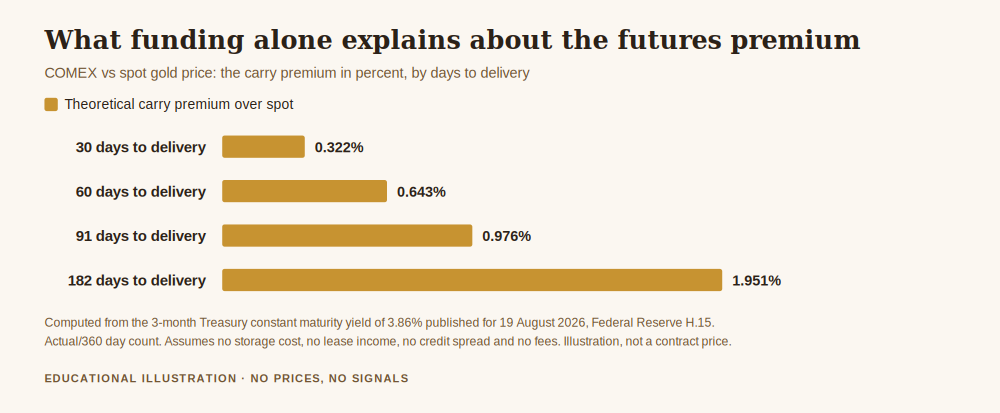
Run the same arithmetic across other horizons and the pattern is the obvious one. Thirty days gives 0.322 percent, sixty days gives 0.643 percent, ninety one days gives 0.976 percent, and one hundred and eighty two days gives 1.951 percent. The premium is roughly proportional to time, because funding is charged by the day. A futures curve sloping gently upward is the normal, healthy state, and it is called contango.
When the Gap Stops Being Arithmetic
The carry calculation describes a calm market. Its usefulness is that it gives you a baseline, and a baseline is what lets you notice when something is not calm.
When the observed gap between the futures and the spot quote is much wider than funding alone can explain, something else is being priced. It usually means the physical side has become difficult: metal is hard to move between vaults, transport or refining capacity is constrained, or holders of one contract suddenly want delivery in a location where the metal is not. In March 2020 and again in the tariff scare of early 2025, the gap between the New York futures and the London spot market widened well past anything funding could account for, and the cause both times was logistics rather than sentiment.
The reverse case, where futures trade below spot, is called backwardation and is rarer in gold. When it appears it generally says that having the metal in hand right now is worth paying for, which is a stress signal rather than a trading opportunity.
None of this is a reason to act. It is a reason to understand what you are looking at, which is a different and more durable thing.
What This Means for the Screen In Front of You
If you trade XAU/USD through a retail broker, you are almost certainly not touching COMEX. You are on a contract for difference whose price references the spot market, and your broker charges you for holding it overnight through a financing adjustment. That financing is the same economic quantity as the carry embedded in a futures price, presented as a recurring line item rather than baked into a single number.
Which means the choice between them is not a choice about cost in any simple sense. It is a choice about how the cost is presented and when you notice it. A futures price shows you the whole carry to expiry at once, in the quote. A CFD hides it in a nightly charge that most people never total up. The same money, different visibility, and visibility is the part that changes behaviour.
Two practical consequences follow. First, comparing a futures quote to your platform's quote and concluding your broker is marking you up is usually wrong, because you are comparing two different dates. Second, if you hold positions for weeks rather than hours, the financing line deserves the same attention you give the spread, because over a long enough hold it becomes the larger of the two.
Get the free Black Gold Market blueprint, a short document on sizing a position so the costs you cannot avoid stay survivable rather than decisive. One email, no spam, unsubscribe anytime.
Get the free blueprint →What This Does Not Say
It does not say which venue is better, because that depends on capital, jurisdiction and holding period, none of which I know about you. It does not say the carry number above is what any contract actually trades at; it is an illustration of a mechanism computed from a published rate under assumptions stated in full. It does not quote a gold price anywhere, deliberately. And it does not suggest that noticing a wide basis is a reason to place a trade, because the people who trade that gap professionally have vault access, delivery capability and funding costs that a retail account does not.
Frequently Asked Questions
What is the difference between comex vs spot gold price in one sentence?
Spot is a price for metal now in the London over the counter market, COMEX is a price for a standardised 100 ounce contract deliverable at a future date, and the normal gap between them is the cost of funding the metal until that date.
Which one is the real gold price?
Both are real, for different things. If you want an auditable reference rather than a live feed, the LBMA Gold Price auctions at 10:30 and 15:00 London time are the published benchmark, administered by ICE Benchmark Administration with fifteen direct participants.
Why does my broker's price differ from both?
Your broker quotes you a price derived from the spot market with its own spread applied, and it may reference a slightly different set of liquidity providers. A small persistent difference is the spread and the feed. A large one is worth asking about. Commission versus spread covers how that bill is presented.
Is a wider than normal gap a trading signal?
No. It is usually a logistics signal, telling you something about the difficulty of moving physical metal rather than about direction. Arbitraging it requires vault access and delivery capability that retail accounts do not have.
Where did the numbers here come from?
The auction times, the count of fifteen direct participants and the weekend publication rule come from the LBMA. The 100 troy ounce contract unit comes from CME Group's published contract specification. The 3.86 percent rate comes from the Federal Reserve H.15 release for 19 August 2026, and every carry percentage was computed by me from that rate under the assumptions listed in the disclaimer.
Where Black Gold Market Fits
Black Gold Market is free to follow. Daily XAU/USD analysis with the level, the context and the risk stated before the trade, losing days included, plus an optional Kit for people who want the full method written down. Nothing here promises a profit and nothing here ever will.
Protect comes first, as usual, and the habit underneath this article is refusing to act on a number you cannot explain. How to protect your capital when gold gets volatile is where that habit is written out in full. Gold versus real yields is the same interest rate mechanism seen from the macro side rather than the contract side. Why gold trades in sessions explains why London keeps turning up in every one of these explanations. And how much it costs to sell gold is the same question of the gap between two quotes, asked at a dealer's counter instead of an exchange.
About the author. Raphael writes Black Gold Market. He works on the part of this business that happens before the trade, the level, the context, and the risk, and on the conviction that a method you can follow through a quiet quarter is worth more than a better one you cannot.
Disclaimer: This article is general educational content about market structure and the arithmetic of forward pricing. It is not financial advice, not a valuation, and not a suggestion to buy, sell or hold any asset or contract. Trading gold, CFDs and leveraged products carries a high risk of losing money rapidly. No entry, stop or target discussed should be treated as a signal. The auction times of 10:30 and 15:00 London time, the figure of fifteen direct participants, the role of ICE Benchmark Administration and the weekend publication rule are quoted from the published LBMA precious metal prices page. The 100 troy ounce contract unit and the GC product code are quoted from the published CME Group gold futures contract specification. The 3-month Treasury constant maturity yield of 3.86 percent for 19 August 2026 is taken from the Federal Reserve's H.15 selected interest rates release. All carry percentages of 0.322, 0.643, 0.976 and 1.951 percent were computed by me from that single published rate using an actual over 360 day count, and they assume zero storage cost, zero insurance cost, zero lease income, no credit spread, no exchange or clearing fees, no bid offer spread, and funding continuously available at the Treasury rate; no real participant faces all of those conditions, so the figures describe the shape of the relationship rather than the price of any contract. A Treasury yield is a proxy for a funding cost and is not the funding cost of any specific firm. The historical episodes referred to are described qualitatively and no magnitude is asserted for them. No gold price level is quoted anywhere in this article and no trading results are represented. Contract specifications, trading hours and settlement rules are set by the exchange and change over time, so the published specification is the authority and not this article. Further reference data is published by the World Gold Council.