

The practical answer to how to insure gold starts somewhere most owners do not expect, which is a list of things that are not covered at all. People buy metal to escape counterparty risk, store it in a bank, and assume the bank's insurance follows it into the vault. It does not. The federal deposit insurer says so in plain words on its own consumer pages, and so does the postal service about the parcel you ship to a dealer. Insurance for physical gold is not one product you buy once. It is three separate gaps, in storage, in transit and in title, and each one is closed by a different document.
How to insure gold, and the first gap nobody reads about
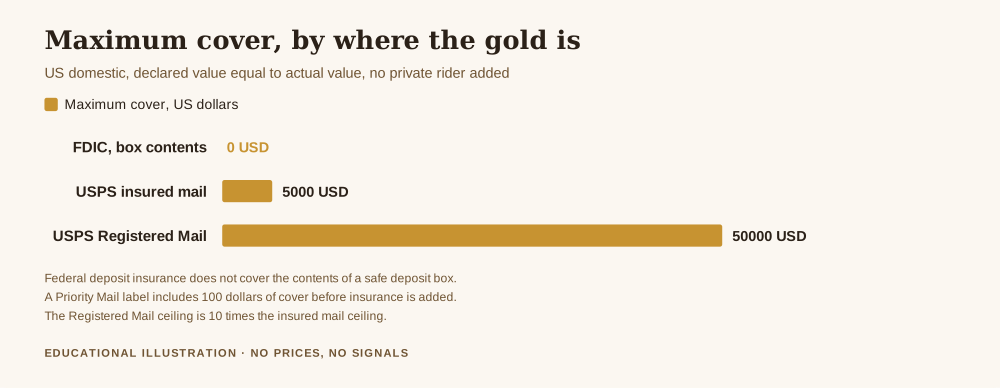
Start with the bank, because this is where the largest share of privately held bullion sits and where the assumption is most confidently wrong. The Federal Deposit Insurance Corporation publishes a list of products it does not insure, and safe deposit boxes and their contents are on it, alongside stocks, mutual funds and annuities. Its consumer guidance explains the reasoning without softening it: a safe deposit box is not a deposit account, it is storage space provided by the bank, so the contents, including cash, cheques or other valuables, are not insured by federal deposit insurance if damaged or stolen.
Then it goes further, and this is the sentence worth copying into your own notes. The same guidance states that financial institutions generally do not insure the contents of safe deposit boxes, and tells readers not to expect the bank to reimburse them for theft of or damage to the contents. The insurer's other page allows one narrow exception, which is that some banks may make a very limited payment if the box or its contents are damaged or destroyed, and directs you to the rental contract you signed to find out whether yours does.
So the cover on metal in a bank box is zero from the deposit insurer, generally zero from the bank, and whatever the rental agreement says, which is usually a small fixed figure that has nothing to do with what you put inside. That is not an argument against bank storage. A vault is still harder to break into than a house. It is an argument against believing the word bank is doing any insuring work at all.
What a carrier actually covers when the metal moves
The second gap opens the moment gold travels, which it does more often than owners expect: to a dealer for sale, to an assayer, to a depository, between family members. Here the numbers are published and specific, which makes this the easiest of the three gaps to close properly.
The United States Postal Service sets out three different ceilings. Priority Mail and Priority Mail Express include up to 100 dollars of insurance in the price, which is the default most people ship under without realising it. Added standard insurance raises that to a maximum of 5,000 dollars of indemnity, priced on declared value, starting at 2.80 dollars. Registered Mail, which the service describes as maximum security for valuable items, can be insured up to 50,000 dollars at a post office counter.
Put those three against each other, because the spread is the part that matters. The Registered Mail ceiling is ten times the standard insured mail ceiling, and five hundred times the cover that comes free inside a Priority Mail label. A parcel you posted without thinking about it carries one five hundredth of the protection available at the same counter. The fee is not the obstacle either: 2.80 dollars against a 5,000 dollar declared value is 0.056 percent of the amount at risk, which is cheaper than almost any other insurance you will ever be quoted.
Two conditions attach, and both are the kind that surface only at claim time. Cover is on actual value, not declared value, so overdeclaring buys nothing while underdeclaring caps your recovery. And mail insured for more than 500 dollars may require the recipient to show acceptable identification before the service will hand it over, which is a feature rather than an inconvenience when the contents are metal.
The ceiling is also the reason wholesale metal does not move this way. A London Good Delivery bar, the form the professional market settles in, holds 350 to 430 fine troy ounces at a minimum fineness of 995.0 parts per thousand. Using a troy ounce of 31.1034768 grams, that is 10.89 to 13.37 kilograms of metal, or the equivalent of between 10.89 and 13.37 one kilogram bars in a single piece, since a one kilogram bar is 32.1507 troy ounces. No retail postal ceiling was designed for an object like that, which is why the professional market uses specialist carriers and why a bar in that form is awkward for a private owner in ways that have nothing to do with its purity.
The third gap, which is about title rather than loss
The gaps above both assume the gold is yours and the question is who pays if it disappears. The third gap is stranger: arrangements where there is nothing to insure because you do not own a specific piece of metal in the first place.
The professional market distinguishes between allocated holdings, where identified bars are held for you and the bars are your property, and unallocated holdings, where you have a claim on a provider for a quantity of metal rather than title to any particular bar. The distinction sounds administrative and is not. With an allocated holding, insurance is the relevant protection, because there is a physical object that can be stolen or destroyed. With an unallocated holding, insurance is beside the point, because the risk you are carrying is the provider failing, and no property policy covers that. You are an unsecured creditor holding a promise denominated in ounces.
This is the exact risk people buy gold to avoid, reintroduced through the storage arrangement. The test is a single question put to whoever holds the metal: are specific bars allocated to me, identified by serial number and refiner, and is that recorded in writing? An answer that describes an entitlement, a balance or an equivalent quantity is an unallocated answer, whatever word the account statement uses.
What to ask for in writing
None of this requires expertise. It requires four documents, and the work is reading them rather than finding them.
From your home insurer, the precious metals and bullion sublimit, in writing, as a figure. Most contents policies treat bullion as a separate category from general contents with its own much lower ceiling, so the number you need is not the policy limit, it is the bullion line. Ask also whether a scheduled rider is available and what it requires, which is normally a professional valuation and sometimes a specified storage condition.
From the bank, the safe deposit rental agreement, and specifically the clause covering liability for loss. The deposit insurer's own advice is to read this document to find out whether any payment is available, and to check whether the bank restricts what may be kept in the box, which some do, cash included.
From the carrier, the service level and the declared value on the receipt, not what you intended to buy. The gap between 100 dollars and 50,000 dollars is one choice made at a counter.
From the depository, a statement that names allocated bars by serial number, together with the name of the insurer and the sum insured on the vault's holdings. A depository that cannot produce that is offering storage, which is a real service, but it is not the same as insured custody of your property.
The pattern across all four is the same one that runs through everything on this site. The protection you have is the protection written down, and the gap between what people believe they are covered for and the figure in the document is where losses actually happen. Metal is the one asset in a portfolio with no issuer standing behind it, which is its entire attraction. The cost of that attraction is that nobody is standing behind it when it goes missing either, unless you arranged for somebody to.
Get the free Black Gold Market blueprint, the capital protection material in one place, for anyone who would rather check a number than take it on trust. One email, no spam, unsubscribe anytime.
Get the free blueprint →Frequently asked questions
Does homeowners insurance cover gold?
Usually to a limited extent, under a separate sublimit for bullion and precious metals that is far lower than the overall contents limit. The figure varies by insurer and by policy form, so the only answer that helps you is the one in your own document. Ask for the bullion sublimit as a number and ask what a scheduled rider would cost to raise it. Do not reason from the headline contents figure, because that is not the line your claim would be paid under.
Is gold in a safe deposit box insured by the bank?
Generally no. Federal deposit insurance does not cover the contents of a safe deposit box, the insurer lists safe deposit boxes among the products it does not cover, and its guidance says financial institutions generally do not insure box contents and that you should not expect reimbursement for theft or damage. Some banks make a very limited payment under the rental agreement. Read that agreement to find out whether yours is one of them.
What is the cheapest way to insure gold in transit?
Comparing published ceilings rather than prices, Registered Mail offers the highest retail cover, up to 50,000 dollars, bought at a post office counter. Added standard insurance tops out at 5,000 dollars from 2.80 dollars, which is 0.056 percent of that ceiling. The expensive mistake is not choosing the wrong paid option, it is shipping under the 100 dollars included with a Priority Mail label and discovering the limit afterwards.
Do I need insurance if my gold is in a depository?
You need to know two things first: whether your holding is allocated to specific bars that are your property, and whether the vault carries insurance and for how much. If the holding is unallocated you are a creditor of the provider rather than an owner of metal, and the risk is provider failure, which property insurance does not address. Ask for allocation in writing with serial numbers, and ask who the vault's insurer is.
Does insurance protect me against the gold price falling?
No, and no insurance product does. Insurance covers physical loss, theft and damage. Price movement is not an insurable event, it is the risk you accepted when you bought the asset. Nothing in this article forecasts what gold will do, and nothing here should be read as a reason to buy or sell any quantity of it.
Where this leaves you
Black Gold Market is free to follow and stays free. The daily work writes out the level, the context and the risk, so you can judge the reasoning rather than copy a number, and there is a free blueprint for anyone who wants the capital protection material in one place. There is an optional kit for people who want the longer version. Nothing here promises a return, and nothing here recommends any dealer, mint, depository, insurer or purchase.
The foundation under this article is how to protect your capital when gold gets volatile. Beside it, the question of where metal should physically sit is in the best place to store gold, what that storage costs each year is in how much it costs to store gold, the custody rules that apply when the metal sits inside a retirement account are in what a gold IRA is, and the trade off between the two physical forms you might be insuring is in buying gold coins versus gold bars.
Outside sources used here: that safe deposit boxes and their contents are not insured, and that some banks may make a very limited payment under the rental contract, are from the FDIC list of products it does not insure. The statements that a safe deposit box is storage space rather than a deposit account, that financial institutions generally do not insure box contents, and that owners should not expect the bank to reimburse theft or damage, are from the FDIC consumer guidance on safe deposit boxes and home safes. The 100 dollar included cover, the 5,000 dollar standard insurance ceiling with fees from 2.80 dollars, the 50,000 dollar Registered Mail ceiling, the actual value condition and the identification requirement above 500 dollars are from the USPS insurance and extra services page. The Good Delivery bar range of 350 to 430 fine troy ounces at a minimum fineness of 995.0 is from the LBMA OTC guide. Every ratio, percentage and kilogram figure here is computed from those published numbers using a troy ounce of 31.1034768 grams, so you can reproduce all of it.
About the author. Raphael writes Black Gold Market. He came to gold through the macro side rather than the chart side, and his standing complaint is that most commentary states a conclusion without ever showing where the number came from. He would rather hand you a smaller claim you can check yourself than a large one you have to trust. Coverage figures here are quoted from the official sources linked above or computed from the stated conversion, sublimits and policy terms vary by insurer and by jurisdiction so your own documents govern rather than this article, nothing here is insurance, investment, legal or tax advice, nothing in it recommends any dealer, mint, depository or insurer, and no entry, stop or target discussed should be treated as a signal.