

Almost everyone who works out how to calculate profit in trading view does it once, gets a number, and then spends the next month quietly puzzled that the number in their account never matches. The platform said the trade was worth nine hundred and something. The account says less. Not dramatically less, just less, every single time, and nobody explains why.
There is nothing wrong with the platform. It is answering a different question from the one you think you asked. Let me show you the arithmetic properly, and then the three reasons the two figures separate, because once you can predict the gap you can plan around it, and planning around it is most of what protecting capital actually means.
How to Calculate Profit in Trading View, the Actual Arithmetic
Gold is quoted per troy ounce. That is not a detail, it is the whole basis of the calculation, and the World Gold Council states it plainly in the notes to its gold price data on Goldhub: prices are quoted in currency unit per troy ounce unless otherwise stated.
So every profit figure in gold is built from two things and only two things: how far the price moved in dollars per ounce, and how many ounces you were holding.
One standard lot of XAU/USD is conventionally 100 troy ounces. That gives you the number worth memorising:
- A move of 1.00 dollar per ounce is worth 100 dollars on one standard lot.
- A move of 1.00 dollar per ounce is worth 10 dollars on 0.10 lots.
- A move of 1.00 dollar per ounce is worth 1 dollar on 0.01 lots.
That is it. Profit equals the move in dollars per ounce, times 100, times your lot size. The position tool on the platform, the one you drag from entry to target, is doing exactly this and nothing more. Drag it across a ten dollar move on one lot and it will report a thousand dollars, because ten times one hundred times one is a thousand.
Which is a correct answer to the question "how much is this move worth". It is not an answer to the question "how much will I keep", and the difference between those two questions is the rest of this article.
Reason One: the Platform Figure Is a Before Costs Figure
The position tool does not know what your broker charges you. It cannot. So it reports the gross move and leaves the subtraction to you.
Let me put real arithmetic on it. I am going to state my assumptions out loud, because you should substitute your own, and because a number without its assumptions is just a claim.
- Spread of 0.30 dollars per ounce, which costs 30 dollars on a one lot round trip.
- Commission of 7.00 dollars per lot, covering both entry and exit.
- Overnight financing of 12.00 dollars per lot per night on the side that pays it.
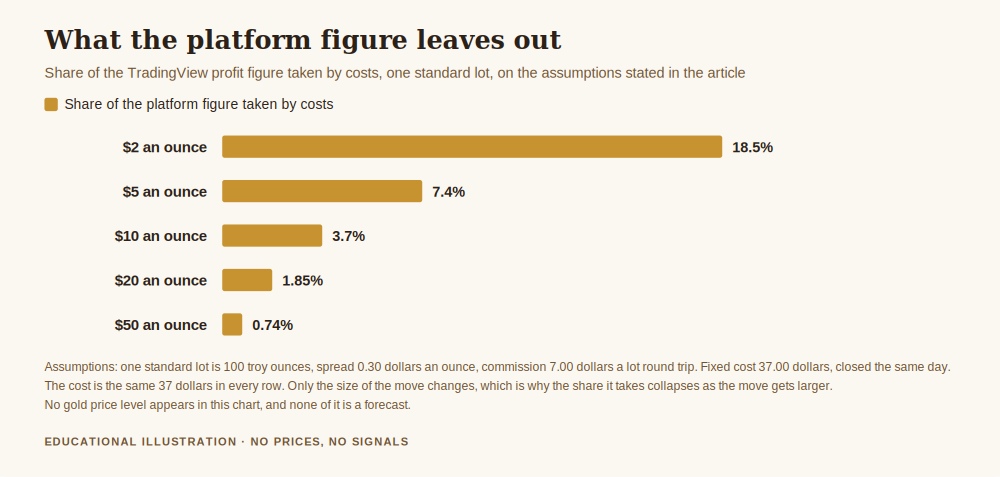
Total fixed cost on a one lot trade closed the same day: 37.00 dollars. Which means the price has to move 0.37 dollars per ounce in your favour before you are level. Not before you profit. Before you are level.
Now watch what that fixed 37 dollars does across different sized moves on one lot:
- A 2 dollar move: the platform says 200.00, you keep 163.00, which is 81.5 per cent.
- A 5 dollar move: the platform says 500.00, you keep 463.00, which is 92.6 per cent.
- A 10 dollar move: the platform says 1,000.00, you keep 963.00, which is 96.3 per cent.
- A 20 dollar move: the platform says 2,000.00, you keep 1,963.00, which is 98.2 per cent.
- A 50 dollar move: the platform says 5,000.00, you keep 4,963.00, which is 99.3 per cent.
Read the right hand column downwards. The cost is the same 37 dollars every time, but the share it eats runs from under one per cent to nearly a fifth. This is the single most useful thing on this page, and it is not really about TradingView at all.
It means the cost of trading is not a percentage. It is a toll, charged per trip, and the shorter the trip the more of it you hand over. Two people with identical analysis and identical accuracy will end the year in different places purely because one of them took forty trips and the other took four hundred.
Reason Two: Holding It Overnight Changes the Answer Again
Financing is charged per night, so it behaves like the spread but keeps accruing. Same ten dollar move, same one lot, held for different lengths:
- Closed same day: keep 963.00, which is 96.3 per cent.
- Held 1 night: keep 951.00, which is 95.1 per cent.
- Held 3 nights: keep 927.00, which is 92.7 per cent.
- Held 5 nights: keep 903.00, which is 90.3 per cent.
- Held 10 nights: keep 843.00, which is 84.3 per cent.
Ten nights on one lot is 120 dollars, which is 1.20 dollars per ounce of the move gone before anything else is counted. If you are a swing trader that number belongs in your plan from the beginning, not as a surprise at the end. The mechanics of why it is charged, and why it can run either way depending on which side you are on, are in what swap charges are in forex.
Reason Three: You Measured on a Price That Was Never Yours
This is the subtle one, and it is the reason two people can drag the same position tool across the same chart and both be slightly wrong.
There is no single authoritative gold price. There is a family of them. The London Bullion Market Association publishes the benchmark the industry settles against, and the LBMA Gold Price is administered independently by ICE Benchmark Administration on an electronic, tradeable and auditable auction platform aligned to the IOSCO Principles for Financial Benchmarks. Alongside that sit spot quotes, futures prices, regional benchmarks, and your own broker's feed.
The chart you dragged the tool across is one of those. The fill you received came from another. They track each other closely, which is exactly why the discrepancy is so easy to dismiss, and they separate most when liquidity is thin, which is when your stop is most likely to be tested.
So the honest version of the calculation is this: the platform gives you the value of a move on a reference series, and your account gives you the value of a move on your broker's series, minus costs. Treat the first as a plan and the second as the result.
The Calculation That Matters More Than Profit
Here is where I would rather you spent your attention, because the same arithmetic runs the other way and almost nobody does it.
If a move of 1.00 dollar per ounce is worth 100 dollars on one lot when you are right, it is worth 100 dollars on one lot when you are wrong. The position tool will happily show you a green rectangle to your target. Drag the red one to your invalidation point and multiply by the same 100 and you have the number that actually decides whether the account survives.
That number has a legal floor in some jurisdictions, which tells you how seriously regulators take it. When the European Securities and Markets Authority restricted contracts for difference for retail clients, the package it agreed included a leverage cap of 20 to 1 on gold, a margin close out rule set at 50 per cent of minimum required margin, and negative balance protection on a per account basis. A regulator looked at retail gold trading and concluded the loss side needed hard limits written into law. Your position size should reflect the same conclusion, which is the whole argument in position sizing so one trade cannot hurt you.
Calculate the loss first. Then calculate the profit. In that order, every time.
Get the free Black Gold Market blueprint, a short document on protecting capital before you try to grow it, including a page for working out what a position costs you before it earns anything. One email, no spam, unsubscribe anytime.
Get the free blueprint →A Two Minute Routine That Keeps the Two Numbers Together
None of this requires a spreadsheet. It requires four numbers written down once and reused.
First, find your own cost per lot. Open a small position, close it immediately, and read the account. Whatever it cost you is your real round trip cost, including the spread you actually got rather than the one advertised. Write it down.
Second, divide that cost by 100 to get your break even in dollars per ounce. On my stated assumptions that was 0.37. Yours will differ. That number is the minimum move that gets you to nothing, and any idea whose entire target is close to it was never a trade.
Third, when you use the position tool, subtract your cost from whatever it reports before you decide the trade is worth taking. Do it before, not after, because the point is to reject the marginal ones.
Fourth, record the platform figure and the account figure side by side for a month. The gap should be stable and predictable. If it is not, something is different from what you assumed, and finding out which one is a better use of an evening than any indicator. That habit is the practical end of evaluating trading performance honestly.
Frequently Asked Questions
How to calculate profit in trading view for gold in one line?
Move in dollars per ounce, multiplied by 100, multiplied by your lot size. One standard lot of XAU/USD is conventionally 100 troy ounces, so a one dollar move is 100 dollars per lot. The platform's position tool does exactly this, and reports the figure before any costs.
Why is my TradingView profit higher than my account balance shows?
Because the platform reports a gross figure. Subtract the spread, the commission and any overnight financing. On the assumptions in this article, a one lot round trip costs 37 dollars fixed, so a ten dollar move that displays as 1,000.00 lands as 963.00 in the account.
Does the gap between the two numbers get worse on small trades?
Much worse, and this is the part people miss. The cost is a fixed amount, not a percentage. On a two dollar move you keep 81.5 per cent of the platform figure. On a fifty dollar move you keep 99.3 per cent. Same trader, same costs, entirely different outcome, decided by how far you were trying to go.
Can I make TradingView show my real profit automatically?
Not reliably, because the platform does not know your broker's spread or commission schedule, and those vary by account type and by hour. The workable version is to measure your own round trip cost once, then subtract it manually. Two seconds per trade, and it stops you taking ideas that were never worth the toll.
Where did the figures in this article come from?
All of them are arithmetic on stated assumptions: 100 troy ounces per standard lot, 0.30 dollars per ounce spread, 7.00 dollars per lot commission and 12.00 dollars per lot per night financing. The quoting convention is from the World Gold Council's Goldhub notes, linked above. No gold price level appears anywhere in this article, and none of it is a forecast.
Where Black Gold Market Fits
Black Gold Market is free to follow. Daily XAU/USD analysis with the level, the context and the risk stated before the outcome is known, losing days included. There is a free blueprint for anyone who wants the capital protection material gathered in one place, and an optional Kit for people who want the full method. Nothing here promises a profit, and nothing here is a signal service. If you are putting the numbers together properly, read what a lot is in forex for the sizing unit, commission vs spread for where the toll is hidden, and how to protect your capital when gold gets volatile for the part that outlasts all of it.
Knowing how to calculate profit in trading view takes a minute. Knowing what the platform left out, and making the subtraction before you click rather than after, is the part that keeps the account intact long enough for the good months to matter.
About the author. Raphael writes Black Gold Market. He works out the cost of a position before the target, on the grounds that the cost is certain and the target is not. Nothing in this article is a recommendation to trade, and no entry, stop or target discussed should be treated as a signal.