
A member of the Black Gold Market group sent me two screenshots last month. Same account, same broker, same instrument, two trades that both went 300 points against him. The first one cost 30 dollars. The second one cost 300. He wanted to know what the broker had changed.
The broker had changed nothing. He had. The first trade was 0.10 lots and the second was 1.00, and that single number, sitting in a box he barely looked at, multiplied the damage by ten. So the question worth answering carefully is what is lot in forex, because the lot is not a formality on the order ticket. It is the number that converts a price move into money, and every other risk decision you make is downstream of it.
This article works through what a lot actually is, what one is worth on a currency pair and on gold, where the size limits come from, and how to run the arithmetic backwards so that risk decides the lot rather than the lot deciding your risk.
What Is Lot in Forex, in One Definition
A lot is a standardised quantity of the thing you are buying or selling. Nothing more exotic than that.
In currency trading the convention is that one standard lot is 100,000 units of the base currency. Buy one standard lot of EURUSD and you have contracted for 100,000 euro against the dollar. The convention exists because the wholesale market it grew out of deals in round parcels, and retail platforms inherited the unit and then sliced it up. A mini lot is a tenth of it, 10,000 units. A micro lot is a hundredth, 1,000 units. Some brokers go further and offer a nano lot at 100 units.
Gold does not follow the currency convention, and this is where people get hurt. XAUUSD is quoted in United States dollars per troy ounce, and the near universal retail convention is that one standard lot is 100 troy ounces. A mini lot is 10 ounces, a micro lot is 1 ounce. Same word, entirely different quantity, because gold is a metal and not a currency.
That is worth pausing on. The London Bullion Market Association describes the market your gold quote comes from: an over the counter market with no exchange in the middle, in which roughly 25 billion dollars of gold settles every day, with London at its centre, and in which the accredited refiners produce around 5,000 tonnes of gold a year. Your platform shows you a price from that market and lets you take a position measured in ounces. The lot is simply how many ounces.
So when a platform tells you your position is 0.50 lots, it is telling you 50,000 units of a currency, or 50 troy ounces of gold, depending on what you clicked. Everything that follows is arithmetic.
What One Lot Is Actually Worth
Here is the part that turns a definition into something you can use. I have run these figures out rather than rounding them in my head, and the assumptions are stated so you can check them: one standard forex lot is 100,000 units of the base currency, one standard XAUUSD lot is 100 troy ounces, one pip on EURUSD is 0.0001, and spread, commission and swap are all excluded so the size effect stands on its own.
On EURUSD, one standard lot moves 10.00 dollars per pip. A mini lot moves 1.00 dollar per pip. A micro lot moves 10 cents per pip.
On XAUUSD, one standard lot moves 100.00 dollars for every 1.00 dollar the gold price moves. A mini lot moves 10.00 dollars. A micro lot moves 1.00 dollar.
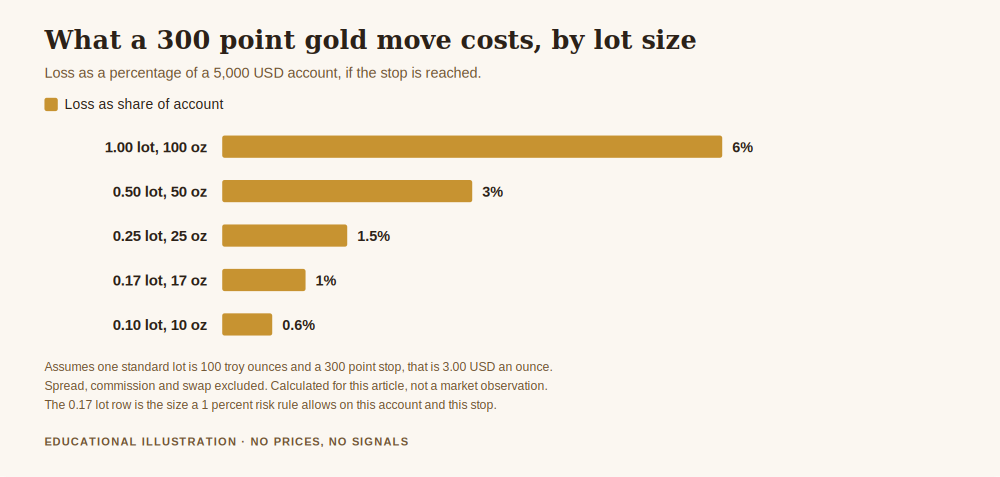
Look at the gold column and the currency column side by side and the asymmetry is obvious. A 300 point move on gold, which is 3.00 dollars an ounce and an ordinary morning, costs 300 dollars at one standard lot. The same 300 pips on EURUSD would be an extraordinary session. Traders who learn size on currency pairs and then move to gold with the same habits are the ones who write to me confused about why the account moves so fast.
Notional value makes the same point from the other direction. One standard EURUSD lot at 1.1000 is 110,000 dollars of exposure. One standard gold lot, using 3,000 dollars an ounce purely as a round reference figure for the arithmetic rather than as any kind of market quote, is 300,000 dollars of exposure. That is the contract you are holding. The cash in your account is not the size of your position, it is the deposit against it.
Where the Ceiling on Size Comes From
You cannot pick any lot you like. Two separate things constrain you, and only one of them is about you.
The first is the regulator. In the European Union, the European Securities and Markets Authority product intervention measures announced in March 2018 cap leverage on the opening of a retail position at 30 to 1 for major currency pairs, 20 to 1 for non major pairs, gold and major indices, 10 to 1 for other commodities, 5 to 1 for individual equities and 2 to 1 for cryptocurrencies. The same measures set a margin close out at 50 percent of minimum required margin on a per account basis, and require negative balance protection per account.
Run those caps against the two positions above. The 110,000 dollar EURUSD lot at 30 to 1 needs about 3,667 dollars behind it. The 300,000 dollar gold lot at 20 to 1 needs 15,000 dollars. If your account holds 5,000 dollars, the second trade is not available to you at one standard lot, and the platform will simply refuse the order. People read that rejection as a technical fault. It is the size ceiling doing its job.
The second constraint is your broker, which may require more than the regulatory floor and may raise the requirement on a position you already hold. That mechanism is a separate subject and I have written it up in detail in what is exchange margin in forex, because it is the one that catches people while their analysis is still correct.
What neither constraint does is tell you what size is sensible. A rule can stop you from opening a position that is obviously too large for the cash behind it. It cannot stop you from opening one that is merely large enough to end you over a run of ordinary losses.
Running the Arithmetic Backwards
Most people choose a lot first and discover the risk afterwards. The order should be reversed, and the calculation is short enough to do in your head once you have seen it twice.
Take a 5,000 dollar account and a decision to risk 1 percent, which is 50 dollars, on a gold trade with a 300 point stop, meaning 3.00 dollars an ounce. One standard lot is 100 ounces, so each lot loses 300 dollars if that stop is reached. The maximum size is therefore 50 divided by 300, which is 0.167 lots, or about 16 micro lots.
Now look at what the alternatives would have done to the same account. A 0.10 lot loses 30 dollars at that stop, which is 0.6 percent. A 1.00 lot loses 300 dollars, which is 6 percent of the account on a single ordinary move. Six percent is not a disaster on its own. Six percent repeated four times in a bad week, which is a completely normal bad week, is a quarter of the account gone, and at that point the arithmetic of recovery starts working against you in a way that has nothing to do with your ability to read a chart.
Notice also that the correct 0.167 lot position still carries about 50,000 dollars of notional exposure at a 3,000 dollar reference price, which is ten times the account. That is not a warning sign. That is what leverage is, and it is fine precisely because the stop, not the notional, is what determines the loss. The notional tells you how big the contract is. The stop and the lot together tell you what it can cost you. Only the second pair is a risk decision.
There is one more habit worth building, which is checking the lot against the instrument every single time rather than trusting muscle memory. Traders who move between currency pairs and gold in the same session are switching between a unit of 100,000 and a unit of 100 without the platform saying anything about it. The box looks identical. The exposure is not.
What Protect Means at This Level
Protect is the first of the three things this journal is about, and it lives here more than anywhere else. Not in the entry, not in the analysis, but in the size box.
Three things follow, and none of them require you to trade differently.
Write the lot down before you write the entry down. If the size is decided after you have already convinced yourself about direction, it will be decided by how convinced you feel. That is the wrong input. Size comes from the account and the stop distance, both of which are known before you have an opinion.
Know your instrument's unit as a number, not as a habit. One hundred thousand units for a currency pair, 100 ounces for gold, and check the contract specification on your own platform rather than assuming, because a minority of brokers use different gold conventions and a few quote in kilograms.
Size against the stop you will actually use, not the one you hope for. A 300 point stop on gold that you widen to 500 when it is nearly touched has quietly turned a 1 percent risk into a 1.7 percent risk after the money is already committed. The lot was correct. The plan was not. Sizing is only as honest as the stop it was calculated from.
None of this makes a losing trade less likely. It makes a losing trade survivable, which is a different and more useful goal, and it is the entire reason position sizing so one trade cannot hurt you exists as a separate piece of work rather than a footnote to a strategy.
Get the free Black Gold Market blueprint, a short document on protecting capital before the trade rather than after it, including the sizing arithmetic in this article laid out as a sheet you can work through. One email, no spam, unsubscribe anytime.
Get the free blueprint →Frequently Asked Questions
What is lot in forex, in one sentence?
A lot is the standardised quantity your trade is measured in: 100,000 units of the base currency for a currency pair, and by retail convention 100 troy ounces for gold, with mini and micro lots at a tenth and a hundredth of those.
Why is a gold lot 100 rather than 100,000?
Because gold is priced per troy ounce rather than as a currency, so the unit follows the metal market rather than the currency market. It is the same word applied to a different underlying quantity, which is exactly why it catches people moving between the two.
Is a bigger lot riskier than a smaller one?
A bigger lot multiplies whatever the price does, in both directions. It does not change the probability of anything. What it changes is how much of your account a single ordinary move can take, which is why size belongs to risk management rather than to strategy.
Why did my broker reject my order?
Frequently because the required margin for that lot exceeds the free cash in the account, given the leverage cap on that instrument. Under the ESMA caps gold sits at 20 to 1, so a full standard gold lot needs a substantial deposit behind it that a small account will not have.
Should I use micro lots when starting?
Smaller sizes let you run a real process on real money without a single mistake being expensive, which is a reasonable thing to want. This is a general observation about size rather than a recommendation about your account, and no entry, stop or target discussed should be treated as a signal.
Where did the numbers in this article come from?
The leverage caps, the 50 percent margin close out and negative balance protection are quoted from the ESMA product intervention measures linked above. The daily over the counter settlement figure and the refining tonnage come from the LBMA page on loco London, also linked. The pip values, notional figures and lot sizing arithmetic were calculated for this article from the stated conventions, using 3,000 dollars an ounce purely as a round reference number for the arithmetic and not as a market price.
Where Black Gold Market Fits
Black Gold Market is free to follow. Daily XAU/USD analysis with the level, the context and the risk stated before the trade, losing days included, on Telegram. There is a free blueprint for anyone who wants the capital protection side written down, and an optional kit for people who want the full process. No profit is promised anywhere, because nobody can promise one.
Protect comes first, and the lot is where protecting starts. How to protect your capital when gold gets volatile is the piece that holds the rest of this together, what is a margin call and how to avoid one covers what happens when size and requirement collide, and the about page explains who writes this and why.
About the author. Raphael writes Black Gold Market. He works on the part of this business that happens before the entry, the level, the context, and the risk, and he thinks most account damage is a sizing decision that was never actually made. Nothing here is a recommendation, and no entry, stop or target discussed should be treated as a signal.
Disclaimer: This article is general educational content about lot sizes and position sizing in retail foreign exchange and gold trading. It is not financial advice, not investment advice, and not a recommendation to buy or sell anything. Leveraged trading in currencies and in gold carries a high risk of losing money rapidly, and a majority of retail accounts lose money. The figures used are either quoted from the public sources linked in the text or calculated for this article from clearly stated assumptions, and the 3,000 dollars an ounce reference used in the arithmetic is a round number chosen for legibility rather than a market quotation. Contract sizes, leverage limits and margin requirements vary by broker, by instrument and by the jurisdiction of the legal entity holding your account, so check your own contract specification before relying on any figure here. Past behaviour of any market does not indicate future behaviour. No entry, stop or target discussed should be treated as a signal, and you should consider taking independent professional advice before making any financial decision.