
A member of the Black Gold Market group sent me a screenshot last week with one line circled in red, and the question was simply what is swap charges in forex and why was his account smaller than his open profit and loss suggested it should be. He had not lost a trade. He had held one for eleven nights.
This is one of the most common gaps I see, and it is a Protect problem rather than a strategy problem. Traders shop hard on the cost of entering a position. They compare spreads between brokers down to the tenth of a point, they read commission tables, they argue about it in groups. Then they hold a position for three weeks and never once work out what those three weeks cost them. The entry cost is visible and paid once. The holding cost is quiet and paid every single night.
So this article does the arithmetic properly. Where the number comes from, how to compute it for your own position size, why one night of the week costs triple, and the point at which holding a trade costs more than opening it did. There are no gold prices anywhere in this article and no positions being recommended, just the cost structure that sits underneath any of them.
What Is Swap Charges in Forex, Stated Plainly
A swap charge, also called a rollover or overnight financing, is what you pay or receive for keeping a leveraged position open past the daily cutoff, which for most venues is 5 p.m. New York time.
The reason it exists is worth understanding, because once you see it the number stops feeling arbitrary. When you buy a leveraged gold position, you are not buying gold with your own money. You are putting up a deposit and someone else is funding the rest of the position. That funding is a loan, and loans have interest. The swap is that interest, charged nightly, on the part of the position you did not pay for.
That is why a swap is not evidence that you are being cheated. The underlying cost is real, and it exists whether your broker is honest or not. What varies between brokers is the markup they add on top of it, and you cannot judge that markup unless you know what the honest base cost looks like. Which is the point of the next section.
Where the Number Actually Comes From
The base cost of holding a long gold position is essentially the cost of borrowing US dollars, because dollars are what funds the position. So the anchor is a published dollar interest rate, not something your broker invents.
The Federal Reserve publishes those rates every business day in a release called H.15. In the most recent release at the time of writing, dated 1 September 2026, the market yield on one month US Treasury securities was 3.85 percent a year. That is the number I am going to use as the base funding cost throughout this article, and you can look up the current one yourself at the Federal Reserve H.15 release in about thirty seconds.
Two honest qualifications before the arithmetic. First, this is the base cost only. A real broker adds its own margin on top, so what appears on your statement will be larger than what I calculate here, and how much larger is a fair question to ask your broker directly. Second, a short gold position works in the opposite direction and can in principle earn financing rather than pay it, though in practice the markup usually eats most or all of that. I am working through the long side because that is what the question was about and it is the side most retail traders sit on.
The Arithmetic on Ten Thousand Dollars of Gold
I am going to work in contract value rather than lots, because lot sizes differ between venues and contract value does not. If you know what your position is worth, you can scale everything below to it directly. Half the size, half the cost.
Take a position worth 10,000 US dollars of gold. The nightly financing at 3.85 percent, using the 360 day convention that the dollar money market uses, is:
10,000 × 3.85% ÷ 360 = 1.07 US dollars a night
One dollar and seven cents. Said out loud on its own, it sounds like nothing, and that is precisely why it goes uncounted. It only becomes visible when you multiply it by the number of nights a position actually stays open.
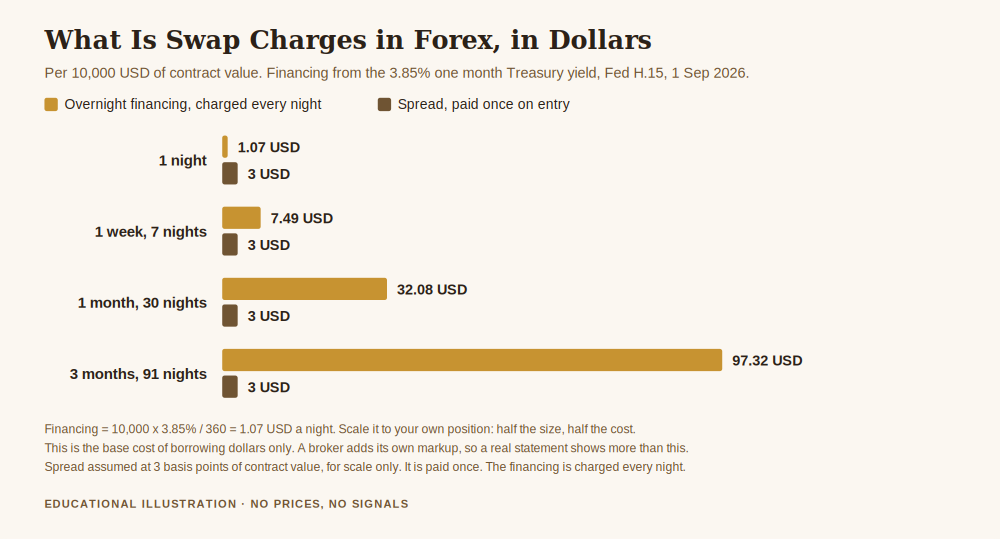
Over a week of seven nights that is 7.49 dollars. Over a month of thirty nights, 32.08 dollars. Hold the position for a quarter, ninety one nights, and it is 97.32 dollars. Carried for a full year it comes to 390.35 dollars on a 10,000 dollar position, which is simply the 3.85 percent showing up as itself.
None of those figures is dramatic in isolation. What matters is that every one of them is subtracted from your result before you count whether the trade worked. A swing position that finishes 80 dollars ahead after a month of holding did not make 80 dollars. It made roughly 112 and gave back 32 to the financing.
The Wednesday That Costs Three Times
Here is the part that produces the confused screenshots, and it looks like an error the first time you see it.
Spot positions settle two business days forward. When you hold through Wednesday night, the settlement date rolls from Friday to Monday, which moves it across the weekend. Since the market is closed on Saturday and Sunday and cannot charge you then, those two nights are collected in advance. So one night in the week carries a triple charge.
On our 10,000 dollar position, a normal night costs 1.07 dollars and the triple night costs 3.21 dollars. Nothing has gone wrong. The week still costs 7.49 dollars in total, exactly seven nights of financing. It is simply collected on five occasions instead of seven, and one of them is three times the size of the others.
The practical consequence is small but real: a position opened Thursday and closed Tuesday pays the triple charge, while the same holding period shifted by two days may not. If you trade on a very short horizon and your edge is thin, that detail is worth knowing. If you hold for weeks, it evens out and does not matter.
Why Leverage Makes the Same Fee Look Different
This next table is the one that changes how people think about carrying a position, so I want to be careful about what it does and does not say.
Leverage does not change the financing charge. The charge is calculated on the contract value, and the contract value is the same whether you posted a large deposit or a small one. What leverage changes is how big that fixed charge looks next to the money you actually put down.
On our 10,000 dollar position the annual financing is 390.35 dollars regardless. What moves is the deposit:
- At 1:20, the deposit is 500 dollars, and the yearly financing is 78.1 percent of it.
- At 1:100, the deposit is 100 dollars, and the same financing is 390.3 percent of it.
- At 1:500, the deposit is 20 dollars, and it is 1,951.7 percent of it.
Now the necessary caution, because a number like 1,951.7 percent invites the wrong conclusion. This is not a forecast that a leveraged account loses that share of its value in a year. Almost nobody holds an account funded to the bare minimum deposit, and almost nobody carries a maximum leverage position for twelve months. What the table shows is narrower and still worth sitting with: high leverage does not make a position cheaper to hold, it makes the holding cost enormous relative to the capital you committed. The cost was always there. Leverage just shrank the denominator.
That is the reason I keep saying that leverage is a Protect topic rather than a Grow topic. It does not increase your edge. It increases everything that is measured against your deposit, and the financing charge is one of those things.
The Cost Everyone Compares, and the Cost Nobody Counts
Now put the two costs side by side, which is what the chart above does.
Assume the spread costs you 3 basis points of contract value, which on our 10,000 dollar position is 3.00 dollars, paid once when you open the trade. I am using an assumed figure here rather than any particular broker's, purely to show the relative size of the two costs.
The financing is 1.07 dollars a night. So:
- After 2.8 nights, the accumulated financing has cost you exactly what the spread cost.
- After a month, the financing is 10.7 times the spread.
- After a quarter, it is 32.4 times the spread.
Read that again against how people actually choose a broker. Traders will move accounts over a fraction of a point of spread and then hold positions for six weeks without ever pricing the financing, which by then has cost them an order of magnitude more than the spread they optimised. The cost that gets all the attention is the one that is paid once and is easy to see. The cost that gets none is the one that is charged repeatedly and quietly.
This is not an argument that spreads do not matter. If you open and close several positions a day, the spread is your dominant cost and the financing is close to irrelevant, because you are rarely holding overnight at all. It is an argument that which cost matters depends entirely on how long you hold, and most traders never make that connection.
What This Changes About How Long You Hold
The useful output of all this is not a number. It is a question you can now answer before you enter rather than after you exit.
Take the position size you are considering, work out its contract value, and multiply by the current one month rate divided by 360. That gives you the nightly cost. Multiply by the number of nights you honestly expect to be in the trade, not the optimistic number. Now you know what the trade has to cover before it breaks even, and you knew it in advance.
For an intraday trader, this exercise will show that the financing is noise and the spread is what matters. That is a legitimate and useful result. For a swing trader holding several weeks, it will show the financing is a real line item that should be sized into the plan. For anyone thinking about holding a leveraged gold position for months as a way to express a long term view, it will show something more pointed: that leveraged instruments are built for holding periods measured in days and weeks, and the cost structure quietly punishes anyone who uses them for years.
That last case is where I see the most damage done, and it is rarely done by a bad trade. It is done by a reasonable trade held for far longer than the instrument was designed to carry, with the financing grinding away underneath it the whole time. The position did not fail. The holding cost outran it.
So the honest answer to what is swap charges in forex is this: it is the price of time in a leveraged position. It is small enough to ignore for a day and large enough to matter over a quarter, and the only way to know which situation you are in is to do the multiplication before you open the trade rather than reading it off a statement afterwards.
Get the free Black Gold Market blueprint, a short document on protecting capital before the trade rather than after it, including how to price the cost of a position you intend to hold for weeks. One email, no spam, unsubscribe anytime.
Get the free blueprint →Frequently Asked Questions
What is swap charges in forex in one sentence?
It is the interest charged or paid for holding a leveraged position past the daily cutoff, because a leveraged position is funded partly by borrowed money and that borrowing carries interest.
Why was I charged three times on a Wednesday?
Because spot positions settle two business days forward, and holding through Wednesday night moves the settlement date across the weekend. The Saturday and Sunday nights are collected in advance, so one night in the week carries a triple charge. The weekly total is unchanged.
Can a swap ever pay me instead of costing me?
In principle yes, on the side of the trade that is effectively lending rather than borrowing. In practice the broker markup usually absorbs most or all of it, so treat a positive financing rate as a small offset rather than a reason to hold a position.
Does higher leverage increase the swap charge?
No. The charge is calculated on contract value, which leverage does not change. What leverage changes is how large that fixed charge is compared with the deposit you posted, which is why the same 390.35 dollars a year is 78.1 percent of a 1:20 deposit and 390.3 percent of a 1:100 deposit on the same position.
Is the swap the same at every broker?
No. The base funding cost is anchored to market interest rates and is broadly similar, but each broker adds its own markup on top and they differ considerably. Ask for the current rate on the instrument you trade and compare it against the base cost calculated the way this article does.
How do I work out my own number?
Contract value multiplied by the current one month rate, divided by 360. For 10,000 dollars of contract value at the 3.85 percent published on 1 September 2026, that is 1.07 dollars a night. Scale it to your own position size and then add whatever markup your broker applies.
Where did the numbers in this article come from?
The 3.85 percent one month Treasury yield is the Federal Reserve H.15 release dated 1 September 2026. Everything else, the 1.07 a night, the 7.49, 32.08 and 97.32 running totals, the 3.21 triple night, the 78.1, 390.3 and 1,951.7 percent leverage figures and the 2.8 night crossover, is my own arithmetic on that rate under the assumptions written out in the text: a 10,000 dollar contract value, a 360 day convention, and an assumed spread of 3 basis points. No gold price appears anywhere in this article.
Where Black Gold Market Fits
Black Gold Market is free to follow. Daily XAU/USD analysis with the level, the context and the risk stated before the trade, losing days included, plus an optional Kit for people who want the method written down in one place. There is no promise of profit here, because nobody can honestly make one.
Protect comes first, and a cost you have not counted is a risk you have not sized. How to protect your capital when gold gets volatile is the pillar this article belongs under. Commission vs spread in forex covers the cost of entering that everybody compares, which is the natural companion to the cost of holding that almost nobody does, and what is better, swing trading or day trading works through the holding period decision that determines which of the two costs actually dominates for you.
About the author. Raphael writes Black Gold Market. He works on the part of this business that happens before the trade, the level, the context, and the risk, and on the conviction that a method you can follow through a quiet quarter is worth more than a better one you cannot.
Disclaimer: This article is general educational content about how overnight financing is calculated on leveraged positions. It is not financial advice, not investment advice, not a recommendation to buy or sell gold or any other asset, and not a solicitation to trade. The one month Treasury yield of 3.85 percent is taken from the Federal Reserve H.15 release dated 1 September 2026, and the daily benchmark gold price referenced in the method is published by the LBMA. Every derived figure is my own arithmetic on that published rate under the assumptions written out in the text. Interest rates change daily and broker markups vary widely, so check current figures before relying on any of it, and nothing here is tax advice. Trading gold, CFDs and leveraged products carries a high risk of losing money rapidly, and no entry, stop or target discussed should be treated as a signal. Readers should consider their own circumstances and speak to a licensed professional in their jurisdiction.