

People ask about gold coin vs gold bar tax expecting the answer to be a rule about shape. They have heard that coins are treated one way because a government issued them, and that bars are treated another way because a refiner poured them. In the United States federal rules, that is not where the line falls. Both forms land in the same category, and the thing that actually changes your bill is how long you held the metal, not what it looks like in your hand.
Gold coin vs gold bar tax, the short answer
The Internal Revenue Service defines a category called collectibles, and precious metal sits inside it. The wording in Publication 550 is specific about what belongs there. A collectibles gain or loss is gain or loss from the sale or trade of "a work of art, rug, antique, metal (such as gold, silver, and platinum bullion), gem, stamp, coin, or alcoholic beverage held more than 1 year."
Read that list slowly. Bullion is named. Coin is named. They appear in the same sentence, in the same category, with no distinction drawn between a one ounce coin and a ten ounce bar. For federal capital gains purposes, a bar and a coin are the same kind of thing.
That is the answer to the question as most people mean it. What follows is the part that is actually worth your attention, because there is a real tax difference hiding in this subject, and it has nothing to do with shape.
Before going further: this is a description of published rules, not tax advice, and I am not your accountant. Rules differ by country, change over time, and depend on facts about you that an article cannot know. Everything here is written to help you ask a professional a sharper question, not to replace one.
What the 28 per cent figure actually is
You will see 28 per cent quoted everywhere in connection with gold, usually as though it were a flat tax on metal. It is not. The published rule is narrower and more useful than that.
IRS Topic no. 409 states that net capital gains from selling collectibles, such as coins or art, are taxed at a maximum 28 per cent rate. The operative word is maximum. It is a ceiling that applies to the long term capital gain on a collectible, and it exists because the ordinary long term rates of 0, 15 and 20 per cent are not allowed to apply to this category.
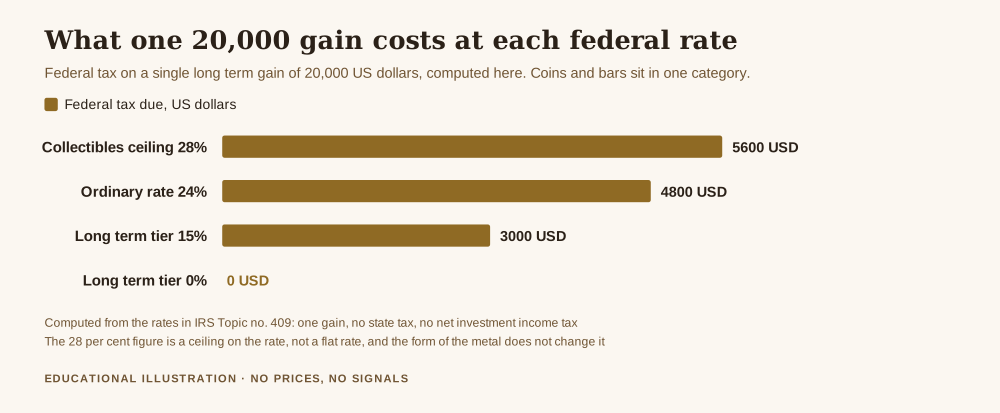
To see what the ceiling does, I worked a single example in Python. Assume one long term gain of 20,000 US dollars, no state tax, no net investment income tax, and nothing else complicating the return:
- at the collectibles ceiling of 28 per cent, the federal tax is 5,600
- at the 15 per cent long term tier, which this gain is not eligible for, it would be 3,000
- at the 0 per cent long term tier, it would be nothing
So the cost of the collectibles classification, on a 20,000 gain for someone who would otherwise sit in the 15 per cent tier, is 2,600 dollars. That is a real number and it is worth knowing before you sell, not after.
Now the part almost nobody mentions. Hold the same metal for one year or less and the gain is short term, which means it is taxed as ordinary income at your marginal rate. At a 24 per cent marginal rate, the tax on that same 20,000 gain is 4,800 dollars, which is 800 dollars less than the long term collectibles ceiling. The ceiling is not automatically the worst outcome, and the common advice to simply hold longer does not always produce the number people assume it will.
The holding period does more work than the shape
The rule that divides short term from long term is stated plainly by the IRS: generally, if you hold the asset for more than one year before you dispose of it, your capital gain or loss is long term.
More than one year. Not one year. Not about a year. A single day on either side of that boundary moves the gain between two entirely different tax treatments, and the date of acquisition is a fact you either recorded or did not.
This is the practical centre of the whole question. A reader who owns both a coin and a bar does not have two tax positions, they have one rule and two purchase dates. The dates decide the outcome. The shapes do not.
Which brings the subject back to something this journal keeps returning to, in a different costume. The person who writes down what they bought, when, and for how much, pays the tax they actually owe. The person who does not pays whatever they can later prove, which is usually more. Protecting capital is not only about the market taking it.
Where coins and bars genuinely differ
Having said that shape does not change the rate, here is where it does matter, and none of it is a tax rate.
Premium over the metal content. Smaller units cost more per ounce to make and to distribute, so the premium you pay on a one ounce coin is typically wider than on a large bar. That premium is part of your cost basis, so it affects the size of your eventual gain, which is a different thing from affecting the rate applied to it. The buying side of this is set out in buying gold coins against gold bars.
Divisibility. A bar is one disposal. A set of coins is many. If you need to realise part of a holding, coins let you choose how much gain to realise in a given tax year, and a bar does not. For somebody near the edge of a rate band, that flexibility is worth more than any difference in premium.
Proof of what you own. Fineness and weight are documented differently for different products, which matters when you come to sell rather than when you come to pay tax. The wholesale market handles this with standards rather than trust, which is why a London good delivery gold bar is defined as holding between 350 and 430 fine troy ounces at a minimum fineness of 995.0, while the silver equivalent is 1,000 troy ounces with a ten per cent tolerance at a minimum fineness of 999.0. Retail products are not good delivery bars, and the gap between the two worlds is covered in what an assay card actually certifies.
Dealer reporting. Some sales to dealers trigger a reporting form and some do not, and the rules turn on the specific product and quantity rather than on coin against bar in general. I am not going to quote a threshold here that I cannot verify as current today, and neither should anyone else. Ask the dealer what they report before you sell, and ask your accountant what you must report regardless of what the dealer does. Those are two different obligations.
The record you will wish you had kept
Everything above collapses into one practical habit, and it is unglamorous.
For every purchase, keep the date, the amount paid including premium and any fees, the dealer, and the description of the item. For every sale, keep the same four facts. That is your cost basis and your holding period, which together are the only inputs the tax calculation needs from you.
The alternative is the position people arrive in when metal has been held for years, or inherited, and nobody can prove what it cost. Inherited metal has its own basis rule, which is why it is treated separately in the tax basis for inherited gold coins, but inherited or bought, the principle is identical: no record, no proof, and the burden sits with you.
If you ever sell into a dealer rather than privately, the cost of that transaction also belongs in the file, and the shape of those costs is laid out in what it costs to sell gold. The tax is calculated on the gain after those costs, so the receipts are not paperwork for its own sake.
What this means if you hold both
Most people who ask this question own a mixture, usually accumulated without a plan: a few coins bought early, a bar bought later when the premium on coins started to annoy them.
If that is you, the useful exercise is not to decide which form is better. It is to lay out every holding with its purchase date and cost, and see which ones have crossed the one year line and which have not. That single sheet tells you more about your eventual tax than any article about coins against bars, including this one.
And when you do sell, sell for a reason that exists outside the tax code. A tax tail wagging an investment dog is how people end up holding a position they no longer want, which is the same mistake in a different market as holding a losing trade because closing it would make the loss official. Protect first, master the detail second, grow third.
Get the free Black Gold Market blueprint, a one page guide to protecting capital before trying to grow it, in the kind of market this article describes. One email, no spam, unsubscribe anytime.
Get the free blueprint →Frequently asked questions
Is there a difference in gold coin vs gold bar tax in the United States?
Not in the rate. Federal rules place both bullion and coins in the collectibles category, and Publication 550 names metal such as gold bullion and coin in the same sentence. The holding period, your income level and your state are what change the outcome.
Is gold always taxed at 28 per cent?
No. Twenty eight per cent is the maximum rate on a long term collectibles gain, not a flat rate. A gain held one year or less is taxed as ordinary income instead, which can be higher or lower depending on your bracket.
Do I owe tax if I have not sold?
Capital gains tax is triggered by a disposal, so holding metal that has risen in value does not by itself create a federal capital gains liability. Other taxes and other countries work differently, which is one of many reasons to ask a professional about your own situation.
Does buying through a different form reduce the rate?
Not in the way people hope. Changing from a coin to a bar does not move the metal out of the collectibles category. What changes your position is the holding period and the records that prove it.
What records should I keep?
Date of purchase, total amount paid including premium and fees, a description of the item, and the dealer. Then the same for the sale. Those are the inputs to the calculation, and reconstructing them years later is the expensive way to do it.
Does this apply outside the United States?
No. The collectibles category and the 28 per cent ceiling are United States federal rules. Other countries treat investment metal very differently, some with exemptions for specific coins, so use this article as a model for the questions to ask, not as an answer for your own country.
Where this leaves you
The honest summary of gold coin vs gold bar tax is that the question is aimed at the wrong variable. Shape changes premium, divisibility and how easily you can prove what you hold. It does not change the federal rate. The holding period changes the rate, the records decide what you can prove, and both are entirely within your control before you ever sell.
The rate ceiling and the holding period rule come from the IRS Topic no. 409 on capital gains and losses, and the definition that places bullion and coin in the same collectibles category comes from IRS Publication 550. The good delivery bar specifications are from the LBMA technical specifications. The figures of 5,600, 4,800, 3,000 and 2,600 dollars were calculated here from those published rates on a single hypothetical 20,000 dollar gain, with the assumptions stated above.
Black Gold Market publishes daily gold analysis with the level, the context and the risk written out, and the free blueprint above is the one page version of the capital rules used here. Following along is free, the Kit is optional, and nothing here promises a profit. If the volatility rather than the tax is what worries you, start with protecting capital when gold gets volatile.
About the author. Raphael writes Black Gold Market around three ideas in a fixed order: protect, master, grow. Capital that survives the bad month is the only capital that gets to compound, and the published work shows the level, the context, and the risk so you can judge the reasoning yourself. This is education and not financial or tax advice, and no entry, stop or target discussed should be treated as a signal.