

Selling on a marketplace feels like the honest route. You set the price, a real buyer pays it, and nobody quotes you a number across a counter and dares you to argue. So how much does ebay charge to sell gold coins is usually asked as a formality, somewhere between listing the item and photographing it. It is not a formality. The published rate for bullion is higher than almost anyone expects, it is charged on more of the money than people realise, and it contains a step so abrupt that one extra dollar of sale price can cut the bill by nearly five hundred.
This belongs under Protect, because it is the same discipline as sizing a trade. The cost is knowable in advance, it is published, and it only hurts the people who find out afterwards. Nothing below is an opinion about whether to sell. It is the fee schedule, read carefully, with the arithmetic done.
How much does ebay charge to sell gold coins, as the fee page states it
eBay sets its final value fee by category, and bullion has its own line. On the store selling fees page, under Coins & Paper Money > Bullion, the rate is 13.6 per cent if the total amount of the sale is 7,500 dollars or less, calculated per item, and 7 per cent if the total amount of the sale is over 7,500 dollars, also calculated per item. On top of that there is a per order fee of 30 cents for orders of 10 dollars or less and 40 cents for orders over 10 dollars.
Two things in that paragraph deserve a second look before anything else.
The first is the base rate. 13.6 per cent is not a payment processing charge. It is the headline commission on the category, and it sits above the ordinary coins line: Coins & Paper Money other than bullion is charged 13.25 per cent up to 7,500 dollars. Bullion is the more expensive of the two by 0.35 of a percentage point, which on a 7,500 dollar sale is 26 dollars and 25 cents.
The second is what the percentage is applied to. eBay states that the total amount of the sale "includes the item price, any handling charges, any shipping costs collected from the buyer, sales tax, and any other applicable fees". Read that again if you have ever thought of shipping as something the buyer pays. If you collect 40 dollars of postage from the buyer, the fee is charged on that 40 dollars too. The same is true of sales tax that you never keep.
The step at 7,500 dollars, which is not a marginal rate
Most eBay categories work the way tax brackets work. The ordinary coins line, for example, is 13.25 per cent up to 7,500 dollars and then 2.35 per cent on the portion of the sale over 7,500. The bullion line does not say that. It says 13.6 per cent if the sale is 7,500 or less, and 7 per cent if the sale is over 7,500. The rate applies to the whole amount, not to a slice of it.
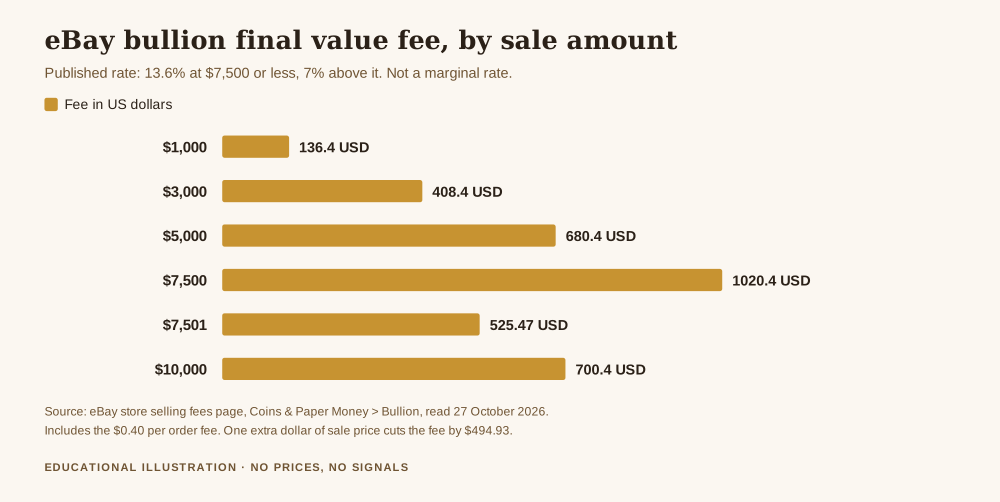
Work the two sides of that step. A sale of exactly 7,500 dollars is charged 13.6 per cent, which is 1,020 dollars, plus the 40 cent order fee, so 1,020 dollars and 40 cents. A sale of 7,501 dollars is charged 7 per cent, which is 525 dollars and 7 cents, plus 40 cents, so 525 dollars and 47 cents. One additional dollar of sale price reduces the fee by 494 dollars and 93 cents.
That is not a rounding quirk, it is a cliff, and it reaches a long way down. Ask which smaller sale costs the same 525 dollars at 13.6 per cent, and the answer is 525.07 divided by 0.136, which is about 3,861 dollars. So every bullion sale between roughly 3,861 and 7,500 dollars pays more in fees than a sale of 7,501 dollars does. A seller who splits one lot into two smaller listings to look more affordable can easily pay more in total than the seller who listed it once.
I am not telling you to price anything at 7,501 dollars. The point is narrower and more useful: the fee schedule is not smooth, so the cost of a sale cannot be estimated by multiplying in your head. It has to be looked up.
Why the effective rate is always worse than the headline
The published percentage is the floor, and three things sit on top of it.
The order fee is the smallest. At 40 cents it barely registers on a four figure sale, though on a 250 dollar coin it lifts the effective rate from 13.60 to 13.76 per cent, which is the general shape of per item charges: they punish small sales.
The fee base is the large one. Because shipping collected from the buyer and sales tax are inside the total amount of the sale, the percentage is charged on money that is not your revenue. Insured, tracked, signature required postage on a parcel of coins is not cheap, and every dollar of it is charged at the category rate.
Then there are the conditional charges the same page lists: an international fee, a seller currency conversion charge, a dispute fee, and insertion fees, plus a monthly subscription if you run a Store. None of these are hidden, and none of them appear in the number most people have in mind when they ask what eBay charges.
The comparison that actually matters
A marketplace fee is only meaningful next to the alternative, and the alternative is selling to a dealer, where the cost is not a percentage at all. It is the gap between what a dealer pays you and what a dealer sells for, and because it is embedded in a quote rather than itemised on an invoice, it is easy to believe it is not there. I set out how that works in what it costs to sell gold, and the conclusion there is the one that applies here: the cheapest looking route is whichever one does not send you a bill.
The honest framing is that the marketplace charges you visibly and the dealer charges you invisibly, and neither is free. What the eBay schedule gives you, uniquely, is a number you can calculate before you commit. You can know your fee to the cent on a sale that has not happened yet. That is worth something on its own, and it is the reason this article can be written at all.
The other half of the comparison is not financial. A marketplace sale means packing, insuring and shipping a valuable object to a stranger, with a dispute process that can be opened after it arrives. A dealer sale ends when you leave the shop. People routinely price the fee and forget to price that difference.
What this does not tell you
These rates are the published US figures I read on 27 October 2026, and marketplace fee schedules change. The bullion rate in particular has moved before. Check the page yourself on the day you list, because an article is a snapshot and the fee page is the authority. eBay operates different schedules in different countries, so a seller outside the United States should read their own site's version rather than this one.
Nothing here covers the tax treatment of a gain on coins, which varies by country and is not something to take from a trading blog. Nothing here says whether selling is the right decision. And the figures I computed, the 1,020.40, the 525.47, the 494.93 and the 3,861, are my arithmetic on eBay's published rates, under the assumption that a single item makes up the whole sale. If you sell several items in one order, the bullion line says the calculation is per item, which changes the sum.
If you hold metal rather than trade it, the storage question sits next to this one, and I worked through it in what it costs to store gold. What you actually own is a separate question again, covered in allocated versus unallocated gold.
Pricing a cost before you meet it
There is a habit underneath this article that matters more than the rate itself, and it transfers directly to a trading account.
Every transaction you will ever make has a cost that is decided before you act and paid after. In a marketplace sale it is a published percentage. In a gold trade it is the spread, the commission and the overnight financing. In both cases the number is available in advance, in writing, from the party charging it, and in both cases most people meet it for the first time on the statement.
The difference between those two groups is not intelligence or experience. It is one step: looking the number up and doing the multiplication before committing, rather than after. It took me longer to convert eBay's wording into arithmetic than it took to find the page. That ratio holds almost everywhere, which is why the step gets skipped, and why skipping it is expensive.
So the useful question is not whether 13.6 per cent is fair. It is whether you knew it was 13.6 per cent before you listed, whether you knew the shipping you collect is inside the base, and whether you knew the rate halves above a threshold. If the answer to any of those was no, the fee schedule was not the problem. The reading was.
Get the free Black Gold Market blueprint, a short document on protecting capital before you try to grow it, including the habit of pricing every cost before you commit rather than after. One email, no spam, unsubscribe anytime.
Get the free blueprint →Frequently asked questions
How much does ebay charge to sell gold coins, in one line?
For the Coins & Paper Money > Bullion category, 13.6 per cent of the total sale amount if that total is 7,500 dollars or less, or 7 per cent if it is over 7,500 dollars, calculated per item, plus a per order fee of 40 cents on orders above 10 dollars.
Is the 7 per cent rate only on the amount above 7,500 dollars?
No, and this is the detail that catches people. Other categories are written as a rate "on the portion of the sale over" the threshold. The bullion line is written as a flat rate applied to the whole sale depending on which side of 7,500 dollars it falls. That is why the fee at 7,500 dollars is 1,020 dollars and the fee at 7,501 dollars is 525 dollars and 7 cents.
Does eBay charge its fee on the shipping I collect?
Yes. eBay states that the total amount of the sale includes the item price, handling charges, shipping costs collected from the buyer, sales tax and any other applicable fees. The percentage is applied to that total, not to the item price alone.
Are gold coins cheaper to sell than other collectible coins?
No, they are slightly more expensive at the lower band. Bullion is 13.6 per cent up to 7,500 dollars while other Coins & Paper Money is 13.25 per cent, a difference of 26 dollars and 25 cents on a 7,500 dollar sale. Above the threshold the bullion rate of 7 per cent behaves very differently from the 2.35 per cent marginal rate on the ordinary coins line.
Is a marketplace cheaper than a dealer?
It depends on the dealer's spread, which is rarely itemised. The marketplace cost is published and calculable in advance, the dealer's is embedded in the quote. Neither is free, and the visible one is not automatically the larger one.
Where did these numbers come from?
The rates, the thresholds, the per order fees and the definition of the total amount of the sale are from eBay's own store selling fees page, read and linked on 27 October 2026. The 1,020.40, the 525.47, the 494.93 saving, the 3,861 break-even, the 13.76 per cent effective rate on a 250 dollar sale and the 26.25 difference are my own arithmetic on those published rates, assuming one item per sale.
Where Black Gold Market fits
Black Gold Market is free to follow. Daily XAU/USD analysis with the level, the context and the risk stated before the trade, losing days included, on Telegram. There is a free blueprint for anyone who wants the capital protection material in one place, and an optional Kit for people who want the full method. Nothing here promises a profit, and nothing here is a signal service. The groundwork this article rests on is in protecting your capital when gold gets volatile.
About the author. Raphael writes Black Gold Market. He works on the part of this business that happens before the entry, the level, the context, and the risk, and he would rather spend ten minutes on a fee schedule than an afternoon explaining a statement. Nothing in this article is a recommendation to trade, and no entry, stop or target discussed should be treated as a signal.