

Someone looking at gold for the first time almost always notices platinum standing next to it and assumes the two are versions of the same idea, one just more exclusive than the other. The word platinum has been used to mean better than gold for so long, on credit cards and record sales and anniversaries, that the assumption feels safe. It is not. What is the difference between gold and platinum turns out to have an answer with real numbers behind it, and the numbers point in the opposite direction from the marketing.
What is the difference between gold and platinum, measured rather than assumed
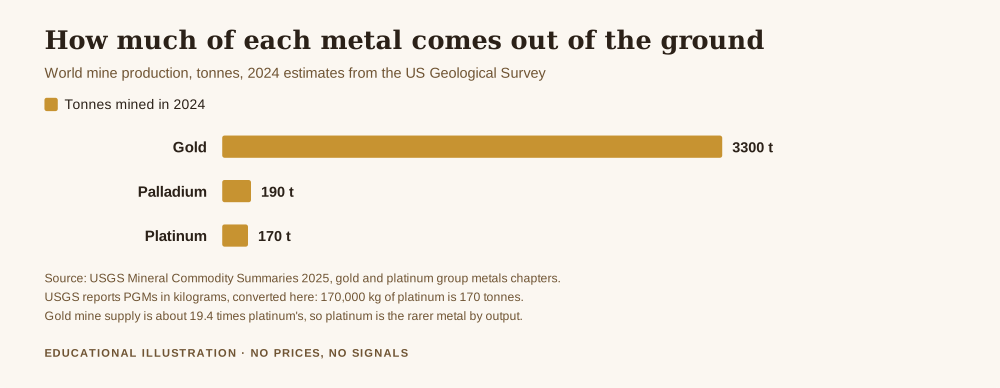
Start with supply, because it is the fact most people get backwards. According to the United States Geological Survey's Mineral Commodity Summaries for 2025, world mine production of gold in 2024 was estimated at 3,300 tonnes. World mine production of platinum in the same year was estimated at 170,000 kilograms, which is 170 tonnes. Palladium, platinum's closest relative, came in at 190,000 kilograms, or 190 tonnes.
Run the division. Gold mine supply is about 19.4 times platinum's. Put the other way, platinum's annual output is roughly 5.2 per cent of gold's. By the plain measure of how much of it the world digs up each year, platinum is far rarer than gold, and it is not close.
Which raises the obvious question. If platinum is the scarcer metal, why does gold behave like the more serious asset, and why does a bad year hit platinum so much harder?
The answer is not rarity, it is what each metal is for
The USGS is blunt about where platinum group metals go. The leading domestic use is catalytic converters, to reduce harmful emissions from vehicles, followed by catalysts for bulk chemical production and petroleum refining, dental and medical devices, and electronics. Platinum is, overwhelmingly, an industrial input. It is bought because a factory needs it to make something else work.
Gold's demand sits in a different place. The USGS gold chapter tracks consumption across jewellery, physical bars, medals and imitation coins, electronics and dentistry, alongside central bank holdings and exchange traded funds. Industry matters, but a very large share of gold demand is somebody deciding to hold gold because it is gold.
That distinction is the whole thing, and it explains the behaviour that confuses people. An industrial metal's demand is tied to industrial activity. When car production slows, or a technology substitutes one metal for another, the demand does not go looking for a different home, it simply shrinks. The USGS notes exactly this substitution pressure: palladium has been used in place of platinum in most petrol engine catalytic converters, about 25 per cent of palladium can routinely substitute for platinum in diesel converters, and the proportion reaches as much as 50 per cent in some applications.
Gold has no equivalent exposure. Nobody holding gold as a store of value switches to palladium because the price moved.
Concentration, and why it matters more than most buyers realise
There is a second structural difference that rarely makes it into comparison articles. Gold is mined widely. In the United States alone the USGS counts production at more than 40 lode mines across 12 states, plus placer operations, and that is one country among many.
Platinum group metals are not spread like that. The USGS records that the largest resources and reserves sit in the Bushveld Complex in South Africa, and in its review of 2024 it attributes falling output to declining prices, higher costs of deep level mining, labour disputes, and ongoing disruption to electricity supply, while Russian production of mined palladium fell on natural disasters, lower ore grades and planned outages at a major metallurgical plant.
Read that list again as a risk register rather than a news summary. A metal whose supply depends on deep shafts in one geological complex and on operations in one other country is exposed to electricity, labour and geopolitics in a way a widely mined metal is not. Scarcity is not automatically a virtue. Scarcity concentrated in few places is a different asset entirely, with different things capable of going wrong.
The reserve picture reinforces it. USGS puts gold reserves at 64,000 tonnes and platinum group metal reserves at more than 81,000,000 kilograms, which is more than 81,000 tonnes. Measured against current production, gold's reserves represent about 19.4 years of output while PGM reserves represent roughly 225 years. The rarer metal annually is the more abundantly reserved one in the ground. Rarity, as a single word, is doing almost no useful work here.
Both are benchmarked, which tells you something about both
One genuine similarity is worth knowing. Platinum is not an obscure corner of the market. The LBMA gold, silver, platinum and palladium price benchmarks are the global benchmark prices for those metals delivered in London, administered by ICE Benchmark Administration. The LBMA Gold Price specifically is set twice daily, in auctions commencing at 10:30 and 15:00 London time.
So both metals have proper institutional price discovery, and if you buy either one you are buying into a market with a recognised reference rather than a dealer's opinion. That is a meaningful protection and it applies to both.
What the shared benchmark does not do is make the two assets interchangeable. The same plumbing carries very different cargo, which is the trap in treating platinum as gold with a better name. For the related question of what any precious metal is actually backed by, I have written that up in what gold is backed by, and the position gold occupies in official reserves is covered in what gold reserves are and who holds them.
What this means if you are choosing between them
Protect first, which here means being accurate about what you are buying rather than cautious about buying at all.
If the reason you want metal is to hold something whose demand does not depend on any particular industry continuing to want it, those two demand profiles are not substitutes for each other, and the choice is about which exposure you are seeking rather than which metal sounds more premium. If you specifically want exposure to industrial demand, platinum gives you that honestly, and the supply concentration described above comes attached to it whether or not you wanted that part.
The failure I would most like you to avoid is the one that starts from the word platinum meaning better. It does not mean better. In this market it means rarer annually, more concentrated geographically, more industrially dependent, and more substitutable by a sister metal. Each of those is a fact you can check, and together they describe an asset that behaves differently from gold in exactly the conditions where you would most want to know how it behaves.
Measured, not assumed. That is the entire discipline, and the measuring in this case takes about ten minutes with a government publication that is free to read. The same habit applied to your own positions is set out in how to protect your capital when gold gets volatile.
Get the free Black Gold Market blueprint, a one page guide to protecting capital before trying to grow it, including how to check what you are actually buying before you buy it. One email, no spam, unsubscribe anytime.
Get the free blueprint →Frequently asked questions
What is the difference between gold and platinum in one sentence?
Platinum is the rarer metal by annual mine production, about 170 tonnes against gold's 3,300, but it is mostly an industrial input concentrated in very few places, while gold's demand includes a large share of people and institutions holding it for its own sake.
Is platinum rarer than gold?
By how much is mined each year, yes, and substantially. USGS estimates for 2024 put platinum at 170 tonnes and gold at 3,300 tonnes, a ratio of about 19.4 to 1. By reserves in the ground the picture reverses, with platinum group metal reserves above 81,000 tonnes against gold's 64,000 tonnes.
Why is platinum sometimes cheaper than gold if it is rarer?
Because price follows demand as well as supply. Platinum's demand is concentrated in industrial uses, principally catalytic converters, so it falls when that activity falls and when manufacturers substitute palladium for it. Gold's demand base includes holders who are not buying it to make anything.
Does platinum protect capital the way gold is said to?
It is a different exposure, not a stronger version of the same one. An asset tied to industrial production tends to struggle in the same conditions that hurt industrial production, which is not the behaviour people are usually seeking when they say they want metal for protection.
Can I buy platinum through the same channels as gold?
Generally yes, and it has the same class of benchmark, since LBMA benchmark prices cover gold, silver, platinum and palladium. The practical cautions that apply to buying physical gold, including premiums, storage and verifying what you are given, apply to platinum as well.
Is palladium the same thing as platinum?
They are separate metals in the same group with overlapping uses, which is precisely why platinum's price is vulnerable. USGS notes that roughly 25 per cent of palladium can routinely substitute for platinum in diesel catalytic converters, and up to about 50 per cent in some applications, so the two compete for the same industrial demand.
Where this leaves you
The short answer to what is the difference between gold and platinum is that one of them is primarily held and the other is primarily used. Everything else, the rarity that runs the opposite way to the reputation, the supply concentrated in a single geological complex, the sister metal waiting to replace it in the application that drives most of its demand, follows from that single distinction.
Protect, master, grow, in that order. Protection starts with knowing what you own, and in this case the knowing is unusually cheap, because a government survey publishes the numbers each year and anyone can check them. The marketing says platinum is the upgrade. The production tables say it is a different job entirely.
The production and reserve figures in this article, namely gold mine production of 3,300 tonnes, platinum at 170,000 kilograms and palladium at 190,000 kilograms for 2024, gold reserves of 64,000 tonnes, platinum group metal reserves above 81,000,000 kilograms, the concentration of resources in the Bushveld Complex, the causes of the 2024 production falls, the catalytic converter and substitution figures of about 25 and up to 50 per cent, and the breakdown of gold end uses, all come from the United States Geological Survey's Mineral Commodity Summaries 2025, gold chapter and platinum group metals chapter. The benchmark arrangements are from the LBMA. The ratios of 19.4 to 1, 5.2 per cent, 19.4 years and about 225 years were calculated here in Python from those published figures, converting kilograms to tonnes. No current metal price, entry, stop or target appears anywhere in this article.
Black Gold Market publishes daily gold analysis with the level, the context and the risk written out, and the free blueprint above is the one page version of the capital rules used here. Following along is free, the Kit is optional, and nothing here promises a profit.
About the author. Raphael writes Black Gold Market around three ideas in a fixed order: protect, master, grow. Capital that survives the bad month is the only capital that gets to compound, and the published work shows the level, the context, and the risk so you can judge the reasoning yourself. This is education and not financial advice, your own circumstances decide what any of this means for you, and no entry, stop or target discussed should be treated as a signal.