

Ask what is gold backed by and you have already accepted a hidden assumption, which is that value needs a backer. Almost everything else in a portfolio does. A bond is backed by a government's willingness to tax. A bank deposit is backed by a bank, and behind the bank an insurance scheme, and behind that a treasury. A share is backed by a company's future earnings. Each one is a promise, and each promise has somebody standing behind it who can fail to keep it. Gold has nobody standing behind it. There is no issuer, no guarantor, no counterparty and no redemption window. The honest answer to the question is nothing, and the interesting part is that this is the reason central banks hold it rather than an objection to holding it.
What is gold backed by, and why the question is upside down
Backing is a promise to exchange one thing for another at a stated rate. A gold certificate was backed by gold because you could present it and receive metal. The metal itself was never backed, because there was nothing to present it for. It was the end of the chain.
That is the whole answer, and it sounds like a weakness until you look at what happens when a backer disappears. When an issuer defaults, the instrument it backed becomes paper. When a bank fails, the deposit becomes a claim in a queue. Gold cannot do either of those things, because there is no promise in it to break. Its value is a matter of what someone will exchange for it today, which is unsentimental and sometimes unkind, but it is not conditional on anyone's solvency.
This is the inversion worth holding on to. The asset with no backer sits underneath the system. The assets with backers sit on top of it.
What the Federal Reserve says about its own notes
You do not have to take that from me. The Federal Reserve publishes the answer to the matching question about the dollar, and the page is titled plainly: is US currency still backed by gold.
Its answer: "Federal Reserve notes are not redeemable in gold, silver, or any other commodity." Not reduced, not partial. Not any other commodity. The page goes on to date it: notes "have not been redeemable in gold since January 30, 1934", which is 92 years ago, when Congress amended the Federal Reserve Act so that the notes would be "redeemed in lawful money on demand at the Treasury Department". Redeemable in lawful money, which is to say redeemable in other notes. Silver convertibility went in the 1960s.
So what does stand behind the notes? The same page says Federal Reserve Banks must hold collateral equal in value to the notes they put into circulation, and that "this collateral is chiefly held in the form of U.S. Treasury, federal agency, and government-sponsored enterprise securities".
Read that slowly, because it is the point of this article. The dollar is collateralised by government debt. Government debt is a promise to pay dollars. The circle closes, and it closes without touching metal at any point. That is not a scandal and it is not an argument for or against anything. It is simply the architecture, stated by the institution that operates it, and it explains why the question "what is gold backed by" is the wrong way round. Gold is what you hold when you would rather not be inside that circle.
The forty two dollars an ounce on the government's books
Here is my favourite piece of evidence, because it is public, dull and completely conclusive.
The US Treasury publishes a monthly status report of the government's gold reserve. As of 31 October 2026 it records 261,498,926.241 fine troy ounces, with a total book value of $11,041,059,957.90.
Divide the second number by the first and you get $42.2222 an ounce. That is not a rounding artefact. It is the statutory value of 42 and two ninths dollars per fine troy ounce, set in 1973, and it has sat there unchanged for 53 years while the market did whatever the market did. The largest official gold holding on earth is carried on its owner's balance sheet at a number that was fixed before most people reading this were born.
Nobody is being deceived by this. It is an accounting convention, and the Treasury is not pretending otherwise. But it tells you something important about book values in general: a figure on a ledger is a bookkeeping decision, and it answers the question "what did we agree to write down" rather than "what is this worth". If a government can carry its own reserve at a number frozen for half a century, you should be slower to trust any valuation you have not checked the basis of.
It also demolishes the idea that the dollar is quietly gold-backed through the reserve. Even at its own stated book value, the entire holding is about $11 billion. Against the scale of the monetary system that is a rounding error. The gold is there, it is simply not doing that job.
How much metal that actually is
Ounces are hard to feel, so convert. A troy ounce is 31.1034768 grams by definition, so 261,498,926.241 ounces is 8,133.53 tonnes. That calculation is the only arithmetic in this section and you can redo it in a moment.
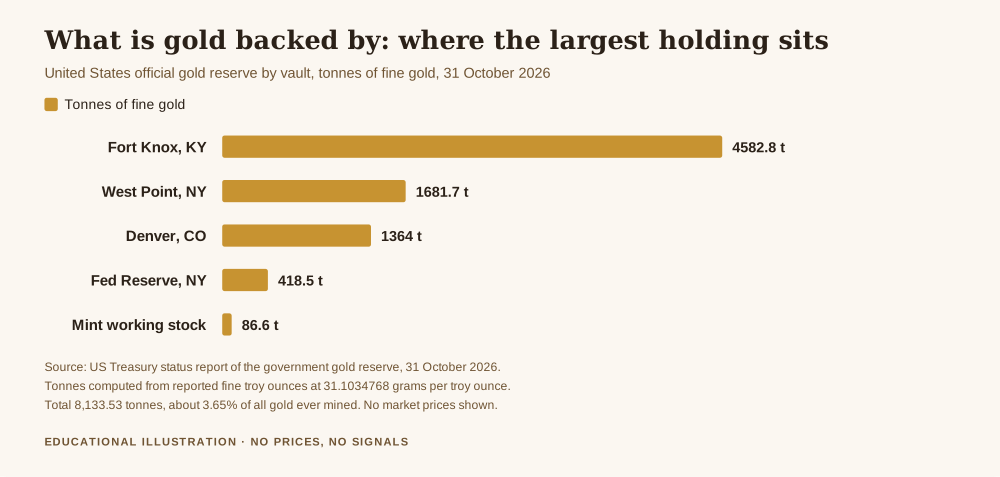
Where it sits, in tonnes, from the same report:
- Fort Knox, Kentucky: 147,341,858.382 ounces, which is 4,582.8 tonnes, or 56.35 percent of the total.
- West Point, New York: 54,067,331.379 ounces, 1,681.7 tonnes, 20.68 percent.
- Denver, Colorado: 43,853,707.279 ounces, 1,364.0 tonnes, 16.77 percent.
- Federal Reserve Bank of New York: 13,452,810.545 ounces, 418.5 tonnes, 5.14 percent.
- Mint working stock, coins, blanks and miscellaneous: 2,783,218.656 ounces, 86.6 tonnes, 1.06 percent.
Note what the report calls the first three categories: deep storage. Together they are 93.79 percent of the holding, and deep storage means what it sounds like. That metal is not inventory to be traded. It is not hedging anything and it is not being lent into the market in that form. It is sitting still, which is the behaviour of an asset held precisely because it is not a promise.
One more comparison to fix the scale. The World Gold Council's best estimate is that around 222,600 tonnes of gold have been mined in all of human history, roughly two thirds of it since 1950. The entire United States official reserve, the largest in the world, is 8,133.53 divided by 222,600, which is about 3.65 percent of it. The rest is in other central banks, in vaults, in funds, in jewellery, in temples and in drawers. No single holder controls this metal, which is another way of saying there is no issuer.
What backs everything else
It is worth being even-handed here, because none of the above makes gold superior. It makes it different, and the difference cuts both ways.
A promise is not a defect. A bond pays you a coupon precisely because somebody owes you something, and that obligation is enforceable. A business can grow, pay a dividend and compound. A deposit earns interest and is insured up to a limit. All of that productivity comes from the existence of a counterparty. Gold has no counterparty, and so it has no coupon, no dividend, no interest and no earnings. It does nothing. It just sits there being itself, with storage costs, and whether that is a virtue depends entirely on what you were worried about.
Which is why "what is gold backed by" turns out to be the wrong question in a second sense. The useful question is not what stands behind the asset. It is which risk you are trying not to carry. If the risk is a specific company, you diversify. If it is a specific bank, you spread deposits. If it is the creditworthiness of the issuer of your currency itself, then an asset whose value depends on no issuer is the only category that answers it, and that is a small category.
What this changes about how you hold it
Three consequences follow from "nothing backs it", and they are practical rather than philosophical.
First, there is no redemption, so there is no fallback price. An instrument with a backer often has a floor underneath it, a par value, a guarantee, a scheme. Gold has none, and its price can fall as far as the bid does. Holding it because it is "safe" misunderstands the word. It is not stable, it is unencumbered, and those are different properties.
Second, custody becomes the whole question. Because the value is in the metal rather than in a promise, whoever physically holds it matters enormously. The moment you hold a claim on gold instead of gold, you have reintroduced exactly the counterparty you were trying to avoid, and you may have excellent reasons to do that, but it should be a decision rather than an accident. Read what you actually own.
Third, be sceptical of any story that gives gold a backer. Gold is not backed by the dollar, by central banks, by the mining industry or by jewellery demand. Those things affect what people will pay for it. None of them owes you anything, and nobody will make you whole if the price moves against you.
Get the free Black Gold Market blueprint, the capital protection material in one place, for anyone who would rather check a number than take it on trust. One email, no spam, unsubscribe anytime.
Get the free blueprint →Frequently asked questions
So what is gold backed by, in one sentence?
Nothing. There is no issuer, no guarantor and no redemption promise, which means there is also nobody who can default on it. Its value comes from what others will exchange for it rather than from an obligation owed to you, and that is a different kind of value rather than a lesser one.
Is the US dollar backed by gold?
No. The Federal Reserve states that its notes "are not redeemable in gold, silver, or any other commodity" and have not been redeemable in gold since 30 January 1934. The collateral behind the notes is chiefly US Treasury, federal agency and government-sponsored enterprise securities, which are financial instruments rather than metal.
Why does the Treasury value its gold at about forty two dollars an ounce?
Because that is the statutory book value, 42 and two ninths dollars per fine troy ounce, set in 1973 and unchanged since. Dividing the reported book value of $11,041,059,957.90 by the reported 261,498,926.241 fine troy ounces gives exactly that figure. It is an accounting convention for the government's own ledger and it is not a market quotation or an official price of gold.
If gold has no backing, why do central banks hold it?
Precisely because it has none. A reserve made entirely of other countries' debt is a reserve made of other people's promises, and in the situations reserves exist for, those promises are exactly what is in doubt. An asset with no counterparty behaves differently from the rest of the balance sheet, and that difference is the function it serves. That is an explanation of the motive rather than a recommendation for your own holdings.
Does holding a gold ETF or a certificate give me the same thing?
Not in this specific respect, and the distinction is the entire subject of this article. Physical metal you control has no counterparty. A fund unit, a certificate or an unallocated account is a claim on somebody, which means you have the price exposure plus a counterparty, custodian and legal structure. That may suit you perfectly well, for cost, convenience or liquidity, but it is a different risk shape and the documents are where the answer is.
Where this leaves you
Black Gold Market is free to follow and stays free. The daily work on Telegram writes out the level, the context and the risk, so you can judge the reasoning rather than copy a number, and there is a free blueprint for anyone who wants the capital protection material in one place. There is an optional kit for people who want the longer version. Nothing here promises a return, because a return is not something anybody can promise you, and nothing here is a recommendation to buy, sell or hold any asset.
The foundation under this piece is how to protect your capital when gold gets volatile. Beside it, the holdings described here in their official context are in what gold reserves are, the reason states bother keeping them is in why countries have gold reserves, the currency relationship that sits behind the whole question is in how the US dollar affects the price of gold, and the wholesale standard that defines what counts as deliverable metal is in what LBMA gold is.
Outside sources used here: the statement that Federal Reserve notes are not redeemable in gold, silver or any other commodity, the date of 30 January 1934, and the description of note collateral as chiefly US Treasury, federal agency and government-sponsored enterprise securities are from the Federal Reserve. The holding of 261,498,926.241 fine troy ounces and the book value of $11,041,059,957.90 as of 31 October 2026, together with the vault by vault breakdown, are from the US Treasury status report of the government gold reserve, read from its official data service. The estimate of around 222,600 tonnes mined in history is from the World Gold Council. Every tonnage and percentage here is computed from those published ounce figures using a troy ounce of 31.1034768 grams, so you can reproduce all of it.
About the author. Raphael writes Black Gold Market. He came to gold through the macro side rather than the chart side, and his standing complaint is that most commentary states a conclusion without ever showing where the number came from. He would rather hand you a smaller claim you can check yourself than a large one you have to trust. Figures here are quoted from the official sources linked above or computed from the stated conversion, the $42.2222 book value is a statutory accounting figure and not a price of gold, nothing in this article forecasts the price of gold or recommends any dealer, mint, fund or purchase, it is not investment, legal or tax advice, and no entry, stop or target discussed should be treated as a signal.