

Someone in the Black Gold Market group watched his open gold position go from comfortable to nearly closed in a single afternoon, without the price moving against him in any meaningful way, and asked me what is exchange margin in forex and whether an exchange had just raised his. It is a fair question with an uncomfortable answer, because the premise underneath it is wrong in a way that matters a great deal for anyone trying to protect capital.
There is no exchange. Retail spot forex and retail gold contracts for difference do not trade on one. So there is no exchange margin. The number that moved on his account was set by his broker, inside a floor set by a regulator, and the space between those two things is where he was exposed without knowing it.
This article works through who actually sets your requirement, what the published floors are, and what happens to an open position when the requirement changes underneath it. That last part is a Protect problem, and it is one of the few risks in this business that can hurt you while you are right about direction.
What Is Exchange Margin in Forex, and Why the Question Has No Answer
Exchange margin is a real and well defined thing. It just belongs to a different market.
In futures, contracts are standardised and cleared through a central counterparty. The exchange and its clearing house set an initial margin, the cash you post to open, and a maintenance margin, the level you must stay above. Everybody trading that contract faces the same requirement. When the clearing house changes it, usually because realised volatility has risen, it publishes a notice with an effective date and the change applies to the whole market at once. You can read it. So can everyone else.
Retail spot forex has none of that architecture. There is no central clearing house, no standardised contract, and no exchange to publish anything. When you open a gold position at a retail broker you are entering a bilateral contract with that firm. It is your counterparty, not a venue matching you against another trader. The margin you post is a term of that private contract.
So the honest answer to what is exchange margin in forex is that the question is asking about a mechanism that does not exist in the market you are trading. The useful follow up question is the one people should be asking instead: who does set my margin, and what can they change without asking me?
The Floor a Regulator Sets, and the Discretion Above It
Two things determine your requirement. The first is a legal minimum set by whoever regulates the legal entity holding your account. The second is your broker's own policy, which can be stricter but never looser.
In the United States, 17 CFR 5.9 requires firms offering retail forex to collect a minimum security deposit of at least "2% of the notional value of the retail forex transaction for major currency pairs and 5% of the notional value of the retail forex transaction for all other currency pairs." That is a floor, and the rule says so explicitly: the requirement set by the registered futures association "cannot be less than" those figures.
In the European Union, the ESMA product intervention measures agreed on 27 March 2018 approach it from the other direction, capping leverage rather than setting a deposit percentage: 30:1 for major currency pairs, 20:1 for gold and major indices, 10:1 for other commodities, 5:1 for individual equities, 2:1 for cryptocurrencies. The same measures added a margin close out rule "at 50% of minimum required margin" and negative balance protection on a per account basis. Those particular measures were temporary and time limited, and national regulators across the bloc subsequently adopted their own permanent versions of them, so check the rules of the specific country your account sits in rather than assuming the ESMA figures apply unchanged.
Notice what those two rulebooks do and do not do. They set a lower bound on how much cash must sit behind a position. Neither of them sets your margin. Neither of them stops a broker requiring far more than the minimum, at any time, on any instrument, if its own risk policy says so.
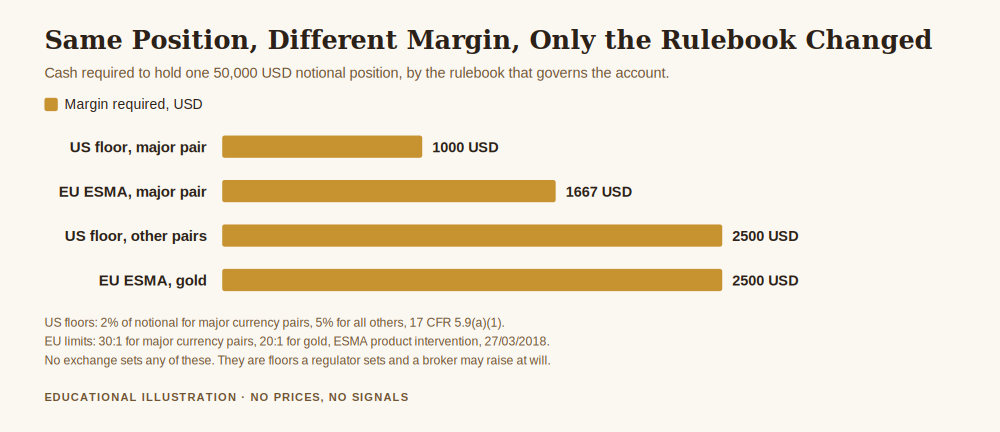
Take a single position with 50,000 dollars of notional value and ask what cash it needs. Under the United States floor for a major pair, at 2 percent, it needs 1,000 dollars. Under the ESMA cap of 30:1 for a major pair, which works out to 3.33 percent, it needs 1,666.67. Under the United States floor for anything that is not a major pair, at 5 percent, it needs 2,500. Under the ESMA limit for gold at 20:1, also 5 percent, it needs 2,500 as well.
Identical position, identical risk to the trader if the price moves, and the cash required varies by a factor of two and a half. The only variable is which rulebook governs the entity holding the account. That is worth sitting with, because it tells you that the number on your platform is not a property of gold. It is a property of your paperwork.
The Part That Can Hurt You While You Are Right
Here is the mechanism that caught the member who wrote to me, and it is worth understanding precisely.
Suppose you hold that same 50,000 dollars of notional gold with 3,000 dollars of equity in the account, at a 5 percent requirement. Your required margin is 2,500 dollars, your margin level is 3,000 divided by 2,500, or 120 percent, and you have 500 dollars of free margin. Not generous, but functioning.
Now your broker raises the requirement on gold to 8 percent, which firms do routinely ahead of major scheduled events and during volatile periods. Required margin becomes 4,000 dollars. Your margin level falls to 75 percent and your free margin is now negative 1,000 dollars. At 10 percent, required margin is 5,000 and your level is 60 percent. At 12 percent, required margin is 6,000 and your margin level is exactly 50 percent, which under the ESMA close out rule is the point at which the firm is required to start closing your position.
Read that sequence again and notice what is absent from it. The gold price never moved. Not one tick. Your analysis was not wrong, your stop was never touched, and your position was liquidated anyway, because the denominator changed.
This is the difference between a market risk and a counterparty risk, and most traders only budget for the first one. You can be entirely right about direction and still be closed out by an administrative decision taken by your counterparty on a Friday afternoon. In futures, the equivalent change is public, applies to everyone, and comes with notice. Here it arrives as an email, or as a line in a client agreement you accepted at signup that reserves the right to vary margin requirements at the firm's discretion.
The futures side of that comparison has its own logic worth knowing, and I have written it up separately in what SPAN is in futures trading, which goes through the portfolio risk model a clearing house actually uses to arrive at its number. The distinction to hold on to is that the futures requirement is computed by a model you can read about and published to everyone at once, while the retail forex requirement is a commercial decision by the firm on the other side of your trade. Same effect on your account, completely different accountability behind it.
What Protect Actually Means Here
None of this is an argument that brokers are villains for raising margin. A firm that lets clients hold heavily leveraged positions into a volatile event, and then eats the negative balances when the gaps come, does not survive to hold anyone's money. Raising margin before a known event is prudent risk management by the firm, and negative balance protection, where it applies, exists precisely because those gaps happen. The problem is not that the requirement moves. The problem is being sized as though it cannot.
Four things follow from that, and none of them require you to trade differently.
Size against a stressed requirement, not the advertised one. If your position only works at the current margin percentage, it does not work. Ask yourself what happens to your margin level if the requirement doubles, because doubling ahead of an event is ordinary rather than exotic. If a doubling puts you near close out, the position is too large now, at today's calm requirement.
Read the margin clause in your client agreement. It is usually short and it usually says the firm may vary margin requirements at its discretion, sometimes with immediate effect and without prior notice. Knowing that sentence is there changes how much free margin you are willing to run.
Know your close out level as a number, not a feeling. Under ESMA rules it is 50 percent of required margin on a per account basis. Elsewhere it varies. Whatever it is, it is a specific percentage in your account terms, and the distance between where you are and where that number sits is a real measurement you can take today.
Know which entity you signed with. A broker group frequently has several regulated entities and the one on your account agreement determines whether the ESMA caps, the United States floors, or something else entirely applies to you. This is the same check that how to check a forex broker licence walks through, and margin is one more reason it is worth doing properly.
Get the free Black Gold Market blueprint, a short document on protecting capital before the trade rather than after it, including how to size a position so a change in requirement does not become a liquidation. One email, no spam, unsubscribe anytime.
Get the free blueprint →Frequently Asked Questions
What is exchange margin in forex, in one sentence?
It is a concept borrowed from futures that does not apply to retail spot forex, because there is no exchange and no clearing house in that market, only a bilateral contract with your broker inside a floor set by a regulator.
So does gold have exchange margin anywhere?
Yes, in exchange traded gold futures, where a clearing house sets and publishes the requirement for everyone trading the contract. That is a different instrument from a retail gold contract for difference, even though the price quoted looks similar.
Can my broker really raise margin on a position I already hold?
In most client agreements, yes, and typically at its discretion. The specific wording is in your agreement under margin or risk management. This is worth reading before you need to know it rather than afterwards.
Does higher leverage make my position riskier?
Leverage does not change what the price does. It changes how much cash sits behind the position, so it changes how little adverse movement, or how small a change in requirement, is needed to reach close out. The risk that matters is position size relative to equity, and leverage is what allows that size to get out of hand.
What is the margin close out rule?
Under the ESMA measures it is 50 percent of minimum required margin, on a per account basis, at which point the provider must begin closing positions. It exists as a consumer protection, and it is also the line that a margin increase can move you across without any price movement.
Where did the numbers in this article come from?
The 2 percent and 5 percent security deposit floors are quoted from 17 CFR 5.9(a)(1). The 30:1, 20:1 and 50 percent close out figures are quoted from the ESMA press release of 27 March 2018 announcing its product intervention measures. Everything else, the 1,000, 1,666.67 and 2,500 dollar requirements on a 50,000 dollar notional position, and the 120, 75, 60 and 50 percent margin levels on 3,000 dollars of equity at 5, 8, 10 and 12 percent requirements, is my own arithmetic under the assumptions written out in the text. No gold price appears anywhere in this article.
Where Black Gold Market Fits
Black Gold Market is free to follow. Daily XAU/USD analysis with the level, the context and the risk stated before the trade, losing days included, plus an optional Kit for people who want the method written down in one place. There is no promise of profit here, because nobody can honestly make one.
Protect comes first, and a requirement you assumed was fixed is a risk you never sized. How to protect your capital when gold gets volatile is the pillar this article belongs under. What a margin call is and how to avoid one covers what happens when the level is breached, what negative balance protection is in forex covers the backstop that exists for when close out arrives too late, and how to check a forex broker licence tells you which rulebook your requirement is actually built on.
About the author. Raphael writes Black Gold Market. He works on the part of this business that happens before the trade, the level, the context, and the risk, and on the conviction that a method you can follow through a quiet quarter is worth more than a better one you cannot.
Disclaimer: This article is general educational content about margin requirements and how they are set. It is not financial advice, not investment advice, not legal advice, not a recommendation to buy or sell gold or any other asset, and not a solicitation to trade. The retail forex security deposit minimums are quoted from 17 CFR 5.9, and the leverage limits, margin close out rule and negative balance protection requirement from the ESMA product intervention measures of 27 March 2018. Both are summarised here rather than reproduced in full, apply only in their own jurisdictions, and are amended from time to time. Your own requirement depends on the specific regulated entity holding your account and on that firm's own policy, which may be considerably stricter, so check your client agreement rather than relying on this article. Every derived figure is my own arithmetic under the assumptions written out in the text. Trading gold, CFDs and leveraged products carries a high risk of losing money rapidly, and no entry, stop or target discussed should be treated as a signal. Readers should consider their own circumstances and speak to a licensed professional in their jurisdiction.