

A dealer shows you two silver items of identical weight and identical purity, and asks very different prices for them. Nothing about the metal explains the gap. That gap is the whole subject of this article, because the answer to what is numismatic silver is not a type of metal at all. It is a type of price: silver whose value is set by collector demand for the object rather than by the weight of the silver inside it. Once you can separate those two numbers, a lot of confusing offers become easy to read.
What is numismatic silver, and what bullion silver is
Start with the clean case, because one country wrote it into statute and the wording is unusually precise.
United States law directs the Treasury to mint a silver coin that is 40.6 millimetres in diameter, weighs 31.103 grams, and contains .999 fine silver, inscribed with the words one ounce fine silver and one dollar. Then, in the next subsection, it says how that coin must be sold: at a price equal to the market value of the bullion at the time of sale, plus the cost of minting, marketing and distributing it.
That is a bullion pricing rule written into law. The price tracks the metal, plus the cost of turning metal into a coin. Nothing in it refers to rarity, condition, date or desirability.
Numismatic silver is priced the other way round. The object's value comes from what collectors will pay for that particular object: its date, its mint, its condition, the number that survived, the grade somebody assigned it. The silver inside it sets a floor and nothing more. Two coins from the same year, the same mint and the same alloy can sell for very different amounts because one spent eighty years in a drawer and the other spent them in a pocket.
So the two words describe pricing logic, not metal. And the honest complication is that a single object can be both: a collectible coin still contains silver, and a bullion coin can acquire a collector following. There is even a nice piece of evidence for that overlap in the same statute. Having set a metal based price for the bullion coin, the law then says that for one particular accounting purpose all such coins shall be considered to be numismatic items. The categories are not watertight even in legislation, which is exactly why you should price the metal yourself rather than trust a label.
How much of the price is actually metal
This is the arithmetic that matters, and it needs no price of silver at all. Work in ratios and it stays true on any day.
Call the metal value of the silver inside the object M, and call what you pay P. The premium is P divided by M. That single ratio tells you how much of your money bought metal and how much bought everything else.
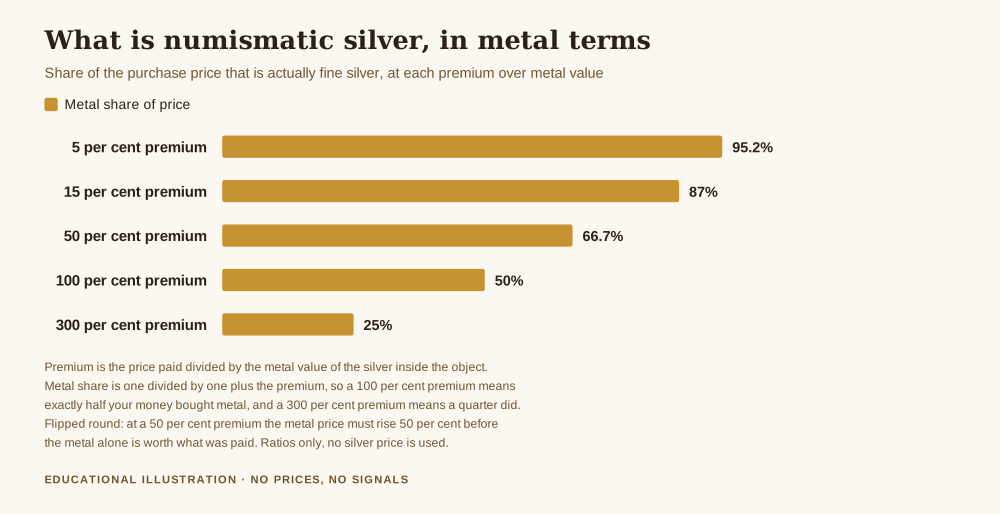
At a 5 per cent premium, the metal is 95.2 per cent of the price. At 15 per cent, it is 87.0 per cent. At 50 per cent, it is 66.7 per cent. At 100 per cent, which is to say paying twice the metal value, the metal is exactly half of what you handed over. At a 300 per cent premium, the metal is 25 per cent of the price and 75 per cent of your money is not metal.
Now flip it, because this is the version that tells you what has to happen next. If you pay a 15 per cent premium, the metal price has to rise 15 per cent before the metal alone is worth what you paid. At a 50 per cent premium it has to rise 50 per cent. At a 300 per cent premium it has to rise 300 per cent, or you need to find somebody who values the object the way the seller did.
That is not an argument against premiums. Every manufactured item carries one, and the statute quoted above builds the cost of minting into the price of a plain bullion coin, quite properly. It is an argument for knowing which number you are paying. A 5 per cent premium and a 300 per cent premium are not two points on the same scale. The first is a fabrication cost. The second is a bet on a market in collectors that has nothing to do with silver.
The trap, and it is the reason people get hurt, is a collector premium sold with a metal story. If the pitch is about silver as protection, about holding real assets, about what happens when currencies wobble, then the thing being sold should be priced like metal. When the sales story is metal and the price is numismatic, those two are pointing in opposite directions, and the ratio above is how you tell.
Purity is a separate question from pricing
People often collapse purity and premium into one idea, and they are independent. A high premium object can be low purity, and a .999 object can be cheap.
The United Kingdom's Hallmarking Act sets out the approved silver standards as four numbers: 800, 925, 958.4 and 999 parts per thousand, each with its own mark, with 925 known as sterling and 958.4 as Britannia. Take an article weighing the same 31.103 grams as the statutory coin above and the fine silver inside it changes with the standard: 31.072 grams at 999, 29.809 grams at 958.4, 28.770 grams at 925, and 24.882 grams at 800.
Put differently, sterling holds 7.41 per cent less fine silver than .999 at the same gross weight, and the 800 standard holds 19.92 per cent less. If you pay by gross weight and the standard is 800, a fifth of what you weighed was never silver.
Incidentally, the statutory bullion coin is itself a small lesson in reading specifications. It weighs 31.103 grams gross at .999 fine, which is 31.072 grams of fine silver, and a troy ounce is 31.1034768 grams. So the coin inscribed one ounce fine silver holds 0.99898 of a troy ounce, about 0.102 per cent short. That is not a scandal, it is rounding in the statute, and it is the right order of magnitude to care about: a tenth of one per cent. Compare it with the 300 per cent premium above and you can see which end of this subject deserves your attention. The same habit of checking the stamp rather than the story applies to gold, which is why the 750 mark on a gold chain is worth understanding too.
What the wholesale market does, for comparison
It helps to see what silver looks like when nobody is selling you a story about it.
The London market's deliverable silver bar, under the LBMA good delivery rules, weighs 1,000 troy ounces, roughly 32 kilograms, with a 10 per cent tolerance either way, and must be at least 999.0 parts per thousand fine. Bars made before 2025 in the older 750 to 1,100 ounce range remain acceptable while they are phased out.
Look at what that specification cares about. Weight and fineness. There is no grade, no date, no condition, no mint. At the wholesale end, silver is a quantity of a substance, and the tolerance band tells you how little the individual object matters: a bar anywhere between 900 and 1,100 ounces settles the same trade. That 200 ounce tolerance is itself worth about 200 of the one ounce statutory coins in metal, and a single 1,000 ounce bar holds roughly 1,001 of them.
Nobody in that market pays extra for a prettier bar. The entire premium structure that makes numismatic silver interesting exists only at the retail and collector end, and it is useful to know that the market the metal price is actually set in does not recognise it at all.
Reading an offer in four steps
None of this requires expertise. It requires four numbers, in order.
One, gross weight and fineness. Multiply them. That is the fine silver content, and it is the only part of the object that the wholesale market will ever pay for.
Two, the metal value. Fine ounces multiplied by the current price per ounce. Use a published reference, not the seller's figure.
Three, the premium ratio. Price divided by metal value. Write it down as a percentage, because a percentage is comparable across items and a dollar figure is not.
Four, ask what the premium is for. Fabrication and distribution on a plain modern coin is a modest, explainable number. Rarity and grade are a different market with different buyers and much wider spreads on the way out. Both are legitimate. Confusing them is not.
If the answer to step four is the seller's confidence rather than a verifiable attribute, treat the premium as the price of the sales pitch. And if you are deciding between metals at all, the prior question is covered in whether to buy gold or silver, while the form of the metal is weighed up in coins against bars.
Get the free Black Gold Market blueprint, a one page guide to protecting capital before trying to grow it, including the habit of pricing what you buy before you buy it. One email, no spam, unsubscribe anytime.
Get the free blueprint →Frequently asked questions
What is numismatic silver in simple terms?
Silver whose price is set by collector demand for the specific object, through its date, mint, condition and rarity, rather than by the weight of silver it contains. The metal sets a floor. Everything above that floor is the collector market's opinion of the object.
Is numismatic silver a better store of value than bullion?
They are different propositions. Bullion tracks the metal, and United States law prices its silver bullion coin at the market value of the bullion plus the cost of minting, marketing and distributing it. A numismatic price depends on a market in collectors, which is narrower and has wider spreads when you sell. Neither is advice, and both can fall.
How do I work out the premium I am paying?
Multiply gross weight by fineness to get the fine silver content, value that at a published price per ounce, then divide the asking price by that figure. A 50 per cent premium means the metal is 66.7 per cent of your money and the metal has to rise 50 per cent before the metal alone covers what you paid.
Does sterling silver count as numismatic?
Not by itself. Sterling is a purity standard, 925 parts per thousand under the UK hallmarking standards, and it holds 7.41 per cent less fine silver than .999 at the same gross weight. Purity and pricing logic are separate questions, and an object can be high premium at low purity or the reverse.
Why is a one ounce coin slightly under a troy ounce?
Because the statute specifies 31.103 grams at .999 fine, which is 31.072 grams of fine silver against a troy ounce of 31.1034768 grams. That is 0.99898 of an ounce, about 0.102 per cent short, and it is rounding in the legislation rather than a shortfall worth worrying about.
Will a dealer buy numismatic silver back at the price I paid?
Expect a spread, and expect it to be wider than on plain bullion, because the buyer has to find another collector rather than a refiner. That is the practical cost of a collector premium and it is worth asking about before you buy, not after.
Where this leaves you
The useful answer to what is numismatic silver is that it is a pricing story attached to a piece of metal, and the two can be separated with one division. Fine weight times fineness gives you the metal. Price divided by metal value gives you the premium. A modest premium is a fabrication cost and a very large one is a bet on a different market entirely, and the only mistake that really costs you is paying the second while believing you bought the first.
The coin specification and the bullion pricing rule are the text of 31 U.S.C. 5112 as published by the Government Publishing Office. The silver purity standards of 800, 925, 958.4 and 999 come from Schedule 2 of the UK Hallmarking Act 1973. The deliverable bar weight of 1,000 troy ounces with a 10 per cent tolerance and minimum fineness of 999.0 is from the LBMA good delivery technical specifications. The figures of 31.072 grams, 0.99898 of a troy ounce, 7.41 and 19.92 per cent, and the premium shares of 95.2, 87.0, 66.7, 50.0 and 25.0 per cent were all calculated here from those published specifications, using a troy ounce of 31.1034768 grams. No price of silver was used anywhere in this article, which is why the ratios still hold whenever you read it.
Black Gold Market publishes daily gold analysis with the level, the context and the risk written out, and the free blueprint above is the one page version of the capital rules used here. Following along is free, the Kit is optional, and nothing here promises a profit. If the volatility rather than the premium is what concerns you, start with protecting capital when gold gets volatile.
About the author. Raphael writes Black Gold Market around three ideas in a fixed order: protect, master, grow. Capital that survives the bad month is the only capital that gets to compound, and the published work shows the level, the context, and the risk so you can judge the reasoning yourself. This is education and not financial advice, and no entry, stop or target discussed should be treated as a signal.