

Search any bullion dealer and you will find a category called IRA eligible, sitting there like a certification. It is not one. No agency issues it, no body audits it, and the phrase appears nowhere in the law it is referring to. So when a reader asks what is ira eligible gold bar, the useful answer is not a list of approved products. It is the three tests a bar has to pass in the statute, because once you can apply them yourself, the label stops mattering and the marketing stops working on you.
The default rule, which is the opposite of what people expect
Start where the law starts, because the exception only makes sense once you have seen the rule it carves out of.
Section 408(m)(1) of the Internal Revenue Code says that the acquisition by an individual retirement account "of any collectible shall be treated as a distribution from such account in an amount equal to the cost to such account of such collectible". Not a penalty. Not a disallowed transaction. A distribution, as if the money had been handed to you.
Then section 408(m)(2) defines a collectible, and the list is short and wide at the same time: any work of art, any rug or antique, any metal or gem, any stamp or coin, any alcoholic beverage, and anything else the Secretary specifies.
Read those two together. Gold is a metal. A gold bar bought inside an IRA is, by default, treated as money taken out of the account on the day it was bought. That is the baseline. Everything a dealer means by IRA eligible is an attempt to land inside the narrow exception that follows.
What is ira eligible gold bar, in the words of the exception
Section 408(m)(3) is where the carve out lives, and the bullion half of it is one sentence. A collectible does not include:
any gold, silver, platinum, or palladium bullion of a fineness equal to or exceeding the minimum fineness that a contract market requires for metals which may be delivered in satisfaction of a regulated futures contract, if such bullion is in the physical possession of a trustee described under subsection (a) of this section.
Three conditions are doing all the work, and they are worth separating because dealers tend to discuss only the first.
- It has to be bullion. Not jewellery, not a collectible coin valued above its metal, not a numismatic piece. Bullion, meaning the thing is the metal.
- It has to meet a fineness floor, and the floor is defined by reference. The statute prints no number. It points at whatever minimum fineness a contract market requires for metal deliverable against a regulated futures contract. The floor moves with the exchange rules, not with the tax code.
- A trustee has to physically hold it. This is the condition people argue about and it is the least ambiguous one in the sentence. The bullion must be "in the physical possession of a trustee described under subsection (a)", meaning the bank or approved non bank trustee of the IRA. Not you. Not your safe.
The Internal Revenue Service says the same thing in plain language in Publication 590-A, listing what a traditional IRA may hold: "It can also invest in certain platinum coins and certain gold, silver, palladium, and platinum bullion." The word doing the work in that sentence is certain.
Where the fineness floor actually comes from
Because the statute defines the floor by reference, the honest answer to "how pure does it have to be" is that you have to look at the delivery rules it points to rather than at the tax code. That sounds evasive until you notice how neatly it lines up with the wholesale market, which is the part worth understanding.
The reference point the physical market uses is the London good delivery standard. The LBMA's technical specifications put the minimum acceptable fineness for a good delivery gold bar at 995.0 parts per thousand, with a gold content of 350 to 430 fine troy ounces. At that fineness, a 350 fine ounce bar weighs about 351.76 troy ounces gross, which is 10.941 kilograms, and a 430 fine ounce bar about 432.16 gross, or 13.442 kilograms.
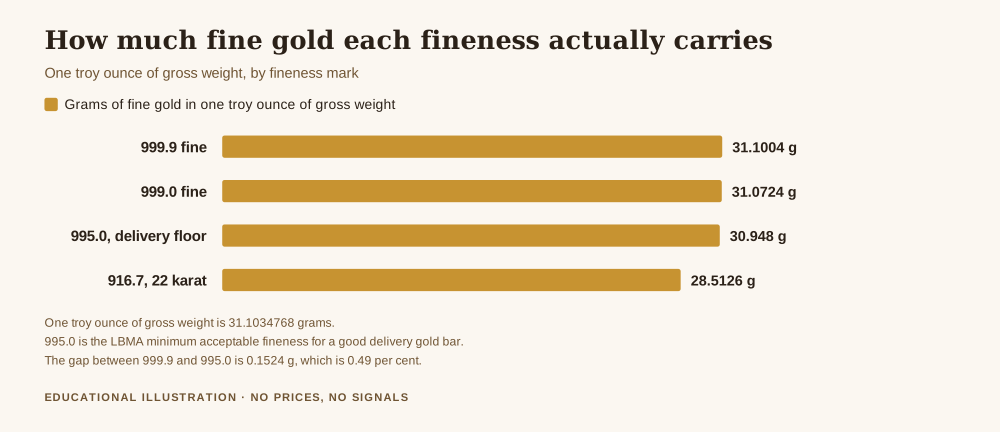
That 995.0 line is the one that matters for the question in front of you, and here is the part that surprises people. The gap between a 995.0 bar and a 999.9 bar is 0.49 per cent of the metal. On a one troy ounce bar, 999.9 fineness gives 31.1004 grams of fine gold and 995.0 gives 30.9480 grams. The difference is 0.1524 grams. On a one kilogram bar the same gap is 4.9 grams.
So the fineness question is not really about how much gold you get, because you are normally paying for fine content rather than gross weight anyway. It is a question about whether the bar sits inside a category the wholesale market and the statute both recognise. A 916.7 bar, which is the familiar 22 karat mark, holds 28.5126 grams in that same one ounce of gross weight. It is perfectly good gold. It just falls on the wrong side of a line that was drawn for settlement rather than for value.
The coin exception, which contradicts the bar rule in a useful way
There is a second half of section 408(m)(3) that explains a lot of confusion, and it rewards a minute of attention.
Subparagraph (A) exempts specific coins by name rather than by purity: gold coins described in paragraphs (7) through (10) of section 5112(a) of title 31, silver coins under 5112(e), platinum under 5112(k), and any coin issued under the laws of a State.
Look at what those statutory gold coins actually are. Section 5112(a) describes a fifty dollar gold coin of 32.7 millimetres weighing 33.931 grams and containing one troy ounce of fine gold, a twenty five dollar coin of 16.966 grams containing half an ounce, a ten dollar coin of 8.483 grams containing a quarter, and a five dollar coin of 3.393 grams containing a tenth.
Do the division on the first one. One troy ounce of fine gold is 31.1034768 grams, inside a coin weighing 33.931 grams gross. That is a purity of 0.9167, which is 91.67 per cent, which is 22 karat.
So the statute admits a 22 karat coin by name while a 22 karat bar fails the fineness test. Both facts come from the same subsection. This is not an inconsistency to be explained away, it is the structure of the exception: coins get in on identity, bullion gets in on fineness. If you have ever wondered why one dealer's eligible list mixes very pure bars with a coin that is visibly not pure, that is the reason, and it is the single clearest sign that you are reading a legal category rather than a quality ranking.
What failing the test costs, with the assumptions on the table
The consequence is not a fine. It is that the purchase is treated as a distribution of its cost, which then lands in the normal rules for taking money out early.
Take an assumed 10,000 of bullion bought inside a traditional IRA that turns out not to qualify, an owner under 59 and a half, no exception applying, and a flat marginal rate. The amount comes into income, and on top of that the Internal Revenue Service applies what it calls a 10 per cent additional tax on early distributions from traditional and Roth IRAs, assessed "to discourage the use of IRA distributions for purposes other than retirement".
- At a 12 per cent marginal rate: 1,200 income tax plus 1,000 additional tax, 2,200 in all, 22.0 per cent of the purchase.
- At 22 per cent: 2,200 plus 1,000, so 3,200, which is 32.0 per cent.
- At 24 per cent: 2,400 plus 1,000, so 3,400, which is 34.0 per cent.
- At 32 per cent: 3,200 plus 1,000, so 4,200, which is 42.0 per cent.
Those four figures were calculated here from the stated assumptions and nothing else. The point is not the precise number, which depends on a return nobody here has seen. The point is the order of magnitude. A fineness detail or a storage arrangement that looked like paperwork can cost roughly a third of the amount involved, and it costs it in the year of purchase rather than at some distant retirement date.
Get the free Black Gold Market blueprint, a one page guide to protecting capital before trying to grow it, including the habit of checking the rule yourself rather than trusting the label on the category page. One email, no spam, unsubscribe anytime.
Get the free blueprint →Frequently asked questions
What is ira eligible gold bar in one sentence?
It is a bullion bar that meets the fineness floor the Internal Revenue Code defines by reference to futures delivery rules, and that is held in the physical possession of the account trustee rather than by the owner. Both halves are required. A bar of the right purity sitting in your own safe does not satisfy the exception.
Can I keep IRA gold at home if I set up a company to hold it?
The statute requires the bullion to be in the physical possession of a trustee described under section 408(a). Arrangements built to route around that are exactly what the condition is addressing, and the consequence of being wrong is a deemed distribution of the full cost. This is education rather than tax advice, so take any structure of that kind to a professional before, not after.
Does a higher fineness bar give me more gold?
Per gram of gross weight yes, but much less than people assume. On a one troy ounce bar, 999.9 fineness gives 31.1004 grams of fine gold and 995.0 gives 30.9480 grams, a difference of 0.1524 grams, or 0.49 per cent. Since bullion is normally priced on fine content, the fineness mostly decides which market category the bar belongs to rather than how much metal you own.
Why do approved lists include a 22 karat coin?
Because coins and bars get in through different doors. Section 408(m)(3)(A) admits specific coins by statutory description, and the one ounce gold coin described in 31 USC 5112(a)(7) weighs 33.931 grams gross for one troy ounce of fine gold, which works out at 91.67 per cent purity, or 22 karat. Bars have no such naming route and must clear the fineness test instead.
Is "IRA eligible" an official certification?
No. It is a dealer's description of their own reading of the statute. There is no register, no certifying body and no audit behind the phrase. That is precisely why it is worth being able to apply the three conditions yourself.
Does any of this apply outside the United States?
No. Section 408(m) is United States tax law and the individual retirement account is a United States structure. Other countries have their own retirement wrappers with their own rules on holding physical metal, and some do not permit it at all. The habit worth exporting is reading the rule rather than the product page.
Where this leaves you
The short answer to what is ira eligible gold bar is that it is not a grade of gold, it is a bar that happens to satisfy three statutory conditions at once: it is bullion, it clears a fineness floor defined by reference to futures delivery standards, and a trustee has physical possession of it. Dealers compress all of that into two words on a category page, and the compression is where buyers get hurt. Ask which of the three conditions the bar in front of you satisfies, and ask who will be holding it. A seller who can answer both without reaching for marketing language is telling you something useful about the rest of the transaction too.
The collectible rule, the definition that includes any metal, the bullion exception quoted above and the coin exception are all from section 408(m) of the Internal Revenue Code as published by the United States Government Publishing Office. The statutory coin specifications of 32.7 millimetres and 33.931 grams, 16.966, 8.483 and 3.393 grams are from 31 USC 5112. The line that a traditional IRA "can also invest in certain platinum coins and certain gold, silver, palladium, and platinum bullion" is from IRS Publication 590-A, and the 10 per cent additional tax on early distributions is from IRS Tax Topic 557. The minimum fineness of 995.0 parts per thousand and the good delivery range of 350 to 430 fine troy ounces are from the LBMA good delivery technical specifications. The figures of 31.1004, 30.9480 and 28.5126 grams, the 0.1524 gram and 4.9 gram gaps, the 0.49 per cent difference, the 351.76 and 432.16 gross ounces, the 10.941 and 13.442 kilograms, the 0.9167 purity and the four tax outcomes of 2,200, 3,200, 3,400 and 4,200 were all calculated here from those published figures and the assumptions stated in the text. No gold price appears anywhere in this article, and no product, dealer or custodian is recommended.
If you want the wrapper rather than the metal inside it, what a gold IRA is covers the account itself, and gold coin versus gold bar tax covers how the same metal is taxed outside a retirement account. For the fineness standard that keeps appearing here, what LBMA gold means explains where the 995.0 line comes from, and is higher k gold better covers the purity question for metal you can actually hold. Underneath all of it, protecting your capital when gold gets volatile is where the size of any gold holding gets decided.
Black Gold Market publishes daily gold analysis with the level, the context and the risk written out, and the free blueprint above is the one page version of the capital rules used here. Following along is free, the Kit is optional, and nothing here promises a profit.
About the author. Raphael writes Black Gold Market around three ideas in a fixed order: protect, master, grow. Capital that survives the bad month is the only capital that gets to compound, and the published work shows the level, the context, and the risk so you can judge the reasoning yourself. This is education and not financial, tax or legal advice, every country taxes retirement accounts differently, and no entry, stop or target discussed should be treated as a signal.