

Ask what is gold before it becomes gold and the honest answer is that for most of its life it is rock, and not very promising rock at that. The metal you see quoted as XAU/USD is the last state in a chain of four, and each link in that chain is a separate physical substance, handled by different companies, moved under different customs codes, and priced on different terms. Somewhere between the ground and the screen, a few grams scattered through a tonne of ore become a bar that a London vault will accept without question. That transformation is the reason a standard exists at all, and understanding it changes how you read the word "gold" when somebody uses it loosely.
What is gold before it becomes gold, the four states it passes through
The chain runs ore, then concentrate, then doré, then refined bar. They are not stages of paperwork. They are different materials.
Ore is rock with gold in it, at concentrations that would strike anyone outside the industry as absurd. Gold is not sitting there in nuggets. It is dispersed, often invisible, sometimes locked inside sulphide minerals that have to be broken down chemically before the metal can be touched at all.
Concentrate is what is left after the rock has been crushed, ground and processed to throw away as much waste as possible. It is a powder or slurry, enormously richer than the ore, and still not metal.
Doré is the first thing that looks like gold. It is an unrefined alloy, poured into bars at or near the mine, typically carrying a significant fraction of silver and other metals along with the gold. It is recognisably a bar. You could hold it. No bullion market would take it.
Refined bar is the end of the chain, and the only state in which the metal is fungible. This is where a standard takes over from a description, and it is the subject of the last section.
The useful thing about this sequence is that it explains why the gold market has such an unusual structure. Almost every other commodity is traded as a described grade with a tolerance. Gold at the wholesale level is traded as a specification so tight that one bar is interchangeable with another, which is only possible because everything upstream has already been stripped away.
The customs schedule proves the stages are different things
If you want evidence that these are genuinely separate commodities rather than one commodity described four ways, the cleanest place to find it is a tariff schedule, because customs authorities have to classify what is physically crossing a border.
The United States Geological Survey's Mineral Commodity Summaries for 2026 lists the relevant lines. Gold content of other ores sits at 2616.90.0040. Gold doré has its own line at 7108.12.1020. Gold bullion sits separately at 7108.12.1013. Gold scrap is 7112.91.0100 again. Four materials, four classifications, in a system that exists specifically to avoid treating different things as the same thing.
The import figures in that same publication show the chain working. Over 2021 to 2024, United States imports of ores and concentrates came 99 per cent from Canada. Imports of doré came from a completely different set of countries: Mexico at 37 per cent, Colombia at 22 per cent, Argentina at 14 per cent, Nicaragua at 8 per cent, and others making up the remaining 19 per cent. Imports of bullion came from a third set again, led by Canada at 46 per cent, Switzerland at 16 per cent, South Africa at 10 per cent and Colombia at 7 per cent.
Look at Switzerland in that last list. It barely mines gold. It appears near the top of the bullion list because refining is a separate industry from mining, concentrated in a handful of places, and material flows there as doré and leaves as bars. The geography of where gold is dug up and the geography of where it becomes gold are two different maps.
The rock arithmetic, and why grade is the whole story
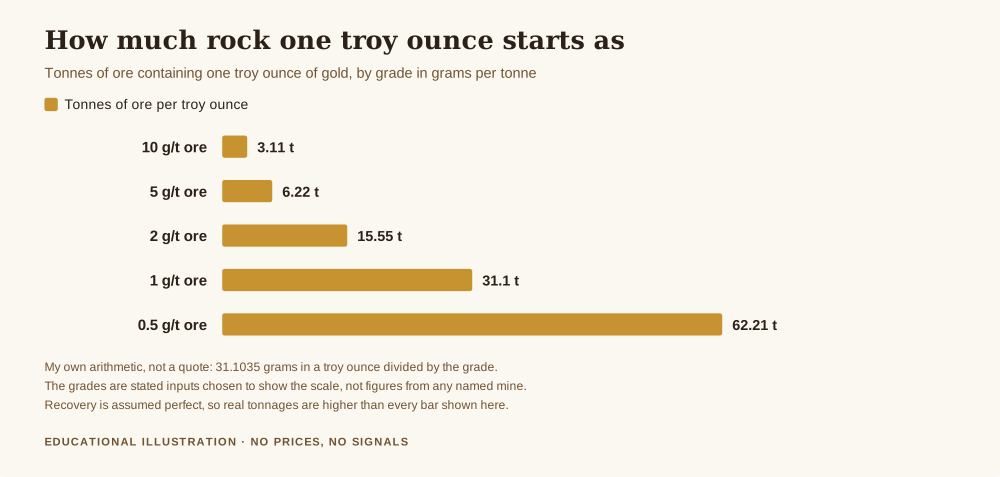
Ore grade is measured in grams of gold per tonne of rock. Since a troy ounce is 31.1035 grams, the tonnes of ore holding one ounce is just that figure divided by the grade. The arithmetic is simple and the result is not intuitive.
- At 10 grams per tonne, a rich underground grade, one troy ounce is dispersed through 3.11 tonnes of rock.
- At 5 grams per tonne, one ounce comes from 6.22 tonnes.
- At 2 grams per tonne, 15.55 tonnes.
- At 1 gram per tonne, a grade entirely normal for a large open pit, 31.10 tonnes.
- At 0.5 grams per tonne, 62.21 tonnes of rock for a single ounce.
Those are computed, not quoted, and the assumptions matter: the grades are inputs I chose to show the scale rather than figures from any named mine, and recovery is assumed to be perfect. No process recovers everything, so the real tonnage moved is higher than every number above. Put the last line next to a coin and the comparison does the work. One small coin, and in the ground it was spread through roughly the mass of forty mid sized cars.
This is also why a change in the gold price changes what counts as ore. Rock is not ore because of what is in it. It is ore because it is worth processing, and that boundary moves. The same material can be waste in one year and feed in another without a single atom changing, which is a useful thing to remember whenever somebody talks about how much gold is "available".
Doré, the bar that is not yet a bar
Doré deserves more attention than it gets, because it is the stage where most of the confusion lives. It is poured at the mine, it is heavy, it is yellow, and it is unmistakably a bar. Photographs of doré are routinely used to illustrate articles about bullion. They are not the same object.
Doré is an alloy of variable composition. It carries silver, and depending on the deposit it can carry copper, platinum group metals or others. Its gold content is not standard and is not assumed; it has to be assayed. Nobody quotes a price for doré the way a price is quoted for metal, because there is no "it" to quote. Each parcel is its own negotiation, settled on assay, with charges for the refining still to come.
That is the real line between doré and bullion. Doré is a described parcel you have to test. Bullion is a specification you can accept sight unseen. Everything the refining industry does sits in the gap between those two sentences.
What a refinery adds, in numbers
The scale of the refining step shows up clearly in the same USGS publication. In 2025, United States mine production was estimated at 160 tonnes of gold content. United States primary refinery output was estimated at 170 tonnes. Refineries produced more than the country's mines did, which is only possible because they are processing imported doré and concentrate alongside domestic material. On those figures the gap is 6.2 per cent above domestic mine output, computed from the two published numbers.
Alongside that primary output, an estimated 90 tonnes came from new and old scrap, which the publication describes as equivalent to about 60 per cent of reported consumption. Gold that was already jewellery or already electronics re-enters the chain at the refinery stage and leaves it indistinguishable from newly mined metal. That is a genuine peculiarity of this market. Once refined to standard, an ounce from a 2025 pit and an ounce from a scrapped necklace are the same commodity, and no analysis can tell them apart.
The publication also notes that commercial-grade gold was produced at approximately 16 refineries in the United States. For a country producing 160 tonnes a year from more than 40 lode mines across 12 states, the funnel narrows sharply at that point. Mining is dispersed. Refining is not.
For context on the whole system, world mine production in 2025 was estimated at 3,300 tonnes, against 3,280 tonnes in 2024, with China, Russia, Australia, Canada and the United States together accounting for 41 per cent of the global figure. At the USGS conversion of 32,150.7 troy ounces to the tonne, 3,300 tonnes is about 106.1 million troy ounces, computed from those two published figures. That is the annual flow through the entire chain described above.
Get the free Black Gold Market blueprint, the capital protection material in one place, for anyone who would rather check a number than take it on trust. One email, no spam, unsubscribe anytime.
Get the free blueprint →The bar the market will actually accept
At the end of the chain sits a document rather than a substance. The London Bullion Market Association publishes technical specifications for a Good Delivery gold bar, and they are precise in a way that repays reading.
- Minimum fineness 995.0 parts per thousand fine gold. Note what that allows: up to five parts per thousand of the bar may be something other than gold, and it is still Good Delivery.
- Weight between 350 and 430 fine troy ounces, roughly 10.9 to 13.4 kilograms. The famous "400 ounce bar" is the middle of a range, not a fixed size.
- Weight expressed in multiples of 0.025 troy ounces, rounded down to the nearest increment.
- Dimensions of 250 millimetres long with a tolerance of 40 millimetres, 70 millimetres wide with a tolerance of 15, and 35 millimetres high with a tolerance of 10, with undercut faces.
- Fineness marked to four significant figures, with five permitted where a national standard requires it.
Two of those are worth sitting with. The first is the fineness floor. Because a bar is specified in fine troy ounces, meaning the gold content rather than the lump, a bar holding exactly 400 fine ounces at 995.0 fineness has a gross weight of 402.01 troy ounces, computed as 400 divided by 0.995. At 999.9 the same 400 fine ounces weighs 400.04 gross. The difference, just under two troy ounces of other metal, is not an error. It is inside the standard, which is precisely why the standard talks in fine ounces.
The second is the rounding rule. Rounding down to a multiple of 0.025 troy ounces means up to that increment of gold is simply not counted, and 0.025 troy ounces is 0.7776 grams on the conversion above. The system does not round to the nearest. It rounds in the direction that never overstates. For a market where bars change hands on trust and paperwork, a rule that can only ever understate what is in the box is a sensible piece of engineering.
So the answer to the original question has a shape. Before it becomes gold, the metal is rock, then powder, then an alloy nobody will quote a price for. It becomes gold, in the market sense, at the moment it satisfies a specification written down by an association, and not a moment before.
Frequently asked questions
What is gold before it becomes gold, in one sentence?
Ore, then concentrate, then doré, then a refined bar that meets a published specification. Only the last of those is the fungible commodity people mean when they say gold, and the first three are separate materials with their own customs classifications, their own handling and their own commercial terms.
Is doré the same as a gold bar?
No, and the visual similarity is what makes the question worth asking. Doré is an unrefined alloy poured at or near the mine, with a gold content that varies by deposit and has to be assayed rather than assumed. A Good Delivery bar meets a minimum fineness of 995.0 and a defined weight range. Doré is a parcel you test. Bullion is a specification you can accept.
How much rock does one ounce of gold come from?
It depends entirely on grade, and the arithmetic is one division. A troy ounce is 31.1035 grams, so at 1 gram per tonne one ounce is spread through 31.1 tonnes of rock, at 2 grams per tonne 15.55 tonnes, and at 10 grams per tonne 3.11 tonnes. Those assume perfect recovery, so the real figures are higher.
Does a Good Delivery bar have to be pure gold?
No. The published minimum is 995.0 parts per thousand, so up to five parts per thousand can be other metal. Because the weight is quoted in fine troy ounces rather than gross, a bar containing 400 fine ounces at that minimum fineness actually weighs about 402.01 troy ounces in total, computed from the specification.
Does recycled gold differ from newly mined gold?
Not once it has been refined to standard, which is the point. The USGS estimated 90 tonnes of United States secondary output from new and old scrap in 2025, and that metal leaves the refinery as the same commodity as primary output. The chain of custody differs, the material does not.
Where this leaves you
Black Gold Market is free to follow and stays free. The daily work on Telegram writes out the level, the context and the risk, so you can judge the reasoning rather than copy a number, and there is a free blueprint for anyone who wants the capital protection material in one place. There is an optional kit for people who want the longer version. Nothing here promises a return, because a return is not something anybody can promise you, and nothing here is a recommendation to buy, sell or hold any asset.
The foundation under this piece is how to protect your capital when gold gets volatile. Beside it, the wholesale standard that ends the chain is in what LBMA gold is, the cost of getting metal out of the ground in the first place is in how much it costs to mine gold per ounce, the scrap that re-enters at the refinery is in how much gold is recycled, and the retail version of the fineness question is in the difference between real and fake gold.
Outside sources used here: the tariff classifications for ores, doré, bullion and scrap, the 2021 to 2024 import shares by material, United States mine production of 160 tonnes and primary refinery output of 170 tonnes for 2025, secondary output of 90 tonnes, the figure of approximately 16 refineries, world mine production of 3,300 tonnes against 3,280 tonnes in 2024, the 41 per cent share held by the five leading producers, and the conversion of 32,150.7 troy ounces to the metric tonne, are all from the United States Geological Survey, Mineral Commodity Summaries, gold, February 2026. The minimum fineness of 995.0, the range of 350 to 430 fine troy ounces, the 0.025 troy ounce rounding, the dimensional tolerances and the marking requirements are from the London Bullion Market Association Good Delivery technical specifications. Every tonnage per ounce, gross weight and percentage in the worked examples is computed from those published figures using a troy ounce of 31.1035 grams, so you can reproduce all of it.
About the author. Raphael writes Black Gold Market. He came to gold through the macro side rather than the chart side, and his standing complaint is that most commentary states a conclusion without ever showing where the number came from. He would rather hand you a smaller claim you can check yourself than a large one you have to trust. Figures here are quoted from the official sources linked above or computed from the stated conversion, the ore grades in the worked example are illustrative inputs rather than figures from any named mine, nothing in this article forecasts the price of gold or recommends any dealer, mint, refiner, fund or purchase, it is not investment, legal or tax advice, and no entry, stop or target discussed should be treated as a signal.